
Porcine Embryonic Fibroblasts
Cat.No.: CSC-C4890L
Species: Pig
Source: Embryo
Cell Type: Fibroblast
- Specification
- Background
- Scientific Data
- Q & A
- Customer Review
Never can cryopreserved cells be kept at -20 °C.
Porcine Embryonic Fibroblasts (PEFs) are a cornerstone of advanced biotechnology, serving as the premier cellular substrate for genetic engineering, nuclear transfer, and basic developmental biology. Derived from the embryonic tissue of Sus scrofa, PEFs represent a highly plastic and robust cell population that bridges the gap between fundamental research and large-scale agricultural or biomedical applications.
- Optimal Substrate for Somatic Cell Nuclear Transfer (SCNT): PEFs are the "gold standard" donor cells for porcine cloning. Their high efficiency in genomic reprogramming makes them indispensable for producing transgenic pigs, which serve as crucial models for human disease and pioneers in xenotransplantation research.
- Superior Genetic Maneuverability: These cells exhibit exceptional resilience to genetic interventions, including CRISPR/Cas9 mediated gene editing, viral transduction, and stable transfection. PEFs maintain high viability post-selection, ensuring the successful generation of precise genetic modifications.
- Feeder Layer Excellence: In the field of stem cell research, PEFs are frequently utilized as highly effective feeder layers. They provide a rich secretome of essential growth factors and extracellular matrix components that support the undifferentiated growth and pluripotency of porcine induced pluripotent stem cells (piPSCs) and embryonic stem cells (ESCs).
- High Translational Relevance: The physiological, anatomical, and genomic similarities between swine and humans make PEFs a superior model compared to rodent fibroblasts. They provide a more predictive platform for evaluating cellular responses to drugs, toxins, and metabolic stressors in a human-proximal context.
Validated for rapid doubling times and consistent morphology, our Porcine Embryonic Fibroblasts undergo rigorous quality control to ensure they are free from mycoplasma and common porcine pathogens. By providing a standardized, "reprogramming-ready" cell system, this product is an essential asset for laboratories and biotech firms focused on genome editing, regenerative medicine, and the development of next-generation animal models.
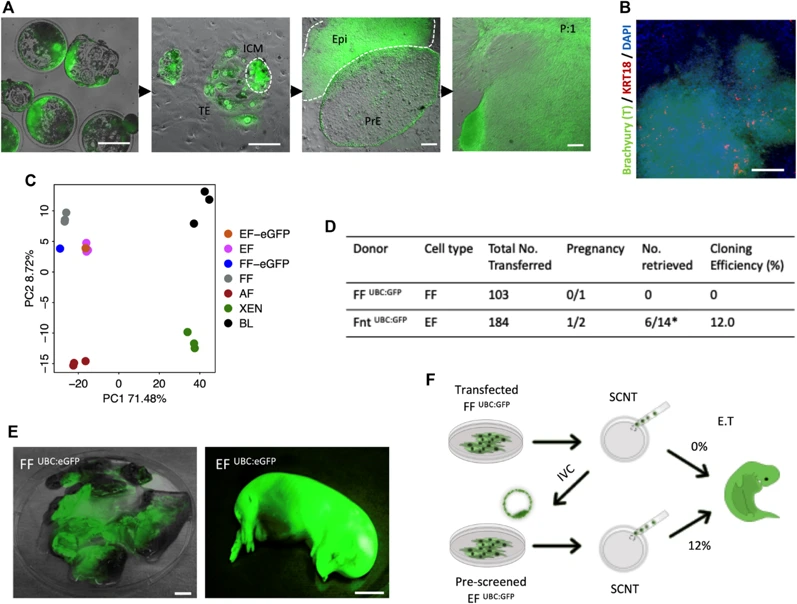
Establishment, Characterization, and Validation of Porcine Embryonic Fibroblasts as A Potential Source for Genetic Modification
Fibroblasts are the common cell type in the connective tissue-the most abundant tissue type in the body. Fibroblasts are widely used for cell culture, for the generation of induced pluripotent stem cells (iPSCs), and as nuclear donors for somatic cell nuclear transfer (SCNT). We report for the first time, the derivation of embryonic fibroblasts (EFs) from porcine embryonic outgrowths, which share similarities in morphology, culture characteristics, molecular markers, and transcriptional profile to fetal fibroblasts (FFs). We demonstrated the efficient use of EFs as nuclear donors in SCNT, for enhanced post-blastocyst development, implantation, and pregnancy outcomes. We further validated EFs as a source for CRISPR/Cas genome editing with overall editing frequencies comparable to that of FFs. Taken together, we established an alternative and efficient pipeline for genome editing and for the generation of genetically engineered animals.
In terms of cell culture status, there is not much difference between culture flasks and Petri dishes, mainly because of the safety factor (flasks > Petri dishes) and the number of cultured cells (large flasks > Petri dishes). However, the cost of culture flasks will be relatively high, so no special requirements, generally choose the Petri dish can be.
Ask a Question
Average Rating: 5.0 | 1 Scientist has reviewed this product
Worth paying more
From the use of Creative Bioarray's cell products, we have established a good relationship.
12 Aug 2023
Ease of use
After sales services
Value for money
Write your own review
Description: Porcine Corneal Epithelial Cells from Creative Bioarray are isolated from corneal tissue of porcine. Porcine Corneal Epithelial Cells are grown in a T25 tissue culture flask pre-coated with ...
Description: Porcine Brain Vascular Fibroblasts from Creative Bioarray are isolated from brain tissue of porcine. Porcine Brain Vascular Fibroblasts are grown in T75 tissue culture flasks pre-coated with ...

Description: Porcine Thymus Endothelial Cells from Creative Bioarray are isolated from thymus tissue of porcine. Porcine Thymus Endothelial Cells are grown in T25 tissue culture flasks pre-coated with ...
Description: Porcine Kidney Endothelial Cells from Creative Bioarray are isolated from kidney tissue of porcine. Porcine Kidney Endothelial Cells are grown in T25 tissue culture flasks pre-coated with ...
Description: Pig bone marrow from Creative Bioarray is procured from the fresh femurs. Bone Marrow-CD34+ stem/progenitor cells are positively isolated using a direct immunomagnetic CD34 MicroBead labeling system.
Description: Porcine Primary Thymus Fibroblasts from Creative Bioarray are isolated from thymus tissue of porcine. Porcine Primary Thymus Fibroblasts are grown in T75 tissue culture flasks pre-coated with ...