
Organoids vs Organ-on-Chip: Which is More Predictive?
The traditional preclinical paradigm is facing an undeniable inflection point. For decades, the pharmaceutical industry tolerated a stark reality: over 90% of drug candidates that excel in 2D cell cultures and animal models ultimately fail in human clinical trials. This translational gap is not merely a financial burden; it represents years of stalled therapeutic breakthroughs. The bottleneck rarely stems from poor chemistry, but rather from the fundamental inability of legacy models to replicate human biology.
As regulatory bodies globally—highlighted by the FDA Modernization Act framework—increasingly accept non-animal data, the race to adopt micro-physiological systems (MPS) has intensified. Organoids and Organ-on-Chip (OoC) technologies have moved from academic novelties to essential components of the drug development pipeline.
For biopharmaceutical teams, the question is no longer if these platforms should be integrated, but how to deploy them strategically. Partnering with a specialized Contract Research Organization (CRO) allows drug developers to seamlessly integrate these advanced modalities without the burden of in-house infrastructure development.
Redefining the Architecture: A Concise Overview
To leverage these tools effectively, it helps to view them through the lens of biological fidelity versus environmental control.
Organoids (Biological Self-Assembly): These are 3D cellular clusters derived from stem cells or primary tissues that self-organize into micro-organs. Their core strength lies in their cellular realism—they naturally develop the heterogeneous cell types, genetic profiles, and spatial architectures of the target organ.
Organ-on-Chip (Engineered Microenvironments): These are microfluidic devices that house human cells within fabricated microchannels. Their core strength is physiomechanical control—they use continuous fluid flow to mimic blood perfusion and mechanical forces to simulate physical dynamics like breathing or peristalsis.
Head-to-Head: Predictive Power in Real-World Applications
Rather than evaluating these platforms in a vacuum, their predictive capabilities are best assessed through the practical scenarios encountered during lead optimization and safety assessment.
1. Patient Stratification and Oncology Target Validation
When predicting how a heterogeneous patient population will respond to a novel oncology asset, Patient-Derived Organoids (PDOs) are uniquely predictive. Because tumors vary drastically between individuals, a single cell line cannot capture clinical reality.
- In Practice (Oncology Screening): In studies evaluating panels of bispecific antibodies, researchers frequently utilize living biobanks of colorectal cancer PDOs. Because these organoids retain the exact somatic mutations and patient-specific architecture of the original clinical tumors, the assays successfully predict which patient sub-populations will experience resistance—saving months of empirical clinical trial design.
- The Verdict: For genetic diversity and disease modeling, organoids offer superior predictive depth, making them an ideal choice when a CRO is tasked with establishing patient-stratified efficacy profiles.
2. Complex PK/PD Modeling and ADME Profiling
A drug's clinical efficacy depends heavily on its pharmacokinetics (PK) and pharmacodynamics (PD). Because static organoids lack a functional vascular system, drug exposure relies on passive diffusion, which fails to mimic real-world systemic clearance.
- In Practice (Multi-Organ Interaction): For the evaluation of oral small molecules, advanced preclinical workflows connect a Gut-on-Chip to a Liver-on-Chip via microfluidic channels. This configuration allows scientists to measure intestinal absorption, microfluidic metabolic clearance by human hepatocytes, and downstream target efficacy simultaneously.
- The Verdict: When the predictive goal requires understanding fluid shear stress, barrier penetration (e.g., Blood-Brain Barrier), or dynamic metabolic profiling, Organ-on-Chip is the definitive choice.
3. Predictive Toxicology and Mechanical Safety
Unforeseen cardiotoxicity and hepatotoxicity are leading causes of post-market drug withdrawals. While an organoid can show cellular stress, it cannot show how a tissue responds to physical strain under drug pressure.
- In Practice (Mechanical Toxicity): Evaluating drug-induced pulmonary edema requires a model that breathes. By utilizing a Lung-on-Chip that introduces cyclic mechanical stretching to human alveolar and endothelial layers, researchers can replicate the exact physical forces that trigger clinical toxicity, identifying safety red flags long before the IND-enabling phase.
Comparative Matrix for Preclinical Strategy
To guide platform selection, the table below highlights where specialized laboratory teams typically deploy each system based on specific assay objectives:
| Assay Objective | Organoid Platforms | Organ-on-Chip Systems | Preclinical Pipeline Fit |
|---|---|---|---|
| High-Throughput Screen (HTS) | High. Scaleable to 384-well formats for automated lead generation. | Low to Moderate. Complex fluidic setups restrict early ultra-HTS. | Organoids for early discovery. |
| Tissue-Tissue Interfaces | Limited. Lacks distinct structural boundaries. | Excellent. Perfect for modeling epithelial-endothelial barriers. | Organ-on-Chip for barrier assays. |
| Tumor Microenvironment (TME) | Excellent. Naturally recreates cell-to-cell signaling. | Excellent. Superior for modeling immune cell infiltration via flow. | Hybrid Approaches (e.g., Organoids-on-Chip). |
| Vascularized Drug Delivery | Challenging. Relies on diffusion. | Native Feature. Perfusible channels simulate blood vessels. | Organ-on-Chip for systemic PK/PD. |
Strategic Integration: Maximizing Preclinical ROI
The debate of "Organoids vs. Organ-on-Chip" is fundamentally a false dichotomy. The most predictive preclinical pipelines do not choose one over the other; they integrate them sequentially to de-risk assets early and thoroughly.
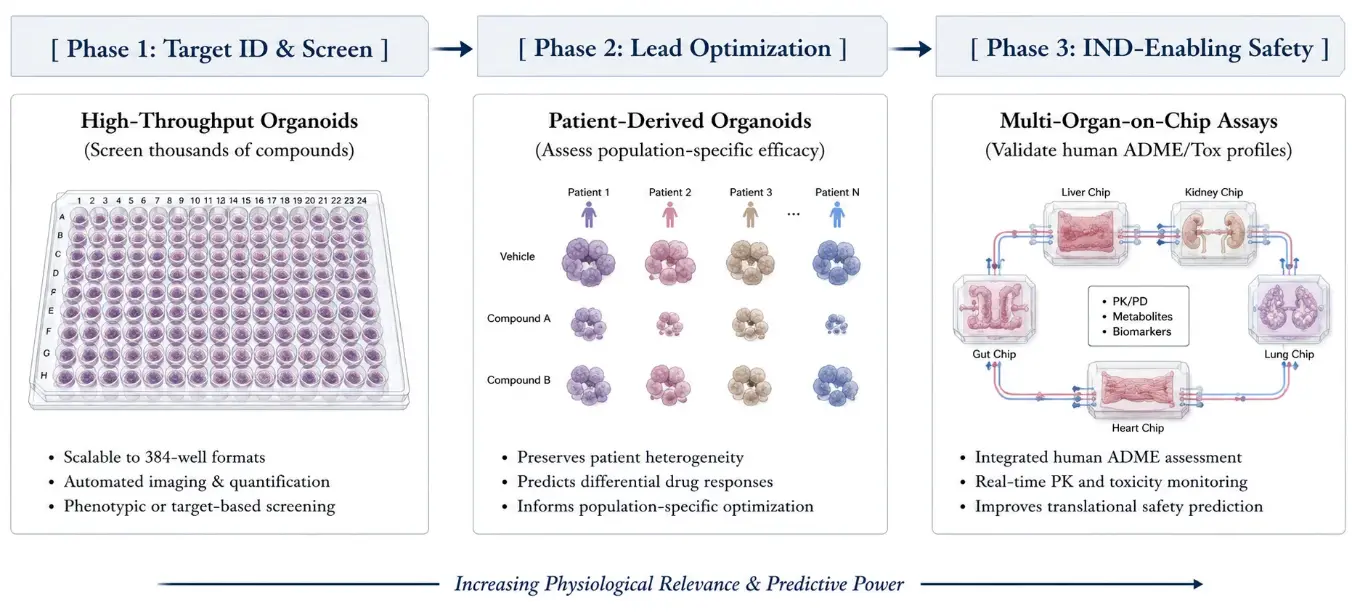
By transitioning from high-throughput organoid screening to highly controlled, mechanistically precise Organ-on-Chip assays, drug developers can construct an unshakeable data package for regulatory submissions.
As a specialized micro-physiological systems CRO, an expert partner's role is to remove the operational complexity of these platforms. Experienced teams provide validated, regulatory-grade workflows that translate complex 3D biology into clear, actionable endpoints. Whether a program requires a custom patient-derived tumoroid panel to validate a rare disease target or a robust microfluidic barrier assay to prove blood-brain barrier penetration, a qualified CRO delivers reproducible data tailored to tight development timelines.