Immortalized Cell Line Engineering Service
- Overview
- Service Details
- Workflow
- Features
- FAQ
- Explore Other Options
Immortalized Cell Lines are in vitro research models that have bypassed the cellular division limit through genetic engineering. The core of this involves introducing SV40 large T antigen, hTERT telomerase, or specific proto-oncogenes, allowing cells to bypass the "Hayflick limit" and achieve unlimited proliferation. These cells not only retain the physiological characteristics of primary cells but also provide a stable genetic background and long-term passaging tolerance, making them an ideal platform for gene editing.

Compared with traditional primary cells, immortalized cells demonstrate three core values in gene editing:
- Experimental Reproducibility: Immortalized cells eliminate the batch-to-batch variability caused by individual differences and limited lifespan in primary cells, ensuring highly consistent results in gene editing.
- Complex Model Construction: Supports multiple rounds of genetic operations (combinations of multi-gene knockout/knock-in) to simulate dynamic pathological processes such as tumor progression and drug resistance development.
- Industrial Application Compatibility: The unlimited proliferation capability meets the demand for long-term stable cell resources required in high-throughput drug screening and large-scale protein production.
Immortalized Cell Line Engineering Service
Our capabilities
Diverse Cell Types
- Support for various species' cell lines, including human, mouse, rat, canine, bovine, rabbit, and chicken.
- Coverage includes tumor cells, stem cells, immune cells, neural cells, and other specialized types.
Flexible Immortalization Methods
Based on client needs, different immortalization strategies can be employed, such as hTERT expression, SV40 large T antigen, HPV E6/E7, EBV infection, etc.
Variety of Gene Editing Services:
- Reporter System Construction
- Gene Knockout and Knockin
- Gene Modification
Our service
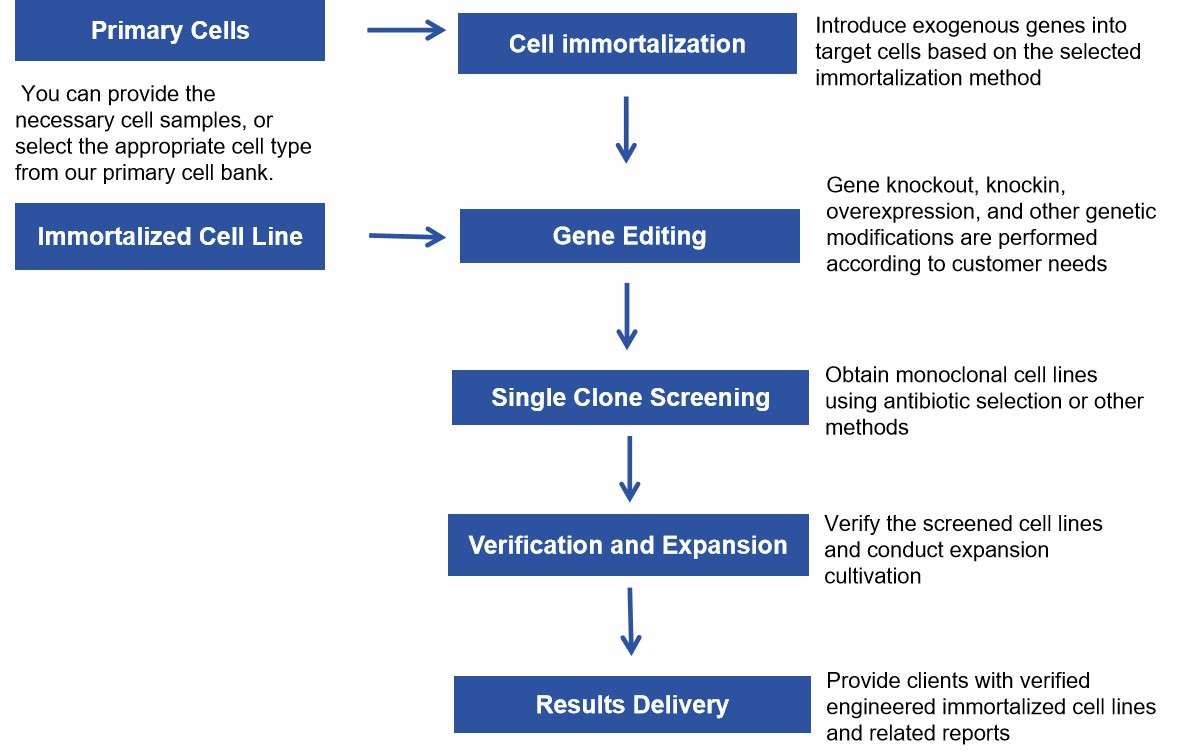
- Primary Cell Immortalization Transduction
- Transgenic Expression Validation: Methods such as qPCR, Western Blot, and immunofluorescence analysis are used to verify the expression of transgenes.
- Cell Quality Testing: Including detection of contamination by mycoplasma, bacteria, fungi, etc., to ensure the purity of the cell line.
- Gene Expression Analysis: Techniques like qPCR and RNA-seq are employed to analyze gene expression within the cell lines.
- Protein Expression Analysis: Methods such as Western blot and ELISA are used to analyze protein expression levels within the cell lines.
- Functional Assays: Depending on the cell line type and customer needs, assays for cell proliferation, migration, invasion, etc., are conducted.
Workflows
Key Features

Provides multiple immortalization methods to meet the needs of different cell types.

Rigorous monoclonal screening and verification to ensure stability and consistency of cell lines.

Offers a complete identification scheme, including genotype, phenotype, and functional verification.

Efficient construction process to shorten the project cycle.
FAQ
How stable are immortalized cell lines?
We ensure high stability and consistency in genotype and phenotype through rigorous monoclonal screening and functional validation. Additionally, we offer services such as telomerase activity detection, senescence detection, and gene expression analysis to further verify the stability of the cell lines.
Can you accommodate special culture conditions for my cells?
Yes. When providing cell samples, you need to inform us of the culture conditions, including required media, growth factors, etc. We will strictly adhere to these conditions during the service process.
Do you accept cell samples provided by the client?
Yes. You can provide specific primary cells isolated independently or choose suitable target cells from our primary cell bank. If needed, we can also offer cell preparation services.
Does immortalization affect the biological characteristics of cells?
The immortalization process may impact certain biological characteristics of cells, but through rigorous screening and validation processes, we ensure that the constructed immortalized cell lines retain as much as possible the biological characteristics of the primary cells.
Explore Other Options