
Smooth Muscle Cell Media
Smooth muscle cells are found in many parts of the body, where they work by controlling the movement of blood, food, or air. Many studies were carried out on cultured smooth muscle cells from various tissues. Creative Bioarray’s smooth muscle cell growth media are designed to provide smooth muscle cells with optimal growth conditions in a low serum environment.
Based on the expertise of Creative Bioarray and some of our client, our smooth muscle cell growth media has been specifically developed and optimized for a variety of fibroblasts of human, mouse, rat, porcine, bovine, monkey, canine, etc.
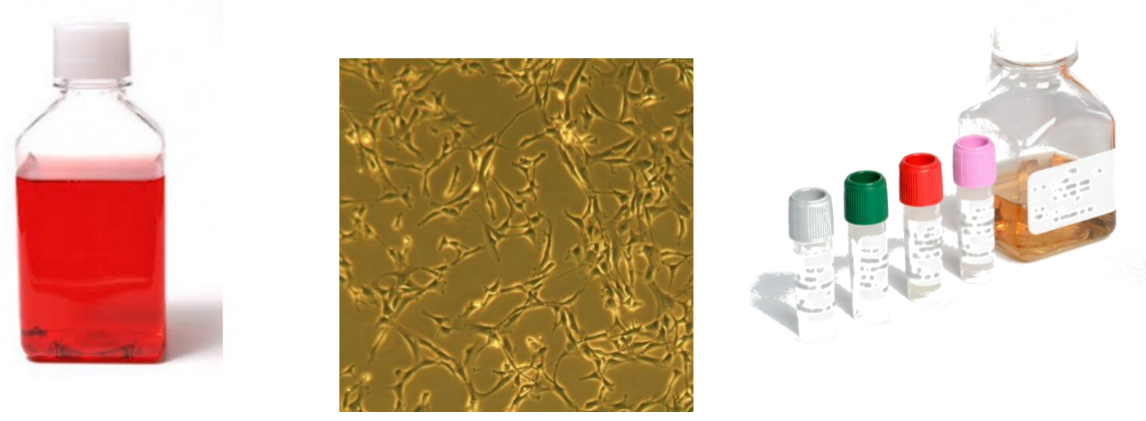
Key Features
Human smooth muscle cell growth medium
- This media system is specifically developed and optimized for hundreds of types of human smooth muscle cells;
- The medium is tested for sterility to confirm that there is no bacterial, yeast or fungal contamination;
- The products undergo further quality control for correct pH, osmolality and lack of endotoxins;
- Our medium requires less frequent cell feeding, which will reduce your cost and overall cell culture time.
Mouse/Rat smooth muscle cell growth medium
- The medium is carefully optimized to accommodate the unique characteristics and requirements of smooth muscle cells;
- The medium is formulated (quantitatively and qualitatively) to provide a defined and optimally balanced nutritional environment that selectively promotes proliferation and growth of mouse/rat smooth muscle cells in vitro;
- Attention to detail ensures ideal cell health, viability, performance, physiology, morphology, consistency and data;
- With these high cost-effective media, you can focus on your own research.
Porcine smooth muscle cell growth medium
- It is a sterile, liquid medium containing essential and non-essential amino acids, vitamins, organic and inorganic compounds, hormones, growth factors, trace minerals and a low concentration of fetal bovine serum;
- Different bioassays affirm the media sustain a proper culture environment for growth, plating, karyotype, physiology, morphology, viability, population doublings, surface markers, cryopreservation, differentiation and/or induction;
- The medium is bicarbonate buffered with a pH of 7.4 when equilibrated in an incubator with an atmosphere of 5% CO2/95% air.
Smooth muscle cell growth media are used for the maintenance and expansion of smooth muscle cells. The media is supplied in several formats:
Basal medium – contains no growth factors, cytokines, or supplements
Supplement kit – growth factors, cytokines, and supplements
Complete medium – basal medium and supplement kit packaged together
Product Use
Laboratory research use only. Not for human, clinical, diagnostic or veterinary use.
Stability and Storage
Store the basal medium at 4-8°C. Supplement kit should be stored at -20°C. Protect from light. Do not use past the expiration data.
For research use only. Not for any other purpose.
Products
-
Tumor Cells
-
Human Tumor Cells
- Astrocytoma/Glioblastoma Cells
- Bladder (urinary) Tumor Cells
- Brain/Nerve Tumor Cells
- Breast Tumor Cells
- Colorectal Tumor Cells
- Esophageal Tumor Cells
- Gallbladder Tumor Cells
- Gastric Tumor Cells
- Human Hybridoma Cells
- Hepatoma Cells
- Kidney Tumor Cells
- Lung Tumor Cells
- Leukemia/Lymphoma/Myeloma Cells
- Melanoma Cells
- Mesothelioma Cells
- Nasopharyngeal Tumor Cells
- Oral Tumor Cells
- Ovarian Tumor Cells
- Prostate Tumor Cells
- Pancreatic Tumor Cells
- Retinoblastoma Cells
- Sarcoma Cells
- Skin Tumor Cells
- Testicular Tumor Cells
- Thyroid Tumor Cells
- Uterine/Cervix Tumor Cells
- Other Human Tumor Cells
- Animal Tumor Cells
- Drug Resistant Cells
- Tumor Cell Media
- Tumor Cell Panels
-
Human Tumor Cells
-
Primary Cell Research
-
Human Primary Cells
- Adipose Cells
- Bone Marrow Cells
- Bone Cells
- Bone and Cartilage Cells
- Blood Vessel Cells
- Bronchial/Tracheal Cells
- Brain Cells
- Bladder Cells
- Cardiac Cells
- Colon Cells
- Dermal Cells
- Epidermal Cells
- Esophagus Cells
- Female Reproductive Cells
- Gastrointestinal Cells
- Gallbladder Cells
- Hepatic Cells
- Hair Cells
- Keratinocytes
- Lymphatic Cells
- Male Reproductive Cells
- Mammary Cells
- Nervous Cells
- Ocular Cells
- Oral Cells
- Pancreatic Cells
- Peripheral Blood Mononuclear Cells
- Placenta Cells
- Prostate Cells
- Pulmonary Cells
- Reproductive System Cells
- Renal Cells
- Skeletal Cells
- Skin Cells
- Spleen Cells
- Thyroid Cells
- Tonsil Cells
- Umbilical Cord Cells
- Urethral Cells
- Other Human Primary Cells
- Animal Primary Cells
- Primary Cell Media
- Dissociated Tumor Cells (DTCs)
- Cell Isolation Kit
- Cytokines & Growth Factors
- ActoFactor™ GMP Cytokines
-
Human Primary Cells
- Immortalized Cell Research
- Stem Cell Research
- Exosome Research
-
ISH/FISH Probes
- CABR™ Chromosome Probes
- CABR™ Detection Probes
-
CABR™ Disease Biomarker FISH Probes
- Acute Lymphoblastic Leukemia FISH Probes
- Pancreatic Cancer FISH Probes
- Melanoma FISH Probes
- Multiple Myeloma FISH Probes
- Myelodysplastic Syndrome FISH Probes
- Myeloid Neoplasms W Eosinophilia FISH Probes
- Follicular Lymphoma FISH Probes
- Lung Cancer FISH Probes
- Lymphoma FISH Probes
- Mantle Cell Lymphoma FISH Probes
- Myeloproliferative Neoplasms FISH Probes
- Ovarian Cancer FISH Probes
- Colorectal Cancer FISH Probes
- Acute Myeloid Leukemia (AML) FISH Probes
- Acute Myelomonocytic Leukemia FISH Probes
- Acute Promyelocytic Leukemia FISH Probes
- Breast Cancer FISH Probes
- Burkitt Lymphoma FISH Probes
- Chronic Lymphocytic Leukemia FISH Probes
- CABR™ 2019 Novel Coronavirus Detection FISH Probe
- CABR™ CAR-T Cell Detection ISH Probes
- CABR™ Animal Probes
- Bacterial Probes
- CABR™ microRNA Probe
- ISH Probes
- Custom Probes
- IHC ISH Reagents
- Biosamples
- Cell Analysis Kit
- ADME Kits
- Stains & Dyes
- Nucleic Acid Extraction