
Animal Models vs. NAMs: Understanding Modern Preclinical Research
Animal models have been the basis of preclinical drug development for decades, offering a platform to evaluate drug efficacy, pharmacokinetics and safety prior to clinical assessment. Yet, despite decades of success, animal studies often fail to accurately predict human responses because of basic biological differences between species. Consequently, researchers are increasingly relying on New Approach Methodologies (NAMs) – a broad spectrum of human-relevant technologies that complement and enhance traditional preclinical testing.
The change is mainly due to the persistent translational gap in drug development. Many drug candidates show promising results in laboratory animals, but more than 90% of them fail in human clinical trials, often due to insufficient efficacy or unexpected toxicity. These challenges have increased international interest in developing more predictive, human-centered experimental models.
NAMs are not a single technology, but a broad ecosystem of in vitro, in silico and in chemico approaches such as organoids, organ-on-chip systems, advanced computational modelling and artificial intelligence. These technologies are transforming modern preclinical research by providing insights complementary to human biology.
Table 1. Animal models vs. NAMs: a quick comparison
| Feature | Animal Models | NAMs |
|---|---|---|
| Biological basis | Whole living organisms | Human-derived cells, tissues, or computational models |
| Species relevance | Animal biology | Human biology |
| Human predictivity | Moderate | High for specific biological questions |
| Throughput | Low to moderate | Moderate to high |
| Cost | Relatively high | Often lower for early-stage studies |
| Ethical considerations | Animal use required | Reduced or no animal use |
| Regulatory maturity | Well established | Rapidly evolving |
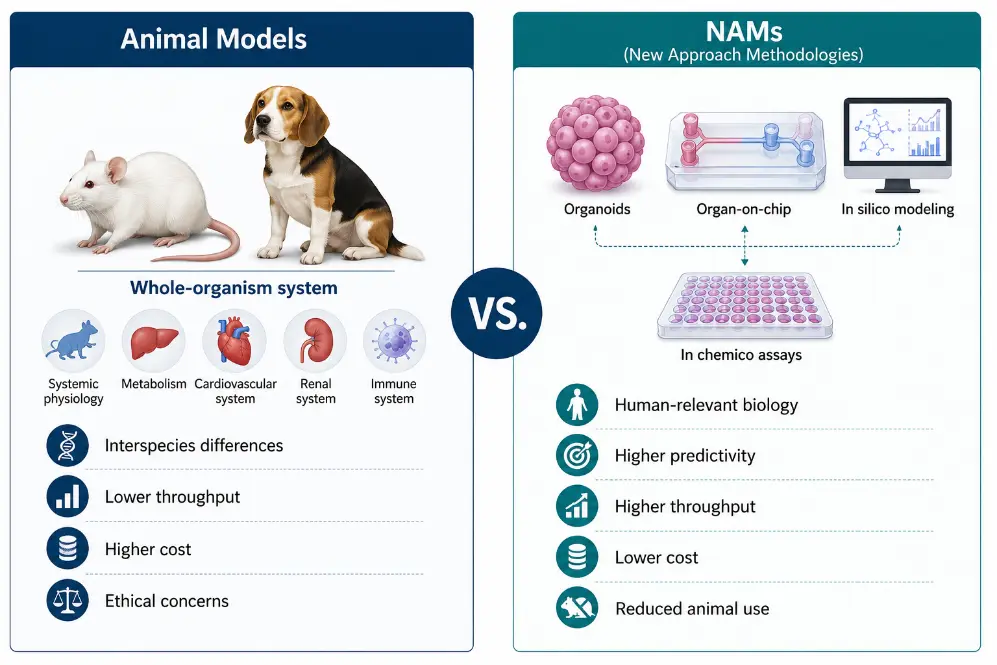
The Structural Comparison: Animal Models vs. NAMs
To understand this paradigm shift, we must look at how these two methodologies approach the human body.
Traditional Animal Models
Animal testing is based on the principle of whole-organism systemic biology. A live mammal gives researchers a chance to see how a drug behaves in the complicated web of connections — how the gut absorbs it, the liver metabolizes it and the kidneys excrete it.
But animal models have an unavoidable problem: genetic and physiological differences between species. Evolution is complicated. A drug that works in an inbred lab mouse often fails in a human patient because our metabolic pathways, gene expressions and cellular receptors are fundamentally different.
Why Animal Models Remain Valuable
The development of NAMs is rapidly progressing, but animal models are still an indispensable part of biomedical research. Their main advantage is that they can capture interactions between multiple organs, immune responses, metabolism, endocrine regulation and long-term physiological changes in a living organism.
Animal models have been the engine behind numerous medical advances, and continue to be a crucial part of many areas of preclinical research. They are increasingly part of a wider evidence generation strategy alongside emerging human-relevant technologies rather than being replaced.
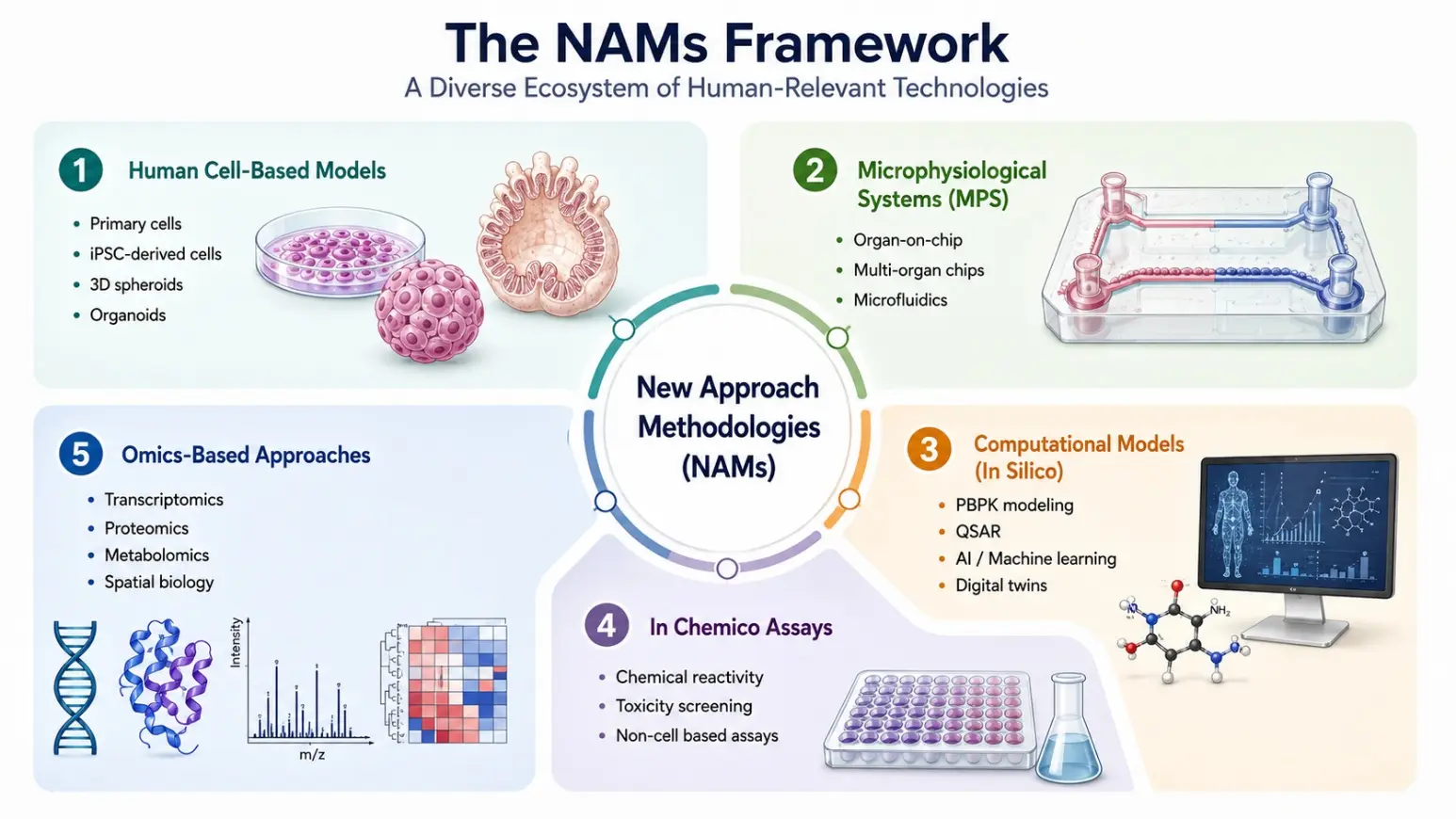
The NAMs Framework
New Approach Methodologies (NAMs) are not one single experimental platform but a diverse ecosystem of technologies that can be used to generate human relevant biological data. These approaches can be classified in several complementary groups:
- Human Cell-Based Models (In Vitro)
Human primary cells, induced pluripotent stem cell (iPSC)-derived cells, 3D spheroids, and organoids enable researchers to study disease mechanisms, drug efficacy, and toxicity using human-derived biological systems.
- Microphysiological Systems (MPS)
Organ-on-chip and multi-organ-chip platforms recreate key aspects of tissue architecture, mechanical forces, fluid flow, and inter-organ communication, providing more physiologically relevant models than conventional cell culture.
- Computational Models (In Silico)
Artificial intelligence, machine learning, physiologically based pharmacokinetic (PBPK) modeling, and quantitative structure–activity relationship (QSAR) models predict drug behavior, toxicity, and efficacy using computational approaches.
- In Chemico Assays
These assays evaluate the intrinsic chemical reactivity of compounds, particularly for toxicity endpoints such as skin sensitization, without relying on living cells or animals.
By focusing entirely on human cells and human data, NAMs eliminate the biological guesswork.
The Core NAMs Technological Pillars
The power of NAMs lies in their ability to replicate the mechanics of human biology without using a living animal. This is achieved through three revolutionary technology pillars:
1. Microphysiological Systems (MPS) / Organs-on-Chips
In the past, cell culture meant growing cells flat in a plastic dish, which looked nothing like the human body. MPS changes this by introducing microfluidics—tiny channels etched into a silicone chip. By pumping fluids through these channels, scientists can grow human cells while mimicking the mechanical shear stress and blood flow. For example, a "lung-on-a-chip" can actually expand and contract like a real lung to simulate breathing, enabling researchers to watch exactly how human lung tissue responds to inhaled drugs or toxins.
Recent advances have also made it possible to have multi-organ chips, where interconnected liver, heart, gut or kidney tissues are connected via microfluidic circulation. These integrated platforms provide valuable insights in systemic drug responses that are difficult to capture using isolated cell cultures.
2. Three-Dimensional (3D) Organoids
Organoids are lab-grown, living mini-organs that self-organize. You take human stem cells, either embryonic or reprogrammed from adult skin cells, and you put them in some sort of nutrient broth. The cells naturally cluster and differentiate. They grow into tiny 3D structures that mimic the architecture and genetic profiles of real human organs like mini-brains, mini-livers or mini-kidneys. This allows scientists to study complex tissue interactions in ways that flat 2D cell cultures never could.
Patient-derived organoids also retain the genetic characteristics and disease heterogeneity of individual patients and are thus valuable tools for precision medicine, biomarker discovery and personalized drug screening.
3. In Silico Systems & Artificial Intelligence
The digital pillar of NAMs relies on the explosion of big data and computational power. Artificial intelligence (AI) and machine learning algorithms can be employed by computational biologists to model complicated molecular interactions. These software systems can analyse the chemical structure of a new molecule and forecast its potential toxicity or effectiveness in seconds. Researchers can remove dangerous compounds before they ever arrive in a physical lab by doing virtual clinical trials on digital human models.
FAQ
1. What are NAMs?
New Approach Methodologies (NAMs) are a collection of innovative, human-relevant approaches—including in vitro, in silico, and in chemico methods—that improve or complement traditional animal testing.
2. Are organoids considered NAMs?
Yes. Organoids are one of the most widely used in vitro NAM platforms because they closely mimic the architecture and function of human tissues.
3. Do NAMs completely replace animal models?
Not yet. While NAMs provide highly human-relevant biological information, they currently complement rather than fully replace animal models in most areas of drug development.
4. Why are NAMs becoming more popular?
Their increasing adoption is driven by improved human relevance, faster experimental timelines, reduced animal use, advances in bioengineering and artificial intelligence, and the growing demand for more predictive preclinical models.
Conclusion
Animal Models and a New Paradigm Methodologies are often characterized as competing technologies, but are in fact complementary in the context of today's biomedical research. Animal models are still useful for understanding complex whole body physiology, while NAMs are increasingly providing human relevant platforms to interrogate disease mechanisms, predict drug responses and improve translational success.
Emerging technologies such as organoids, organ-on-chip and artificial intelligence are not just replacing existing methods but are broadening the scientific toolbox that researchers have at their disposal and will continue to evolve and reshape the future of preclinical research.
In our next article we'll step back from the technologies themselves and turn to the practical questions that researchers ask themselves every day: When to use animal models? When should you choose NAM? How can such approaches be incorporated into the contemporary drug development pipelines while fulfilling regulatory expectations?
Creative Bioarray Relevant Recommendations
| Products & Services | Description |
|---|---|
| Animal Disease Models | Our comprehensive portfolio of disease models spans multiple therapeutic areas, providing reliable preclinical platforms to study disease mechanisms and accelerate the development of innovative therapies. |
| 3D Spheroid Platform for Drug Development | Creative Bioarray provides advanced 3D spheroid models designed for researchers aiming to explore cell behavior in a more realistic environment. |
| Organoid Platform for Drug Development | Creative Bioarray presents a state-of-the-art Organoid Platform designed to transform drug development and biomedical research. By leveraging advanced organoid and organoid-immune co-culture models, this platform provides highly accurate and predictive solutions that closely replicate human biology. |
| Organ-on-a-Chip Platform for Drug Development | Creative Bioarray focuses on developing specific human disease models and leveraging our organ-on-a-chip platform to identify new therapeutics and clinical biomarkers, promote drug development, and create novel drug delivery systems. |