
Graft-versus-host Disease (GvHD) Models
Clinically relevant GvHD models for transplantation immunology, inflammatory injury, and immunotherapy research.

Overview of GvHD
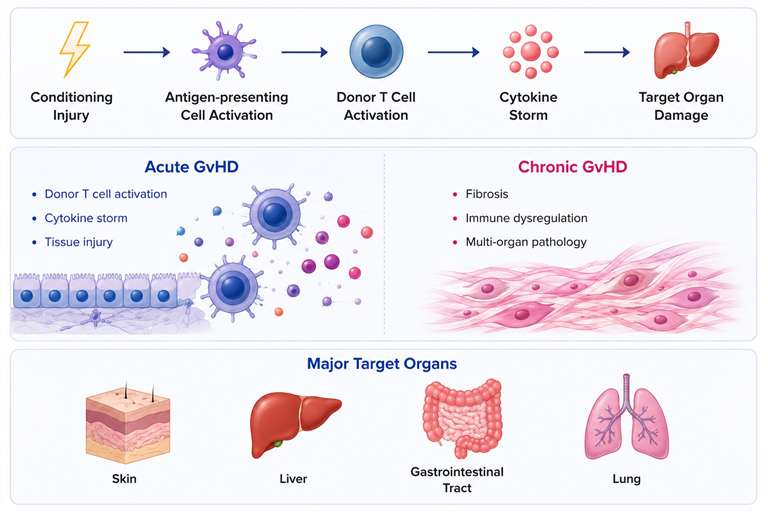
Graft-versus-host disease (GvHD) is a serious immunological-mediated consequence of allogeneic haematopoietic stem cell transplantation (allo-HSCT), in which donor-derived immune cells identify host tissues as foreign and cause systemic inflammatory damage. Acute GvHD is mainly caused by activation of donor T-cells, excessive cytokine release and rapid destruction of epithelial tissue, whereas chronic GvHD is related to long-lasting immunological dysregulation, progression of fibrosis and multi-organ disease.
Tissue injury caused by conditioning breaks down epithelial barriers and releases inflammatory danger signals, the first steps in the pathophysiology of GvHD. After activation, donor T cells are stimulated by activated host antigen-presenting cells to generate a cytokine storm, immune cell proliferation, and inflammatory infiltration of target organs including skin, liver, gastrointestinal tract, and lung. In chronic GvHD, prolonged immunological activation increases fibroblast activation and extracellular matrix deposition, eventually leading to tissue fibrosis and reduced immune tolerance.
Available GvHD Models

Allogenic Bone Marrow Transplantation-Induced GvHD Model
This model is established through allogeneic bone marrow and immune cell transplantation following recipient conditioning irradiation. It closely recapitulates donor T-cell-mediated immune activation, cytokine storm, and target organ injury observed in clinical GvHD.
Features
- Classical murine allo-HSCT model
- Acute and chronic GvHD induction
- Reproducible inflammatory pathology
- Well-characterized immune mechanisms

Human PBMC Transplantation-Induced GvHD Model
This xenogeneic GvHD model is generated by transplantation of human peripheral blood mononuclear cells (PBMCs) into immunodeficient mice, enabling evaluation of human immune cell activation, cytokine release, and immunotherapy-associated toxicity.
Features
- Humanized immune response
- Human T-cell-mediated pathology
- Rapid and stable disease onset
- Translational immunotherapy platform
Model Comparison
| Feature | Allogenic BMT-Induced Model | Human PBMC-Induced Model |
| Immune System | Murine alloimmune system | Human immune cell-mediated response |
| Disease Mechanism | Alloreactive donor T cells | Human PBMC xenoreactivity |
| Disease Onset | Moderate | Rapid |
| Translational Relevance | Classical mechanistic studies | High translational relevance |
| Cytokine Analysis | Murine cytokines | Human cytokines |
| Fibrosis Studies | Suitable | Limited |
| Immunotherapy Evaluation | Moderate | Excellent |
| Typical Applications | Transplant biology, fibrosis | CAR-T, TCE, immunotherapy safety |
Endpoint Analysis
Creative Bioarray provides integrated endpoint analysis for comprehensive evaluation of GvHD progression, immune activation, and therapeutic efficacy.

Clinical Evaluation
- Body weight loss
- Survival analysis
- Clinical GvHD scoring

Histopathology
- Skin pathology
- Liver inflammation
- Intestinal tissue injury
- Fibrosis assessment

Immunological Analysis
- Flow cytometry
- T-cell activation profiling
- Cytokine analysis
- Immune cell infiltration

Molecular Analysis
- ELISA
- qPCR
- IHC/IF staining
Why Choose Us

Clinically Relevant GvHD Platforms
Validated murine and humanized GvHD models supporting both mechanistic and translational studies.

Reproducible Disease Induction
Standardized transplantation and conditioning protocols ensure stable and consistent disease progression.

Humanized Immune System Expertise
Advanced PBMC-engrafted platforms for evaluating human immune responses and immunotherapy-associated toxicity.

Experienced Immunology Research Team
Extensive expertise in transplantation immunology, inflammatory diseases, and preclinical efficacy evaluation.
FAQ
What is the difference between acute and chronic GvHD?
Acute GvHD is a rapidly evolving inflammatory tissue injury driven by donor T-cell activation and cytokine release, while chronic GvHD is associated with long-term immunological dysregulation, fibrosis, and multi-organ remodeling.
Which GvHD model is better for immunotherapy evaluation?
The human PBMC-induced GvHD models are often chosen in the translational immunotherapy investigations since they better replicate human immune cell activation and cytokine responses.
Can chronic GvHD and fibrosis be evaluated?
Yes. Chronic GvHD models can be created to study long-term inflammation, tissue fibrosis, immunological dysregulation, and anti-fibrotic therapies.
What endpoints are available for efficacy evaluation?
Available endpoints include survival analysis, clinical scoring, histopathology, cytokine profiling, flow cytometry, immune infiltration analysis, ELISA, qPCR, and IHC/IF assays.
Advance Your GvHD Research with Clinically Relevant Preclinical Models
Creative Bioarray provides customizable GvHD animal models and integrated translational research services for transplantation immunology, immunotherapy safety assessment, and preclinical drug development.