
The Bioanalysis Masterclass: Labile Metabolites
Within the context of bioanalysis biological samples are generally considered as frozen images of drug exposure and metabolism. However, for many compounds, degradation processes begin immediately after sample collection. Labile metabolites, including esters, acyl glucuronides, and thiol-containing compounds, may rapidly degrade or convert back to the parent drug if samples are not appropriately stabilized during collection and handling.
Lack of a well-controlled bench-to-instrument workflow can lead to analyte instability that can impair PK/PD interpretation and dependability of IND-supporting bioanalytical data. To reduce analytical artefacts caused by instability and maintain sample integrity throughout the analysis process, the following techniques are often employed.
Recognizing Structural Features Associated with Instability
Chemical instability is an inherent challenge in bioanalysis. During method development, particular attention is given to functional groups known to exhibit poor stability under standard sample handling conditions.
Acyl Glucuronides
Acyl glucuronides are well known to be unstable at physiological pH. These metabolites may rapidly hydrolyze back to the parent drug or undergo intramolecular rearrangement through acyl migration.
Esters and Prodrugs
Esters and ester-based prodrugs are highly susceptible to hydrolysis by plasma carboxylesterases (CES), potentially leading to significant degradation before sample preparation begins.
Thiol-Containing Compounds
Thiol-containing compounds are highly sensitive to oxidation and may form disulfide bonds or undergo covalent binding to plasma proteins such as albumin.
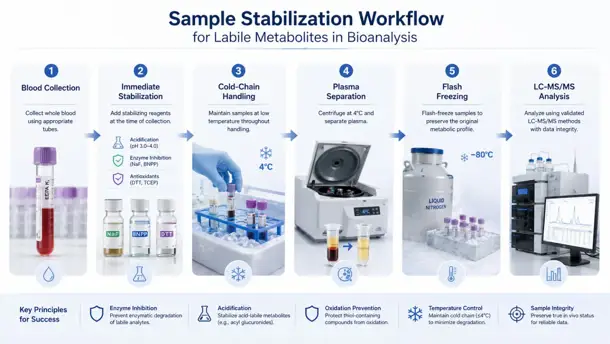
Stabilization at the Point of Collection
For unstable analytes, sample stabilization should begin immediately upon collection rather than after transfer to the analytical laboratory.
Enzyme Inhibition
For ester-containing compounds, collection tubes may be preloaded with esterase inhibitors such as bis-(4-nitrophenyl) phosphate (BNPP) or sodium fluoride (NaF) to suppress enzymatic degradation during sample handling.
Acidification
Acidification is commonly used to stabilize acyl glucuronides. Reagents such as phosphoric acid (H3PO4) or citric acid may be added to reduce plasma pH to approximately 3.0-4.0, which can significantly reduce hydrolysis and acyl migration.
Antioxidants
For thiol-containing analytes, reducing agents such as dithiothreitol (DTT) or tris(2-carboxyethyl)phosphine (TCEP) may be added during collection to prevent irreversible oxidation and disulfide formation.
Cold-Chain Handling and Temperature Control
Temperature is one of the primary drivers of analyte degradation. Effective cold-chain handling procedures are therefore essential for maintaining sample stability.
Pre-Chilled Consumables and Equipment
Collection tubes, centrifuge components, pipette tips, and related consumables should be pre-chilled to 4℃ prior to sample contact whenever instability is a concern.
Controlled Sample Processing
Samples may be aliquoted using chilled metal racks or dry ice-supported workstations to maintain low sample temperatures throughout processing and transfer procedures.
Rapid Freezing Procedures
Immediately following centrifugation and plasma separation, samples are commonly flash-frozen using liquid nitrogen or dry ice-based cooling systems to preserve the original metabolic profile prior to storage at -80℃.
Extraction and Autosampler Stability Considerations
Sample instability may continue after extraction and during autosampler storage if appropriate controls are not implemented.
Extraction Considerations
High-temperature evaporation procedures are generally avoided for labile analytes. Nitrogen evaporation at room temperature or refrigerated centrifugal evaporation may be used to evaporate samples to dryness while minimizing thermal degradation.
Autosampler Stability
Even after successful extraction, processed samples may remain in the autosampler queue for extended periods. Therefore, stability of the reconstituted extract should be evaluated during method validation. If degradation is observed, mitigation strategies may include lowering autosampler temperature to 4℃, optimizing mobile-phase composition, or implementing batch-specific "just-in-time" extraction procedures.
Regulatory Expectations and Stability Validation
Regulatory agencies including the FDA and EMA expect bioanalytical methods to demonstrate that stabilization procedures are effective and scientifically justified.
Freeze-Thaw Stability
Samples are typically evaluated through at least three freeze-thaw cycles during stability assessment. For highly labile analytes, repeated freeze-thaw exposure may be minimized through the use of single-use aliquot strategies prepared at the clinical site.
Whole Blood Stability
Because degradation may occur before plasma separation, whole blood stability studies are commonly conducted at both 0℃ and 37℃ to establish acceptable processing windows for clinical and preclinical sample handling.
A Final Word
Stabilization of labile metabolites requires a comprehensive and scientifically designed sample handling strategy. From the moment of sample collection, careful control of chemical conditions, enzymatic activity, and temperature is essential for maintaining analyte integrity.
By identifying instability risks early and implementing appropriate stabilization procedures throughout collection, processing, and analysis, bioanalytical laboratories can generate accurate and reproducible data that more reliably reflect in vivo drug behavior. In many studies, the quality of the final bioanalytical dataset is strongly influenced by the handling conditions established during the earliest stages of sample collection and preparation.
Creative Bioarray Relevant Recommendations
| Products & Services | Description |
|---|---|
| Bioanalytical Package | Comprehensive bioanalytical services providing reliable method development, validated PK/TK studies, and advanced biomarker analysis to accelerate drug discovery and development. |