
Mastering the Noise: A Practical Guide to Minimizing Variability in Preclinical Studies
Every preclinical researcher knows the stomach-dropping feeling of running a replication study only to watch a once-beautiful statistical significance evaporate into a messy cloud of data points. You checked the protocol. You used the same drug. So, what went wrong?
Welcome to the reproducibility crisis-a quiet storm costing global biomedical research billions annually. In preclinical research, variance is the ultimate thief of time and funding. While biology is inherently noisy, a massive chunk of the experimental drift we encounter doesn't stem from true biological diversity, but from hidden, systemic variables.
To build a study that stands up to scrutiny and translates smoothly into clinical development, we have to become variance detectives. Here is a practical blueprint to hunt down data noise and build ironclad preclinical experiments.
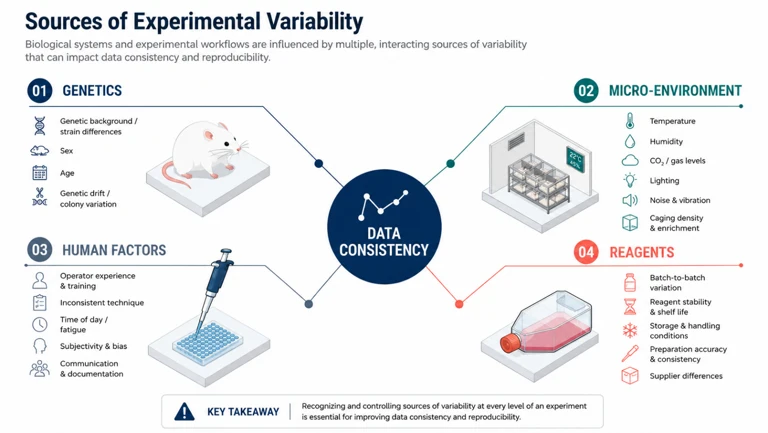
Animal Standardization: Beyond the Strain Label
It's easy to treat laboratory mice as standardized reagents, much like a bottle of PBS. But they are complex biological systems highly sensitive to their surroundings.
The Genetic Slide
Choosing between inbred (e.g., C57BL/6J) and outbred (e.g., CD-1) models is a foundational decision. Inbred mice offer a uniform genetic baseline, but they aren't immune to change. Over generations, genetic drift can introduce spontaneous mutations within the same colony. If you are noticing subtle phenotype shifts, it might be time to refresh your colony with live stock from a primary vendor rather than breeding indefinitely in-house.
The Microbiome Ghost in the Machine
Two mice with identical genomes can yield radically different immunology or metabolic data if their gut microbiomes don't match. Vendor barriers, shipping stress, and even changing a diet brand can shift the microbiome overnight. To counteract this:
- Co-house animals or mix their bedding prior to starting an experiment to normalize the microbiota across experimental groups.
- Keep a strict eye on vendor health reports; a shift in sub-clinical commensal flora can quietly alter your baseline phenotype.
The Micro-Environment Cage Effect
Think your facility is perfectly controlled because the wall thermostat reads \(22^\circ\text{C}\)? Look closer. Cages on the top rack of a holding room often experience higher light intensity and slightly warmer temperatures than those on the bottom rack. Furthermore, mice are hyper-sensitive to ultrasound-noises from malfunctioning equipment that humans can't hear can spike their corticosterone levels.
Eradicating the "Human Factor" in the Vivarium
We talk a lot about automated science, but preclinical work remains deeply manual. The subtle differences in how humans interact with animals are a massive, underestimated source of data noise.
The Handler Effect
Mice can recognize individual human handlers by scent and sight. A technician who handles animals aggressively or rushes through a cage change creates an environment of chronic stress. This stress alters immune baselines and warps behavioral assays. Implement standard habituation protocols: spend a few minutes letting the animals acclimate to your hand before running a test.
Chronobiology: Timing is Everything
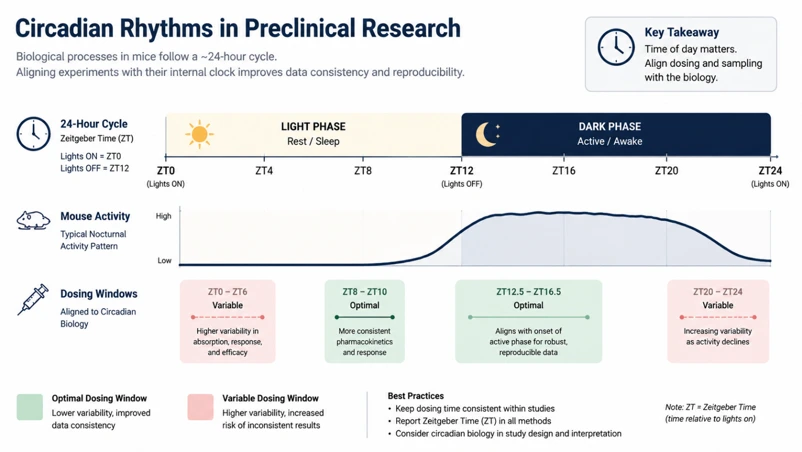
Mice are nocturnal, meaning their biological clocks are the exact inverse of ours. If you perform a behavioral test or administer a metabolic drug at 9:00 AM (their biological night) on Monday, and at 4:30 PM (approaching their active phase) on Wednesday, you are looking at two entirely different metabolic landscapes.
- Rule of thumb: Lock down a strict, narrow time window for all procedures, dosing, and tissue collections.
Securing the In Vitro Foundation
If your study relies on a mix of benchwork and animal work, your in vitro assays need to be just as tightly locked down.
The Identity Crisis of Cell Lines
Using an unauthenticated cell line is like building a house on quicksand. Cross-contamination (often by aggressive lines like HeLa) and mycoplasma contamination can subtly alter cell signaling and drug sensitivity without showing obvious visual signs in the flask.
- Invest in regular Short Tandem Repeats (STR) profiling.
- Set a hard limit on passage numbers (e.g., never run an assay past passage 15) to prevent phenotypic drift.
Taming the Batch Effect
We've all been there: a western blot or ELISA suddenly stops working because you started a new vial of antibody or a new lot of Fetal Bovine Serum (FBS).
- The fix: When launching a major study, purchase a single, large lot of critical antibodies and serum after a successful pilot test. Aliquot them immediately to prevent the destructive freeze-thaw cycles that degrade proteins.
Designing Experiments to Defy Variance
Sometimes, the best way to handle variance isn't to eliminate it, but to outsmart it using sound statistical architecture.
Ditch the "Rule of Thumb" for Sample Sizes
Choosing N=6 because "that's what the lab has always done" is a recipe for underpowered studies or wasted lives. Use a power analysis before ordering animals. By evaluating your pilot data's standard deviation and your target effect size, you can mathematically determine the exact number of subjects needed to achieve a reliable statistical power (typically 80%).
Embrace Randomized Block Designs
If you have 40 mice to evaluate, you likely cannot perform all surgeries or behavioral tests on the same day or using the same equipment. Instead of processing the entire control group on Day 1 and the treated group on Day 2 (which confounds your data with a "day effect"), use a randomized block design. This ensures that any environmental noise introduced by a specific day or batch is distributed evenly across all your experimental arms.
Conclusion: The Path to Bulletproof Data
Reducing variability in preclinical studies isn't about achieving an impossible, sterile perfection. It is about identifying the hidden, moving parts in your laboratory ecosystem and stabilizing them one by one.
When designing your next project, cross-reference your workflow with the ARRIVE Guidelines 2.0. By committing to transparent reporting, rigorous blinding, and strict environmental consistency, you protect your data from the noise. In doing so, you don't just save time and resources-you build a foundation of translational data that can truly stand the test of time.