Spatial Omics Services
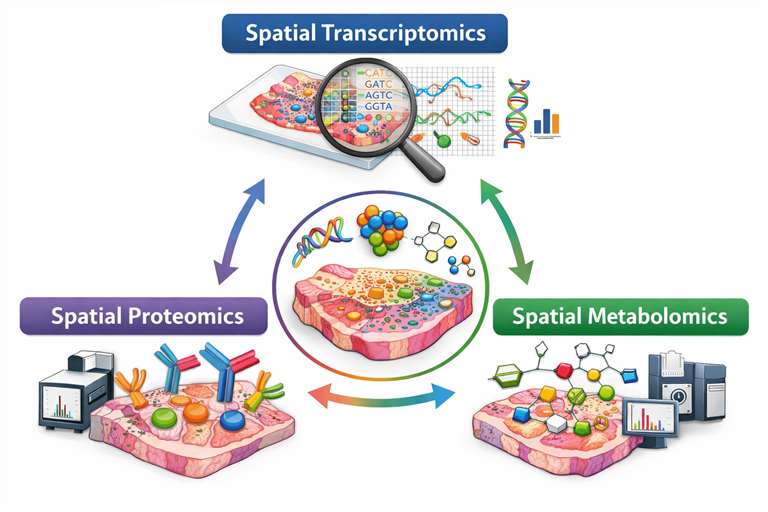
Spatial context is fundamental for the understanding of tissue heterogeneity and function. Our spatial omics solutions bring together digital spatial profiling (DSP), transcriptomics, proteomics, and metabolomics to provide the molecular maps of where in the tissue specific molecules are present. By preserving spatial information, we enable researchers to uncover gene expression patterns, protein interactions, and metabolic activity in their native tissue architecture. These solutions empower biomarker discovery, disease mechanism studies, and therapeutic development with unprecedented resolution.
Our Services
Multiplexed, spatially-resolved protein and nucleic acid analysis, enabling comprehensive molecular characterization of tissues.
Spatial Transcriptomics Solutions
Genome-wide RNA mapping in situ to reveal cellular organization and microenvironmental interactions.
Multiplexed protein profiling across spatially resolved tissue compartments for deeper biological understanding.
Spatial Metabolomics Solutions
Spatially resolved metabolite mapping that captures the functional biochemistry in the tissue microenvironment.
Our Platform & Technology

Digital Spatial Profiling (DSP)
High-plex, region-specific protein and RNA quantification within tissue sections, enabling targeted spatial analysis of multiple biomarkers simultaneously.
Antibody-Based Fluorescence Imaging & LCM-MS
Multiplexed immunofluorescence combined with laser capture microdissection (LCM) coupled to mass spectrometry (MS) for targeted protein and metabolite profiling of selected tissue regions.
Matrix-Assisted Laser Desorption/Ionization Mass Spectrometry Imaging (MALDI-MSI)
Spatially resolved mapping of metabolites, lipids, and small molecules directly from tissue sections, providing insights into the functional biochemistry of the tissue microenvironment.
Spatial Omics Analytics Capabilities
Our bioinformatics pipeline translates spatial omics data into actionable biological insights:
Spatial Clustering & Cell Type Annotation
Identify distinct cell populations and spatial domains based on transcriptomic, proteomic, or metabolomic profiles.
Ligand–Receptor & Microenvironment Interaction Analysis
Map cell–cell communication and pathway activity within intact tissue architecture.
Differential Expression & Pathway Enrichment
Quantify spatially variable genes, proteins, or metabolites to reveal functional heterogeneity across tissue regions or conditions.
3D Tissue Mapping & Visualization
Integrate multi-omics datasets for interactive visualization of molecular distribution in three-dimensional tissue space.
Custom Analysis Pipelines
Tailored computational approaches for biomarker discovery, therapeutic target identification, and disease mechanism studies.
Explore Other Options