Cytogenetics & Molecular Cytogenetics Analysis
In situ detection provides the essential spatial context often lost in bulk sequencing, making it a cornerstone of modern molecular biology. Creative Bioarray offers a suite of validated in situ and molecular quantification platforms designed to deliver clear, spatially resolved insights into gene expression, chromosomal organization, and biomarker localization. We have optimized our protocols across a wide range of sample types—including human, animal, and complex plant tissues—to ensure consistent sensitivity and specificity even in challenging specimens.
Whether your project requires identifying chromosomal abnormalities, profiling RNA at single-cell resolution, or performing multi-omic co-localization, our services focus on generating reproducible, quantitative data while maintaining the structural integrity of the native tissue architecture
Our Services
Fluorescent In Situ Hybridization (FISH)
High-sensitivity detection of defined DNA sequences within cells or tissue sections, enabling precise assessment of chromosomal targets.
In Situ Hybridization (ISH) & RNAscope
Advanced RNA detection solutions, including RNAscope's single-molecule amplification platform, offering exceptional specificity and sensitivity for low-abundance transcripts.
Integrate DNA/RNA detection with protein immunostaining to study gene expression and protein localization simultaneously.
Interphase Fluorescence In Situ Hybridization (I-FISH) technique used to detect and localize specific DNA sequences within interphase nuclei.
Specialized RNA visualization techniques optimized for plant tissues, enabling spatial transcriptomics studies in developmental and stress-response research.
Telomere Length Analysis (Q-FISH)
Fluorescence-based telomere measurement offering chromosome-specific resolution at the single-cell level.
Telomere Length Analysis (qPCR assay)
High-throughput quantitative assessment of average telomere length across large sample sets.
Splice Variant Analysis (FISH)
Detect aberrant mRNA splicing events in transgene transcripts using FISH-based RNA visualization, ensuring correct transcript processing.
Assess mitochondrial RNA (mtRNA) distribution and abundance to evaluate mitochondrial function or dysfunction in cells or tissues.
Absolute nucleic acid quantification with exceptional sensitivity for low-abundance targets, rare variant detection, and copy-number analysis.
Amplification-free, multiplex RNA quantification using branched-DNA technology for high-throughput, highly reproducible transcript measurement.
Digital ISH Image Quantification and Statistical Analysis
High-resolution quantification of in situ hybridization signals using automated image analysis pipelines and validated statistical algorithms.
Why Choose Our In Situ Detection Services?
Our bioinformatics team designs custom probes and thoroughly validates their specificity and performance across a range of species and targets (DNA, mRNA, lncRNA).
Expert Probe Design & Validation
Access to our automated fluorescence and confocal microscopy imaging systems to capture high-content, statistically significant, and publication-quality image data with maximum resolution and clarity.
Next-Generation Imaging Infrastructure
Ongoing optimization of protocols (especially for RNAscope and IHC) to deliver the best possible performance, with the lowest background autofluorescence and unambiguous signal detection.
Maximized Signal-to-Noise Ratio (SNR)
Proven expertise in processing and obtaining quality results from challenging sample types, including archival FFPE tissues, fresh frozen specimens, primary cells, and complex plant matrices.
Sample Versatility
In addition to image capture, our advanced image analysis service can quantify signals, identify co-localization events and perform statistical validation.
Comprehensive Quantitative Analysis
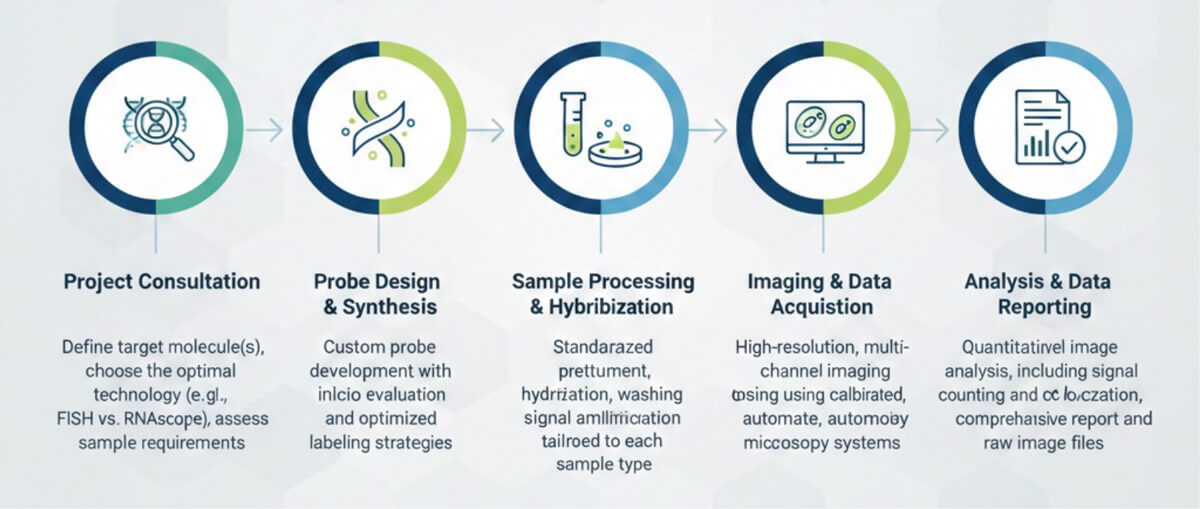
Standard Workflow
Applications
Oncology and Pathology

Detection of chromosomal rearrangements and copy number variations, tumor heterogeneity and expression of biomarkers for use in research and diagnostic development.
Neuroscience
Mapping spatial gene expression patterns in complex brain regions and cell-type profiling to explore cell-to-cell communication and the underlying mechanisms of neurodegenerative diseases.
Developmental Biology
Spatially tracing the expression of important regulatory genes throughout embryonic and organ development.
Infectious Disease
Localization of viral/bacterial genomes or transcripts in cells and tissues to study the dynamics of infections.
Plant Science
Spatially map transcripts in different reproductive tissues in plant, study plant defense and response mechanisms, or analyze gene editing efficacy.
Explore Other Options