
ddPCR vs qPCR vs NGS: Which Platform Fits Your Research?
Selecting a molecular analysis platform is rarely about choosing the most advanced technology—it is about choosing the one that best answers your specific research question.
Both qPCR and ddPCR as well as NGS are widely used in molecular biology but each has been designed to solve a fundamentally different analytical problem. Treating them as interchangeable often leads to unnecessary costs, longer turnaround times, or data that fail to tackle the core biological question.
A common misconception is that new technologies just replace older ones. In practice, many modern research workflows are a hybrid of multiple platforms. NGS can discover novel genetic variants in a discovery phase, ddPCR can validate those variants with extraordinary sensitivity, and qPCR can evaluate downstream changes in gene expression. Each technique has its own strengths, so that they are best seen as complementary rather than competing tools.
Compare qPCR, ddPCR and NGS from a practical research perspective, to help you choose the most efficient platform for your study.
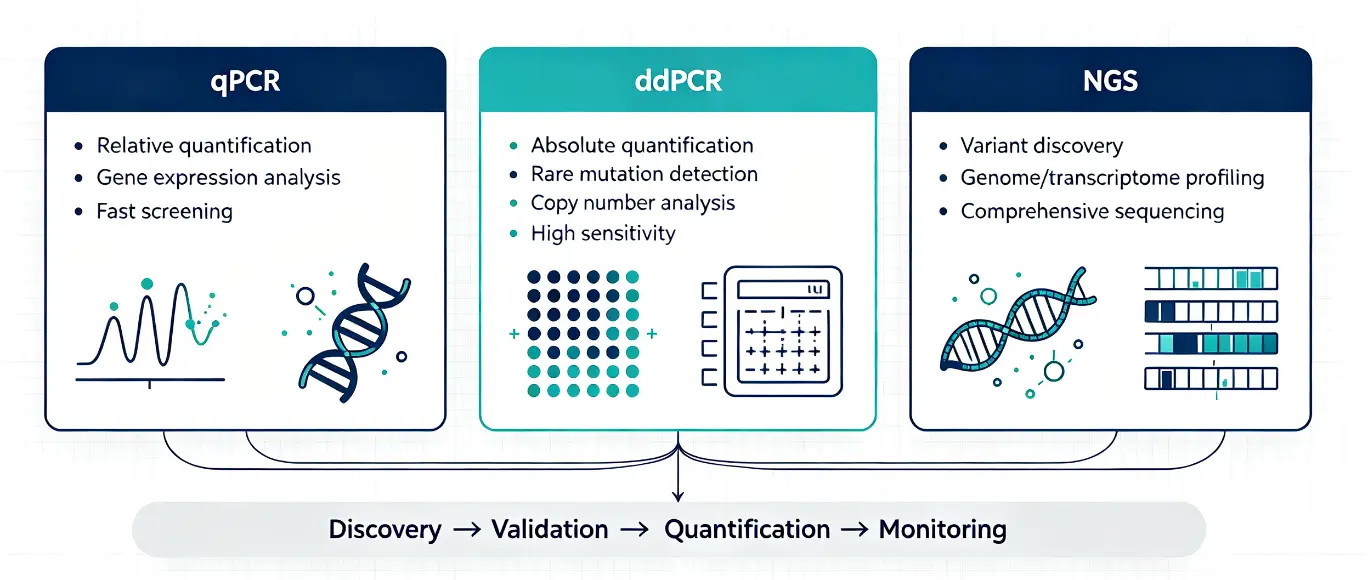
At a Glance: Core Roles of Each Platform
| Technology | Primary Role | Typical Output | Best Suited For |
|---|---|---|---|
| qPCR | Relative nucleic acid quantification | Ct / Cq values and fold changes | Gene expression analysis, routine target screening |
| ddPCR | Absolute nucleic acid quantification | Copies per uL or per reaction | Rare mutation detection, copy number variation (CNV), MRD monitoring |
| NGS | Comprehensive sequence characterization | Millions of sequencing reads | Variant discovery, transcriptome profiling, genomic mapping |
Fast and efficient quantification of gene expression: qPCR
qPCR is still one of the most widely used molecular techniques for its speed, cost effectiveness and ease of implementation.
How It Works
Quantitative PCR (qPCR) is used to determine the relative abundance of a target sequence compared with a reference gene or standard curve (e.g. ΔΔC t method) by detecting fluorescence during the amplification cycles.
Main Applications
- Differential Gene Expression: Comparison of transcript levels between experimental groups (e.g. treated vs. untreated cells).
- Pathogen Detection: Routine testing for known viral or bacterial targets.
- High-Throughput Screening: Screening large sample sizes rapidly.
Limitations
Quantification relies on real-time amplification kinetics and reference controls, which makes qPCR less reliable for the measurement of extremely low-abundance targets, detection of rare allele frequencies or calculation of subtle fold-changes.
Main Takeaway: If you are primarily interested in quickly and economically determining relative expression differences ("how many fold higher or lower"), then qPCR is the way to go.
High Precision Absolute Quantification: ddPCR
Droplet Digital PCR (ddPCR) overcomes many of the limitations of conventional qPCR, such as the need for standard curves and amplification kinetics.
How it works
ddPCR partitions a sample across thousands of independent nanoliter-sized droplets, where PCR amplification is performed independently. The system counts the number of positive (fluorescent) and negative droplets and calculates the absolute concentration of target molecules directly from the Poisson statistics.
Main Uses
- Rare Mutation Detection: Identification of somatic mutations at low frequencies (e.g. circulating tumour DNA at fractions <1%).
- Copy Number Variation (CNV): Detecting small differences in the number of copies of a gene (e.g. 2 copies vs. 3 copies).
- Minimal Residual Disease (MRD): Longitudinal monitoring of response to therapy and early detection of relapse.
- Gene Therapy & CRISPR Validation: AAV/lentivirus viral vector titers, CAR-T construct stability, gene editing knock-in efficiencies.
Limitations
ddPCR is a targeted assay. It requires pre-specified primers and probes, and cannot detect unknown variants or mutations outside the target region.
Main Takeaway: Opt for ddPCR for absolute molecular quantification, superior sensitivity for low-abundance targets or precise tracking of known variants.
Next Generation Sequencing: Full Sequence Exploration
Next-Generation Sequencing (NGS) is a technique innovated to investigate genomes instead of count target sequences, unlike PCR-based methods.
How it works
NGS can interrogate millions of DNA or RNA fragments simultaneously without the need to select primers for each specific base. It generates massive amounts of sequence reads across targeted panels, whole exomes or whole genomes.
Common Uses
- Variant Discovery: Identification of novel single nucleotide variants (SNVs), insertions/deletions (indels), structural variants and gene fusions.
- Transcriptome Profiling (RNA-Seq): Unbiased genome-wide mapping of gene expression and alternative splicing events.
- Complex Genomes & Microbiomics: Characterization of heterogeneous microbial communities or whole tumor mutational landscapes.
Limitations
Complex library preparation, extended processing times, a large computing infrastructure, and substantial bioinformatics support are all necessary for NGS workflows. Routine screening of a single known mutation with NGS is often inefficient and costly.
Main Takeaway: If you are doing exploratory studies where you want to characterize unknown variants across large genomic regions, NGS is the way to go.
Selecting the Right Platform for Common Research Questions
To determine which method fits your experimental setup, start with your core research objective:
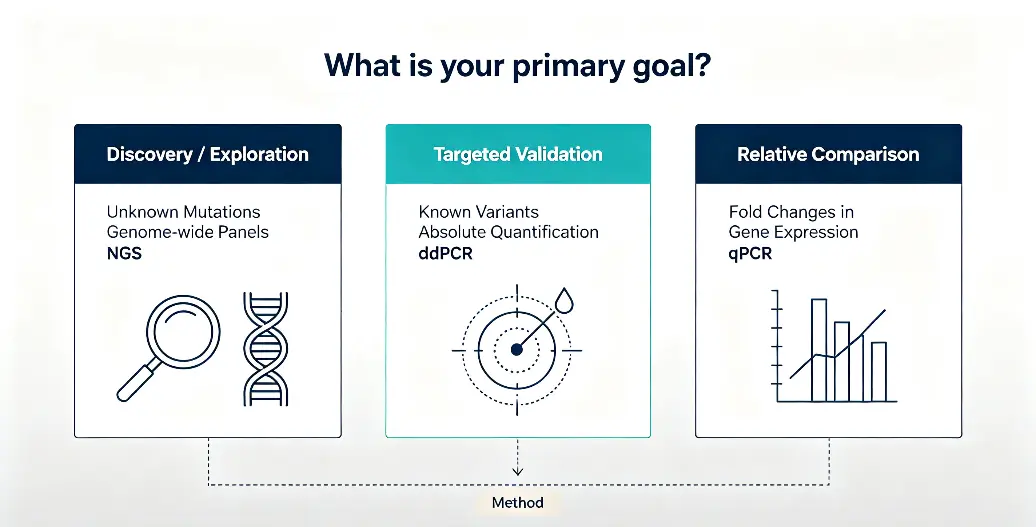
1. Do you need to find unknown variations?
Recommended: NGS (Next Generation Sequencing)
Why: PCR assays use pre-designed primers to target sequences. NGS is the only tool that provides an unbiased discovery of sequence when you have no idea what mutations or fusions are in the sample.
2. Confirming known variants?
Recommended: ddPCR
Why: ddPCR offers a fast, highly sensitive, and cost-effective method to confirm and quantify a candidate target identified by NGS in larger cohorts or over time.
3. Do You Need Absolute Quantification without Standard Curves?
Suggested: ddPCR
Why: Determining whether a gene has 2, 3, or 4 copies—or measuring exact viral vector copies per microliter—requires precision that relative qPCR kinetics cannot reliably deliver.
4. Are You Measuring Relative Differences in Gene Expression?
Recommended: qPCR
Why: Standard gene expression studies usually ask whether a transcript increased or decreased relative to a control group. qPCR offers the throughput, standardized workflows and speed required for fold-change analysis.
5. Are You Tracking Low-Frequency Mutations Over Time?
Recommended: ddPCR
Why: Target mutant DNA can represent less than 0.1% of total cell-free DNA in liquid biopsy and disease monitoring. ddPCR partitions the reactions to separate the rare signal from the background noise allowing precise monitoring of disease progression.
Platform Comparison across Key Applications
The table below outlines common molecular applications alongside their primary recommended technology:
| Application | Recommended Platform | Primary Rationale |
|---|---|---|
| Relative Gene Expression | qPCR | Fast, cost-effective, and standardized for fold-change calculations. |
| Rare Mutation Validation | ddPCR | High analytical sensitivity for low-frequency known alleles. |
| Novel Variant Discovery | NGS | Unbiased, broad coverage across genomic regions without prior knowledge. |
| Gene Fusion Identification | NGS | Identifies novel breakpoints and unknown fusion partners. |
| Known Fusion Tracking | ddPCR | Rapid and sensitive quantification of specific breakpoint transcripts. |
| Copy Number Variation (CNV) | ddPCR | Direct absolute molecular counting with high reproducibility. |
| Viral Load Quantification | ddPCR | Precise measurement of copy numbers without reliance on reference standards. |
| CRISPR Editing Efficiency | ddPCR | Accurately quantifies knock-in percentages and edited alleles. |
| Off-Target CRISPR Analysis | NGS | Broad genomic evaluation of unintended edits across non-targeted sites. |
| Microbiome Profiling | NGS | Simultaneous sequence identification of complex microbial species. |
Combining Technologies for Integrated Workflows
Discussions comparing qPCR, ddPCR, and NGS often imply that researchers must select a single platform. In fact, many effective molecular studies utilize a combination of these technologies, where each plays a role at a separate step of the workflow.
Workflow 1. Discovery of variants → Validation → Disease monitoring
A common oncology workflow begins with targeted or whole-exome sequencing to identify clinically relevant mutations. Once actionable variants are identified, ddPCR tests can be devised to confirm findings and to assess mutation load in subsequent plasma or tissue samples. ddPCR can be practically used for long-term follow-up for the monitoring of changes in variant abundance, without needing to re-sequence each sample every time.
Workflow 2: Transcriptome Screening → Expression Verification
RNA sequencing allows researchers to determine which genes are expressed differently in the whole transcriptome. Candidate genes are then chosen for detailed study. qPCR is an efficient way to validate expression changes in larger sample cohorts. ddPCR also offers extra quantitative assurance when accurate transcript copy counts are required, as in the research of low abundance biomarkers.
Workflow 3: Evaluation of Gene Editing
Multiple analytical approaches are often employed in genome editing studies. NGS is useful in characterizing on-target and off-target editing events throughout the genome. ddPCR can be used to precisely quantify knock-in efficiency, transgene integration, or edited allele frequency, while qPCR can be used to explore downstream transcriptional responses.
The examples demonstrate an important principle: technology selection is not always an either-or decision. Different phases of a research project such as discovery, validation, quantification and routine monitoring may require different analytical platforms.
By seeing qPCR, ddPCR, and NGS as complementing rather than competing technologies, researchers can design scientifically sound and operationally efficient processes.
Key Considerations Before Making Your Decision
Before finalizing your choice, evaluate these operational and technical factors:
- Target Status: Are your targets known or unknown? Known targets favor qPCR or ddPCR; unknown targets require NGS.
- Target Multiplicity: Interrogating 1–3 targets are efficient with PCR; interrogating dozens to hundreds of genes favors NGS panels.
- Sensitivity Needs: If measuring rare events (<1% allele frequency), ddPCR provides superior resolution over qPCR.
- Turnaround Time and Budget: PCR assays generally offer shorter workflows and lower per-sample costs, making them ideal for routine verification.
Conclusion
There is no single "superior" platform in molecular biology. qPCR, ddPCR, and NGS were engineered to address distinct research requirements.
- qPCR excels in rapid, cost-effective relative gene expression.
- ddPCR provides absolute precision for rare mutations, viral loads, and CNVs.
- NGS offers unexcelled breadth for genomic discovery and complex profiling.
By aligning your platform choice with your primary biological question, you can design workflows that maximize data quality while maintaining cost and operational efficiency
Creative Bioarray Relevant Recommendations
| Products & Services | Description |
|---|---|
| Droplet Digital PCR (ddPCR) Service | Our experienced team at Creative Bioarray provides expert ddPCR analysis support with advanced technical capabilities and customized solutions for diverse molecular research applications. |