
Implementing NAMs in Drug Development
In our previous article, we explored the foundational differences between traditional animal models and New Approach Methodologies (NAMs). The next operational step for R&D teams is integration: moving these tools from a promising concept into existing preclinical pipelines.
Adopting NAMs within a commercial pipeline presents distinct operational challenges. This guide outlines how to embed these methods into your current workflow, address ongoing technical bottlenecks, and format data to meet regulatory expectations.
Tactical Integration into the Preclinical Pipeline
Rather than blindly replacing every legacy asset, non-animal testing should be embedded at high-leverage decision points to mitigate late-stage clinical attrition and control discovery costs.
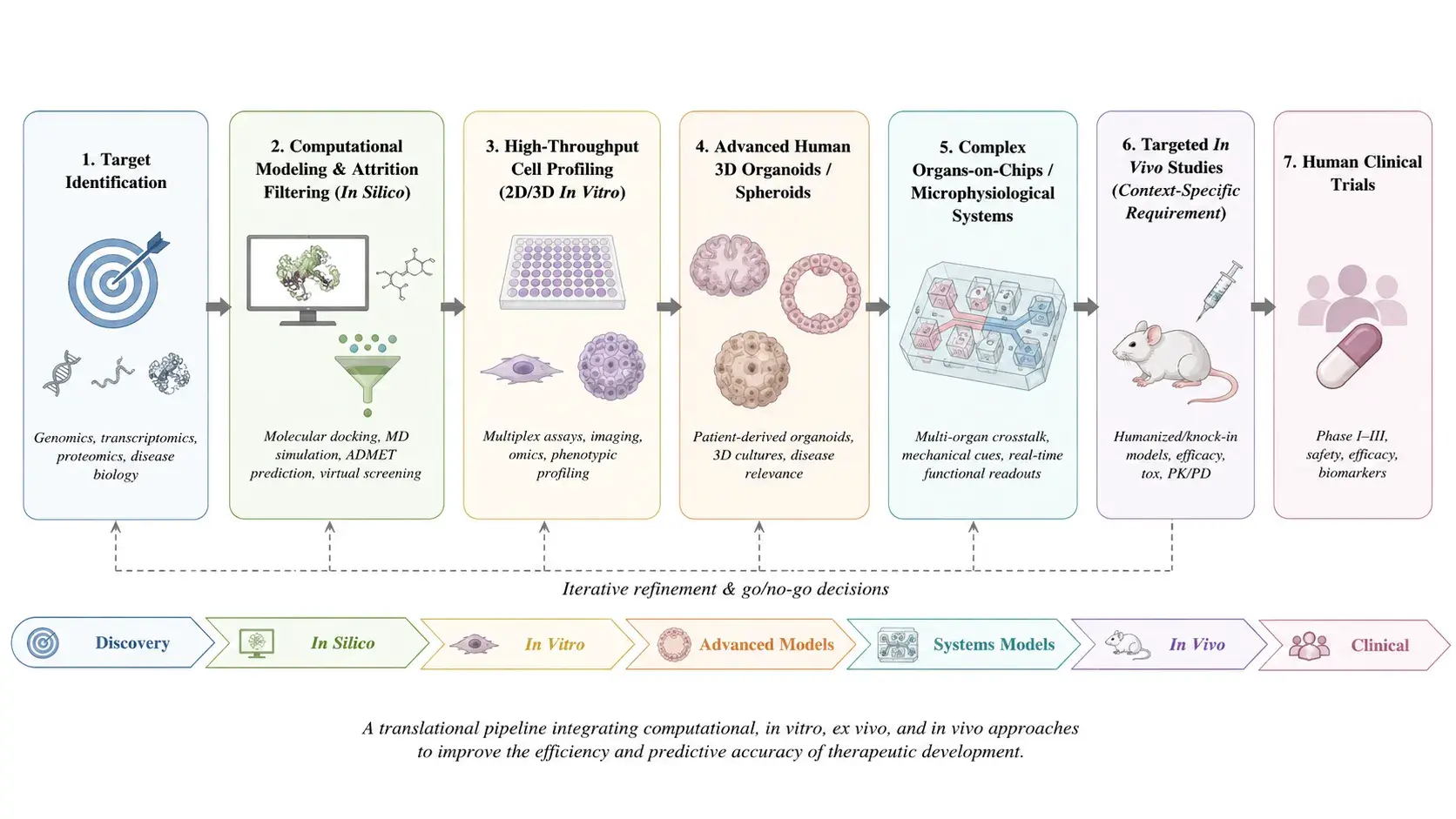
Early-Stage Screening & Lead Optimization
Value generation begins at the start of the discovery funnel. Machine learning models are employed to filter virtual libraries to flag metabolic liabilities and structural toxicity prior to physical synthesis. Once hit compounds are generated, teams can profile thousands of candidates in parallel using automated 2D/3D in vitro assays. This fast filtering process preserves the resource-expensive animal protocols only for the validated and high potential leads.
Mechanistic Toxicity Diagnostics
NAMs are reliable diagnostic tools when a lead candidate fails for safety reasons. Conventional legacy models frequently miss patient-specific toxicities due to the significant differences between human and rodent metabolic pathways. Teams can also use specialized human organ chips (e.g., liver, cardiotoxicity or nephrotoxicity models) to identify the specific cellular mechanisms that led to the failure. This detailed understanding allows researchers to decide whether to chemically optimize a compound or to drop the project early.
Technical Bottlenecks and Practical Workarounds
Adopting NAMs requires a transparent evaluation of current engineering and biological limitations. Recognizing these data gaps allows research teams to implement specific workarounds.
Preclinical Technical Challenges and Solutions
| Technical Challenge | Operational Impact | Practical Workaround |
|---|---|---|
| Lack of Systemic ADME | Drug absorption, distribution, metabolism, and excretion are difficult to evaluate in isolated tissues. | Fluidic Interconnection: Physically coupling gut, liver, and kidney chips via microfluidics to simulate multi-organ crosstalk. |
| Missing Immune Systems | Cannot accurately assess immunotoxicity, cytokine release, or complex inflammatory responses. | Immune Co-Culture: Intentionally seeding primary human immune cells (e.g., T-cells, macrophages) into the tissue matrix. |
| Limited Vascularization | Poor nutrient transport limits the lifespan, size, and physiological maturity of 3D tissues. | Endothelial Co-Culture: Lining microfluidic channels with endothelial cells to create functional vascular barriers. |
| Batch-to-Batch Variability | Reduced reproducibility across different studies, laboratories, or manufacturing lots. | Standardized Protocols: Utilizing qualified, commercially available cell lines and continuous quality control frameworks. |
| Platform Standardization | Many advanced NAM platforms remain laboratory-specific, hindering cross-study comparisons. | Open-Access Harmonization: Aligning internal methodologies with emerging industry-wide hardware and validation standards. |
The Regulatory Action Plan: Preparing Your Data
Regulatory agencies, including the U.S. Food and Drug Administration (FDA) and the European Medicines Agency (EMA), are increasingly encouraging the use of scientifically valid NAMs to complement or, where appropriate, replace certain animal studies. However, regulatory acceptance depends entirely on the context of use (CoU), the quality of supporting evidence, and specific submission requirements.
Building an IATA Dossier
No single NAM platform can currently answer every complex biological question. Therefore, a regulatory submission must build a cohesive "weight-of-evidence" dossier by stacking complementary data layers.
An Integrated Approach to Testing and Assessment (IATA) dossier integrates computational predictions, high-throughput cell lines, and advanced 3D tissue validation. Demonstrating that multiple independent, non-animal methods point to identical safety or efficacy conclusions gives regulators significantly greater confidence in your data.
Engaging with Regulators Early
Do not wait until the final Investigational New Drug (IND) filing to present novel NAM data. Pharmaceutical developers should actively leverage formal qualification programs:
- FDA ISTAND Program: The Innovative Science and Technology Approaches for New Drugs pilot program provides a dedicated pathway for sponsors to validate novel testing tools outside of a specific drug application.
- Early Engagement Benefits: Getting an assay qualified through these channels early ensures that when the final IND package is submitted, the agency is already familiar with and accepting of the testing platform used.
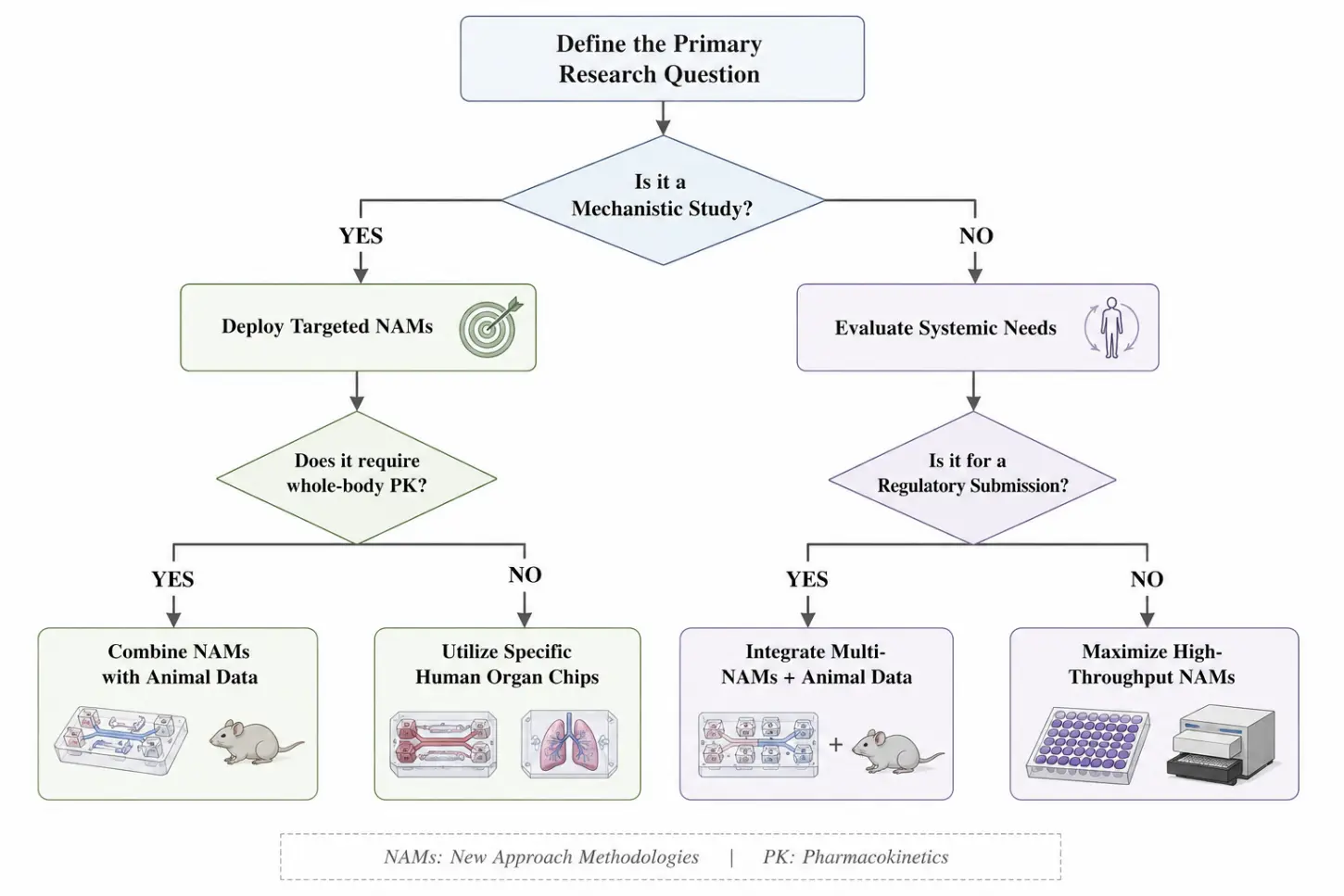
Preclinical Decision Matrix for Project Managers
When mapping out a testing strategy for a new compound, research leads can follow this practical workflow matrix to optimize resource allocation:
Best Practices for Implementing NAMs
To ensure a seamless transition and reliable data output, incorporate these core checklist items into your protocol design:
- Define the Biological Question First: Align the complexity of the model with the exact endpoint you need to measure.
- Select Validated, Human-Relevant Models: Prioritize cell lines and matrices derived from human donors over animal-derived components.
- Combine Complementary NAM Platforms: Use a hybrid approach (e.g., in silico screening followed by 3D organoid verification) to build statistical confidence.
- Standardize Protocols: Implement strict Standard Operating Procedures (SOPs) to mitigate batch variability and ensure cross-study reproducibility.
- Engage Regulators Early: Utilize pilot validation programs to confirm acceptance before locking in late-stage data.
FAQ
1. Can NAMs completely replace animal studies right now?
Not entirely. While NAMs can fully replace animal models in specific contexts—such as dermal toxicity testing or early-stage target screening—complex systemic studies (like multi-generation reproductive toxicity or behavioral neurology) still require whole-organism physiology where integrated multi-organ NAMs are not yet fully mature.
2. What are the biggest barriers to implementing NAMs?
The primary challenges are platform standardization, biological complexity gaps (such as the lack of complete vascular and immune systems), and the extensive time required to validate new assays against decades of historical preclinical data.
3. Are NAMs legally accepted by regulatory agencies?
Yes. Landmark updates like the US FDA Modernization Act 2.0 legally allow drug sponsors to submit data from human-relevant NAMs (including cell-based assays and computer models) to demonstrate safety and efficacy, provided the methods are scientifically validated for their specific context of use.
Creative Bioarray Relevant Recommendations
| Products & Services | Description |
|---|---|
| Animal Disease Models | Our comprehensive portfolio of disease models spans multiple therapeutic areas, providing reliable preclinical platforms to study disease mechanisms and accelerate the development of innovative therapies. |
| 3D Spheroid Platform for Drug Development | Creative Bioarray provides advanced 3D spheroid models designed for researchers aiming to explore cell behavior in a more realistic environment. |
| Organoid Platform for Drug Development | ative Bioarray presents a state-of-the-art Organoid Platform designed to transform drug development and biomedical research. By leveraging advanced organoid and organoid-immune co-culture models, this platform provides highly accurate and predictive solutions that closely replicate human biology. |
| Organ-on-a-Chip Platform for Drug Development | Creative Bioarray focuses on developing specific human disease models and leveraging our organ-on-a-chip platform to identify new therapeutics and clinical biomarkers, promote drug development, and create novel drug delivery systems. |