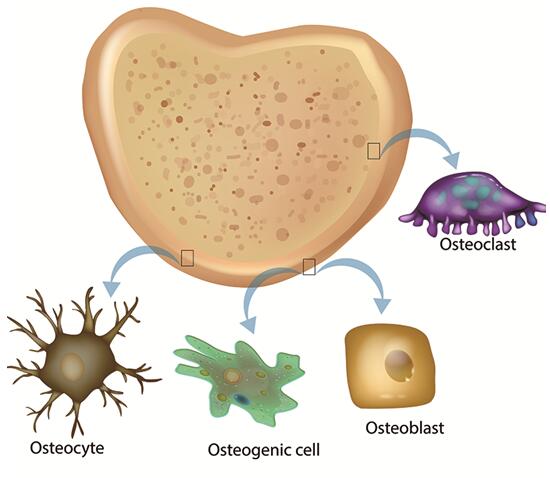

Bone Cells

Our bone cell portfolio features primary human osteoblast models derived from anatomically distinct skeletal tissues, including femoral and calvarial bone. These cells provide physiologically relevant in vitro systems for studying bone formation, mineralization, skeletal development, and bone remodeling processes.

Widely used in orthopedic research, regenerative medicine, biomaterials evaluation, and osteoporosis-related studies, our osteoblast resources support investigations into osteogenic differentiation, extracellular matrix production, and bone tissue responses to therapeutic interventions.

Product List

Our Bone Cell Portfolio Highlights

Primary Osteoblast Resources

Our collection includes primary osteoblasts isolated from different skeletal sites, supporting a broad range of bone biology applications.

  • Anatomically Distinct Osteoblast Models
    • Human femoral osteoblasts
    • Human calvarial osteoblasts
    • Primary human osteoblast cultures
  • Bone Formation Research Tools
    • Osteogenic differentiation studies
    • Bone matrix synthesis investigations
    • Mineralization and bone remodeling research
  • Research-Ready Cell Resources
    • Cryopreserved primary cell formats
    • Suitable for routine and advanced bone research workflows

Bone Research Support

We support research projects focused on skeletal biology, bone regeneration, and musculoskeletal disease mechanisms.

  • Osteogenesis Studies

    Suitable for evaluating osteoblast proliferation, differentiation, matrix deposition, and mineralization capacity.

  • Biomaterial and Implant Evaluation

    Applicable for assessing cellular responses to bone graft materials, orthopedic implants, and tissue-engineering scaffolds.

  • Bone Disease Research

    Support for investigations involving osteoporosis, fracture healing, bone defects, and skeletal regeneration.

  • Customized Project Support

    Flexible solutions for academic research, preclinical studies, and regenerative medicine programs.

4 +
Research
Application

100 %
Mycoplasma-Free
Tested

24-72 h
Rapid
Delivery

Frequently
Asked
Questions

Find your question here or ask us

Ask Question

What is the difference between femoral and calvarial osteoblasts?

Femoral and calvarial osteoblasts originate from different skeletal regions and may exhibit distinct growth characteristics, gene expression profiles, and mineralization behavior. Researchers often select a specific osteoblast source based on the biological context of their study.

Can these cells be used for osteogenic differentiation and mineralization assays?

Yes. Human osteoblasts are commonly used to evaluate osteogenic activity through alkaline phosphatase expression, matrix deposition, calcium accumulation, and mineralized nodule formation assays.

Are these cells suitable for bone biomaterial testing?

Yes. Osteoblasts are widely used to assess biocompatibility, cellular attachment, proliferation, differentiation, and osteointegration potential of bone grafts, scaffolds, coatings, and implant materials.

Which endpoints are commonly evaluated using osteoblast cultures?

Common endpoints include cell viability, alkaline phosphatase activity, collagen production, osteogenic marker expression, extracellular matrix formation, and calcium mineralization.

What research areas commonly utilize primary human osteoblasts?

Primary human osteoblasts are frequently used in studies of bone development, osteoporosis, fracture repair, skeletal regeneration, orthopedic biomaterials, tissue engineering, and bone-targeted drug discovery.

Filters Clear all filters

Species

  • Human (797)
  • Mouse (3)
  • Rat (1)

Source

  • Adipose (9)
  • Adrenal Gland (4)
  • Airway (7)
  • Aorta (16)
  • Artery (47)
  • Bile Duct (1)
  • Bladder (8)
  • Blood (157)
  • Bone (3)
  • Bone Marrow (81)
  • Brain (36)
  • Breast (10)
  • Bronchus (20)
  • Cartilage (6)
  • Chorion (2)
  • Choroid (3)
  • Ciliary Body (1)
  • Colon (10)
  • Conjunctiva (2)
  • Cord Blood (24)
  • Cornea (2)
  • Dental Pulp (4)
  • Dermis (43)
  • Embryo (2)
  • Endometrium (2)
  • Epidermis (19)
  • Esophagus (4)
  • Eye (20)
  • Foreskin (2)
  • Gallbladder (1)
  • Gingiva (2)
  • Hair Follicle (5)
  • Heart (14)
  • Intestine (20)
  • Iris (1)
  • Kidney (31)
  • Lens (1)
  • Liver (34)
  • Lung (56)
  • Lymph Node (2)
  • Mesentery (3)
  • Nose (1)
  • Oral Cavity (3)
  • Ovary (10)
  • Pancreas (8)
  • Pancreatic Islet (1)
  • Perineurium (1)
  • Periodontal Ligament (2)
  • Periodontium (4)
  • Peripheral Blood (130)
  • Peritoneal Cavity (2)
  • Placenta (11)
  • Prostate (8)
  • Rectum (1)
  • Retina (9)
  • Seminal Vesicle (1)
  • Skeletal Muscle (9)
  • Skin (78)
  • Small Intestine (5)
  • Spinal Cord (1)
  • Spleen (6)
  • Stomach (3)
  • Synovial Fluid (2)
  • Synovium (8)
  • Tendon (1)
  • Testis (3)
  • Thymus (3)
  • Thyroid (4)
  • Tongue (1)
  • Tonsil (3)
  • Tooth (4)
  • Trabecular Meshwork (1)
  • Trachea (6)
  • Umbilical Cord (23)
  • Uterus (7)
  • Vas Deferens (1)
  • Vein (30)

Cell Type

  • Astrocyte (9)
  • B Cell (22)
  • Basophil (1)
  • Cardiomyocyte (2)
  • CD133+ Cell (6)
  • CD34+ Cell (16)
  • Cholangiocyte (1)
  • Chondrocyte (4)
  • Dendritic Cell (4)
  • Endothelial Cell (133)
  • Eosinophil (1)
  • Epithelial Cell (84)
  • Fibroblast (139)
  • Glial Cell (14)
  • Granule Cell (1)
  • Granulocyte (3)
  • Hepatic Stellate Cell (3)
  • Hepatocyte (8)
  • Interstitial Cell (1)
  • Keratinocyte (14)
  • Keratocyte (1)
  • Kupffer Cell (1)
  • Lymphocyte (55)
  • Macrophage (4)
  • Melanocyte (10)
  • Meningeal Cell (1)
  • Mesangial Cell (2)
  • Mesothelial Cell (2)
  • Microglia (1)
  • Microvascular Cell (61)
  • Monocyte (7)
  • Mononuclear Cell (98)
  • Myeloid Cell (2)
  • Myoblast (5)
  • Myosatellite Cell (1)
  • Neuron (7)
  • Neutrophil (2)
  • NK Cell (5)
  • Oligodendrocyte Progenitor Cell (3)
  • Osteoblast (3)
  • Pancreatic Stellate Cell (1)
  • Pericyte (10)
  • Podocyte (1)
  • Preadipocyte (10)
  • Progenitor Cell (4)
  • Red Blood Cell (1)
  • Satellite Cell (1)
  • Schwann Cell (1)
  • Sebocyte (1)
  • Sertoli Cell (1)
  • Skeletal Muscle Cell (2)
  • Smooth Muscle Cell (48)
  • Stromal Cell (16)
  • Synoviocyte (6)
  • T Cell (28)
  • Tenocyte (1)
  • Trabecular Meshwork Cell (1)
  • Trophoblast (1)

Disease

  • Acute Lymphocytic Leukemia (ALL) (15)
  • Acute Myeloid Leukemia (AML) (13)
  • Amyotrophic Lateral Sclerosis (ALS) (4)
  • Aplastic Anemia (AA) (1)
  • Arteriovenous Malformation (AVM) (1)
  • Asthma (5)
  • Astrocytoma (2)
  • Autoimmune Hemolytic Anemia (AIHA) (1)
  • Autoimmune Lymphoproliferative Syndrome (ALPS) (1)
  • Breast Cancer (3)
  • Cancer (121)
  • Chronic Lymphocytic Leukemia (CLL) (19)
  • Chronic Myeloid Leukemia (CML) (14)
  • Chronic Obstructive Pulmonary Disease (COPD) (6)
  • Colon Cancer (4)
  • Crohn's Disease (3)
  • Cystic Fibrosis (CF) (7)
  • Diabetes (35)
  • Diabetes Type 1 (16)
  • Diabetes Type 2 (18)
  • Diffuse Large B-Cell Lymphoma (4)
  • Dilated Cardiomyopathy (DCM) (1)
  • Duchenne Muscular Dystrophy (DMD) (5)
  • Essential Thrombocythemia (ET) (1)
  • Glioblastoma (3)
  • Guillain-Barre Syndrome (GBS) (1)
  • Hypertension (27)
  • Idiopathic Thrombocytopenic Purpura (ITP) (1)
  • Inflammatory Bowel Disease (IBD) (5)
  • Iron-Deficiency Anemia (1)
  • Kidney Cancer (3)
  • Legg–Calvé–Perthes Disease (LCPD) (2)
  • Leukopenia (1)
  • Liver Cancer (3)
  • Lung Cancer (6)
  • Mantle Cell Lymphoma (MCL) (8)
  • Melanoma (2)
  • Mucopolysaccharidosis (2)
  • Multiple Myeloma (MM) (12)
  • Multiple Sclerosis (MS) (3)
  • Muscular Dystrophy (MD) (1)
  • Myelodysplastic Syndrome (MDS) (3)
  • Neurofibromatosis (NF) (3)
  • Non-Hodgkin Lymphoma (NHL) (10)
  • Normal (524)
  • Osteoarthritis (OA) (5)
  • Ovarian Cancer (6)
  • Pancreatic Cancer (1)
  • Pancytopenia (1)
  • Parkinson's Disease (PD) (2)
  • Plasmacytoma (1)
  • Polycythemia (1)
  • Prostate Cancer (3)
  • Psoriasis (4)
  • Rheumatoid Arthritis (RA) (7)
  • Robertsonian Translocation (ROB) (1)
  • Sickle Cell Anemia (2)
  • Systemic Lupus Erythematosus (SLE) (4)
  • Thrombocytopenia (1)
  • Transverse Myelitis (TM) (1)
  • Ulcerative Colitis (UC) (2)
  • Waldenström Macroglobulinemia (WM) (2)

Description: Human Osteoblasts-femural (HO-f) from Creative Bioarray are isolated from human femur. HO-f are ...

Cat#: CSC-7744W INQUIRY

Description: Human Calvarial Osteoblasts (HCO) from Creative Bioarray are isolated from human calvariae. HCO are ...

Cat#: CSC-7820W INQUIRY

Description: Human osteoblasts cells are derived from femoral trabecular bone tissue from the knee or hip joint ...

Cat#: CSC-7860W INQUIRY

For research use only. Not for any other purpose.