
How to Match Models to Drug Modalities: Small Molecules vs. Biologics
The success of an in vivo efficacy study rarely hinges on the drug candidate alone. Instead, it depends heavily on the compatibility between the drug and its preclinical testing ground. As pipelines diversify beyond classical chemistry into complex biologics, a recurring translational bottleneck has emerged: choosing a model based on tumor type rather than the drug's physical modality.
Small molecule inhibitors and targeted biologics operate under completely different pharmacological laws. They exhibit contrasting molecular weights, distinct mechanisms of action, disparate pharmacokinetics (PK/PD), and highly variable species cross-reactivity. For a Principal Investigator or a procurement director at a biopharma company, selecting an incompatible host model creates a significant risk-either generating false negatives that kill a viable asset, or producing false positives that fail spectacularly in Phase I clinical trials. This guide maps out how your molecule's structural nature dictates your preclinical in vivo strategy.
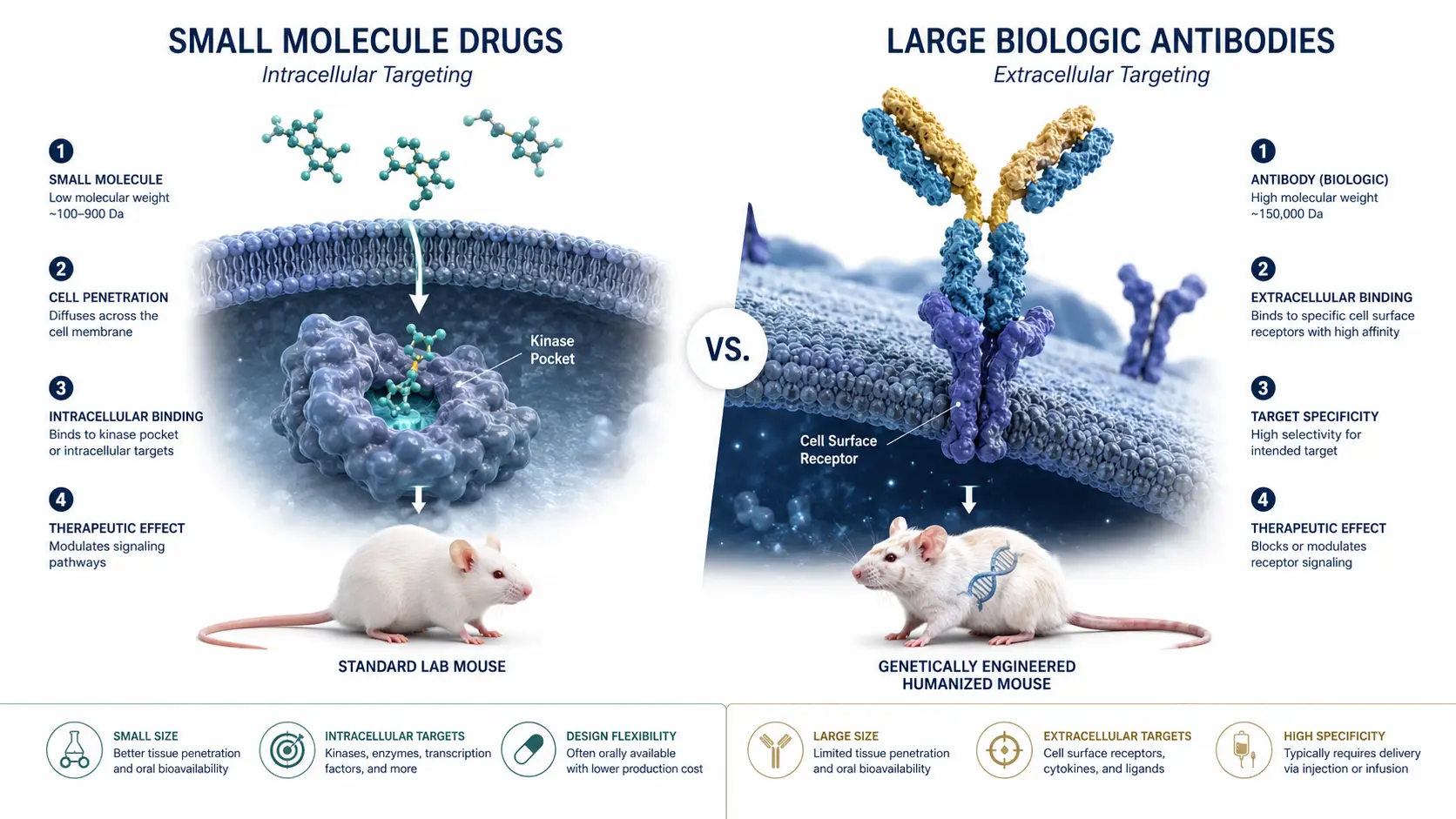
Small Molecule Models: Conserved Targets and Metabolic Clearances
Small molecule drugs (Mw < 900 Da) typically function by penetrating cell membranes to bind intracellular domains, kinase pockets, or active enzymatic sites. Because these active sites often reside in highly conserved evolutionary regions of proteins, small molecules frequently demonstrate excellent species cross-reactivity between humans and standard laboratory rodents.
Syngeneic Models for Intact Immunity
When evaluating small molecule immunomodulators-such as IDO1, TGF-β, or adenosine receptor antagonists-preserving a fully functional, native immune system is paramount. Syngeneic mouse models (mouse tumor cell lines derived from and implanted into matching inbred strains like C57BL/6 or BALB/c) provide the ideal physiological landscape. Since the small molecule can freely bind both the murine tumor receptors and the host murine immune cells, these models offer a reliable, cost-effective framework for assessing immune checkpoint modulation and leukocyte infiltration.
CDX and PDX Models for Targeted Inhibitors
For small molecules designed to exploit specific genetic vulnerabilities or human oncogenic mutations (e.g., mutant EGFR, KRAS G12C, or BRAF V600E), traditional Cell Line-Derived Xenograft (CDX) or Patient-Derived Xenograft (PDX) models remain the industry workhorses. Implanted into severely immunodeficient mice (like Balb/c nude or NCG), these human tumors retain their specific target architecture. Because small molecules are usually non-immunogenic and cross-reactive, they can suppress tumor growth in these hosts without needing humanized stromal or immune components.
- The Critical Operational Caveat: While small molecules bypass target cross-reactivity hurdles, they are highly sensitive to species-specific metabolic differences. Rodents express a distinct profile of Cytochrome P450 (CYP) enzymes compared to humans. A small molecule may be cleared rapidly by murine hepatic metabolism, requiring heavy dosing schedules that do not mirror human clinical regimens. Preclinical designs must balance the in vivo efficacy dose with a robust understanding of the mouse PK profile.
Biologics Models: Crossing the Species Barrier
Biologics-ranging from monoclonal antibodies (mAbs) and bispecific T-cell engagers (TCEs) to antibody-drug conjugates (ADCs) and cellular therapies-are large, sophisticated structures. They recognize highly specific, conformation-dependent extracellular human epitopes. Consequently, most advanced biologics show zero cross-reactivity with wild-type murine targets, rendering standard syngeneic or CDX models functionally useless.
Target-Humanized Models (GEMMs) for Monoclonal Antibodies
For a standard humanized mAb targeting an immune checkpoint (e.g., anti-PD-1 or anti-CTLA-4), a wild-type mouse will simply clear the antibody without any target engagement. To resolve this, researchers must utilize Genetically Engineered Mouse Models (GEMMs) where the murine extracellular gene sequence is knocked out and replaced with the human equivalent. This preserves the natural intracellular signaling cascades and whole-body immune architecture while permitting human antibody binding, serving as the gold standard for monospecific mAb profiling.
Immune-Reconstituted Platforms for Complex Modalities
As we advance to multi-specific biologics like Bispecific T-cell Engagers (BiTEs) or T-cell redirection therapies, target humanization alone falls short. A bispecific antibody requires simultaneous binding to a human tumor antigen and the human CD3 complex on a functional T cell. This necessitates an immune-reconstituted model, such as a hu-PBMC or hu-HSC mouse bearing a human tumor xenograft. Without human effector cells present in the host system, the biologic cannot bridge the immunological synapse, leading to a false negative result.
- The FcRn Nuance in Biologics PK: Biologics possess extended half-lives due to the neonatal Fc receptor (FcRn) recycling mechanism. However, human IgG antibodies bind to murine FcRn with a significantly higher affinity than murine IgG does, paradoxically altering their physiological clearance kinetics in standard mice. For precise translational PK/PD modeling of antibody longevity and micro-dosing toxicity, advanced pipelines are increasingly utilizing FcRn-humanized mouse strains.
The Modality-to-Model Matrix
To streamline your study design, the matrix below outlines how primary drug modalities map onto preferred preclinical host systems and highlights the primary technical pitfalls to avoid.
| Drug Modality | Primary Mechanism | Preferred In Vivo Model | Critical Technical Pitfall |
|---|---|---|---|
| Small Molecule Inhibitors (e.g., Kinase Blockers) | Intracellular binding; targets highly conserved active pockets. | CDX / PDX (Immunodeficient strains) | Rapid murine CYP-mediated clearance can lead to miscalculated clinical dosing. |
| Monoclonal Antibodies (e.g., Checkpoint Blockade) | Extracellular binding to specific human epitopes. | Single/Dual GEMMs (e.g., hPD-1/hPD-L1) | Antibody neutralizes mouse immune targets poorly if humanized domains are missing. |
| Bispecific/TCEs (e.g., Dual-Target BiTEs) | Simultaneously cross-links tumor antigen and human T-cells. | hu-PBMC / hu-HSC (with human tumor co-engraftment) | GvHD-induced systemic inflammation can alter tumor growth kinetics artificially. |
| Antibody-Drug Conjugates (ADCs) | Targeted antigen delivery of cytotoxic small molecule payloads. | Target-expressing CDX / PDX or GEMMs | Mice may lack the specific tissue cross-toxicity profile of the payload found in humans. |
The Converging Frontier: Next-Generation Modalities
The boundary between small molecules and biologics is blurring with the rise of proximity-induced modalities like PROTACs (Proteolysis Targeting Chimeras) and Molecular Glues. These small molecules do not simply block a pocket; they form a ternary complex that recruits an endogenous E3 ubiquitin ligase (such as CRBN or VHL) to polyubiquitinate a target protein for proteasomal degradation.
This mechanism introduces an unexpected species barrier for small molecules. For instance, a single amino acid substitution between human and murine CRBN can completely abolish a molecular glue's ability to recruit the target protein in a wild-type mouse. Consequently, these advanced degraders now demand the same rigorous target-humanization strategies historically reserved for complex biologics-such as utilizing CRBN-humanized mice-to avoid catastrophic false negatives during lead optimization.
Creative Bioarray Relevant Recommendations
| Products & Services | Description |
|---|---|
| Oncology Models | Creative Bioarray provides professional drug testing services using oncology disease models. Our disease models are suitable for testing new drugs or compounds that act on disease targets. |
| Humanized Mouse Models | Creative Bioarray enhances your preclinical immuno-oncology research endeavors by offering state-of-the-art humanized mouse model solutions that are tailored to target specific human immune responses. |
| Humanized PBMC Mouse Models | Creative Bioarray has successfully established highly stable humanized PBMC mouse models, tailored for our clients to evaluate the efficacy of immune therapies in tumor treatment. |
| Humanized CD34+ HSC Models | Creative Bioarray has successfully engineered sophisticated humanized mouse model featuring CD34+ hematopoietic stem cells (HSCs), meticulously designed for cutting-edge drug efficacy studies. |