
6 Easy Steps to Get Your In Vitro ADME Done
A solid understanding of pharmacokinetics is the lifeblood of early drug discovery. ADME - absorption, distribution, metabolism and excretion - is what makes a drug candidate succeed or fail further down the pipeline. There's no room for guessing games in early ADME evaluation, yet too many teams dive into late-stage studies without adequate prior knowledge. The result? Losing precious time, money and resources that could have been invested into the right compounds.
Hit-to-Lead or Lead Optimization teams deserve better. When executed during early discovery, in vitro ADME testing can generate prioritization-ready insight to focus your resources on the best compounds and guide medicinal chemistry strategies. In this blog, we lay out an easy ADME workflow step-by-step, including what to expect at each stage of the workflow, what to look for in your results, and how we can help at every step. Consider this your "practical playbook" for running ADME screens that get you decision-ready data without a hassle.
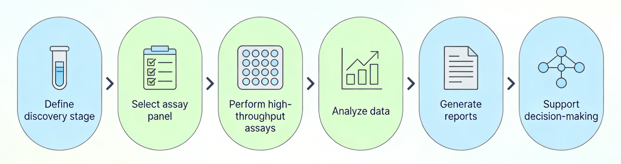
Step 1: Assess Your Discovery Stage and Define Goals
Before setting up any experiments, take a moment to clarify what you really need from your ADME program:
- Are you in Hit-to-Lead? You're likely looking for fast-tracked triage to weeding out compounds with poor absorption or clearance liabilities. You'll also want to rank your compounds for follow-up.
- Are you in Lead Optimization? In this case, you'll want more detailed insight into specific metabolic pathways, transporter interactions, and clearance mechanisms to help you focus your chemical series.
Ask yourself:
- Which properties are most likely to limit exposure?
- Are you aiming for speed or detailed mechanistic insight?
- Do you need comparative ranking or predictive human PK?
Our scientists can assist in defining the right stage-specific panel and recommend an efficient workflow, ensuring that your assays focus on the most informative properties without wasting compounds or time.
Step 2: Select the Right Assay Panel
Not every compound requires every assay. The right panel depends on your stage, goals, and the resources available. Here's a practical framework:
| Discovery Stage | Key Assays | Purpose / Insight | Our Service |
|---|---|---|---|
| Hit-to-Lead | Permeability (PAMPA, Caco-2), Microsomal Stability, Plasma Protein Binding | Rapidly rank compounds, identify major exposure risks | Panel design guidance; high-throughput assay execution |
| Early Lead Optimization | Permeability + Efflux (MDCK, P-gp), Hepatocyte Stability, CYP Inhibition | Identify metabolism and transporter liabilities, refine chemical series | Flexible assay execution; QC oversight; trend analysis |
| Late Lead Optimization | Extended Metabolism Panels, Transporter Profiling (BCRP, OATP), Blood-to-Plasma Ratios | Support PK study design, minimize DDI risk | Comprehensive coverage; detailed reporting; interpretation support |
Start with the minimum panel necessary to flag liabilities. You can expand later based on initial results. Our services allow you to scale efficiently without over-consuming compounds or time.
Step 3: Prepare Compounds and Run Assays
Once you've selected your panel, it's time to get hands-on. Here's what to consider:
- Compound preparation: Check solubility, ensure correct concentrations, and plan for replicates.
- High-throughput execution: Screening multiple compounds in parallel saves time and helps establish relative ranking across your chemical series.
- Controls and QC: Always include positive and negative controls. Track assay performance carefully to avoid misleading conclusions.
Our platform handles compound prep, assay execution, and QC, providing consistent, reproducible data so your team can focus on interpretation rather than troubleshooting.
Step 4: Analyze Results and Spot Risk Signals
After your assays are complete, the next step is to make sense of the data. Look for common early-stage red flags:
- Low permeability: May indicate poor oral absorption
- High intrinsic clearance: Suggests rapid metabolic elimination
- Strong plasma protein binding: Limits the free drug fraction
- Efflux-dominated transport: Could reduce tissue exposure
How to interpret:
- Compare multiple assays and compounds to identify patterns
- Focus on relative differences within your series rather than absolute numbers
- Link observed liabilities to chemical features to guide optimization
Our scientists can help analyze trends, flag potential liabilities, and provide recommendations on structural modifications to improve drug-like properties.
Step 5: Generate Actionable Reports
Data is only as good as its presentation. A well-structured report should include:
- Raw experimental data
- Calculated parameters (clearance, permeability, binding fractions)
- Notes on assay conditions and limitations
Reports should be standardized and presented in a way that allows you and your team to make quick decisions. Ideally, you can use your ADME data as another tool to rank compounds, prioritize medicinal chemistry, and plan your next-stage studies.
Our reports are completely decision ready. We take care of all the formatting and interpretation so that you can focus on using your results to make timely decisions.
Step 6: Decide Next Steps
Finally, use the data to guide project decisions:
- Advance: Compounds with favorable ADME properties
- Optimize: Compounds with manageable liabilities that can be addressed chemically
- Deprioritize: Compounds with multiple red flags unlikely to improve
This is where the workflow comes full circle. With structured data and expert interpretation, your team can focus on compounds with the highest likelihood of success, saving time and resources.
Why Partner with a Professional In Vitro ADME Service
Even if you have internal capabilities, working with an experienced partner provides:
- Guidance on panel selection and discovery-stage strategy
- High-throughput, reproducible assay execution
- Expert data analysis and interpretation
- Decision-ready reporting that integrates seamlessly into your workflow
Partnering with us means you can focus on chemistry and discovery decisions, while leaving assay execution, QC, and reporting to experts.
Next Steps
Ready to streamline your early-stage ADME workflow? We can support you at every step - from panel selection to high-throughput execution, data analysis, and reporting.
Request a Quote for In Vitro ADME Testing
Discuss Your Screening Strategy with Our Scientists
Following these six steps provides a practical, step-by-step path from initial compound assessment to actionable decision-making - ensuring your discovery program is efficient, informed, and focused on the most promising molecules.
Creative Bioarray Relevant Recommendations
| Products & Services | Description |
|---|---|
| Safety Evaluation Services | Creative Bioarray stands as a premier provider of comprehensive safety evaluation studies, adeptly serving a diverse spectrum of industries. Our expertise extends to a broad range of product categories, encompassing pharmaceuticals, cosmetics, and personal care items within the realm of daily chemical products, as well as disinfectants and food products |
| Drug Metabolism and Pharmacokinetics (DMPK) | Creative Bioarray provide comprehensive in vitro and in vivo DMPK solutions to support lead optimization, candidate selection, and regulatory submissions, accelerating the path from discovery to clinical development |