
Alzheimer's Disease (AD) Modeling and Assays
Accelerate your Alzheimer's drug discovery with integrated in vivo models, in vitro platforms, and advanced study tools.
Overview of Alzheimer's Disease
Alzheimer's disease (AD) is a progressive neurodegenerative disease that is the leading cause of dementia. Currently, AD affects over 55 million people worldwide, and with our aging population the disease burden continues to grow.
Clinically, AD is characterized by progressive cognitive decline, memory impairment, and behavioral changes. Pathologically, AD is defined by the over deposition of amyloid-β (Aβ) plaques, formation of tau neurofibrillary tangles, neuroinflammation, and mass neuron death.
While there have been many attempts to develop therapeutics to halt the progression of Alzheimer's disease, the attrition rate for drug development is high. Leading researchers suggest that Alzheimer's disease is multifactorial and can not be recapitulated by one model system alone.
Successful preclinical studies will require a variety of in vivo models along with in vitro assays and multi-dimensional readouts to fully elucidate drug efficacy and mechanisms of action.
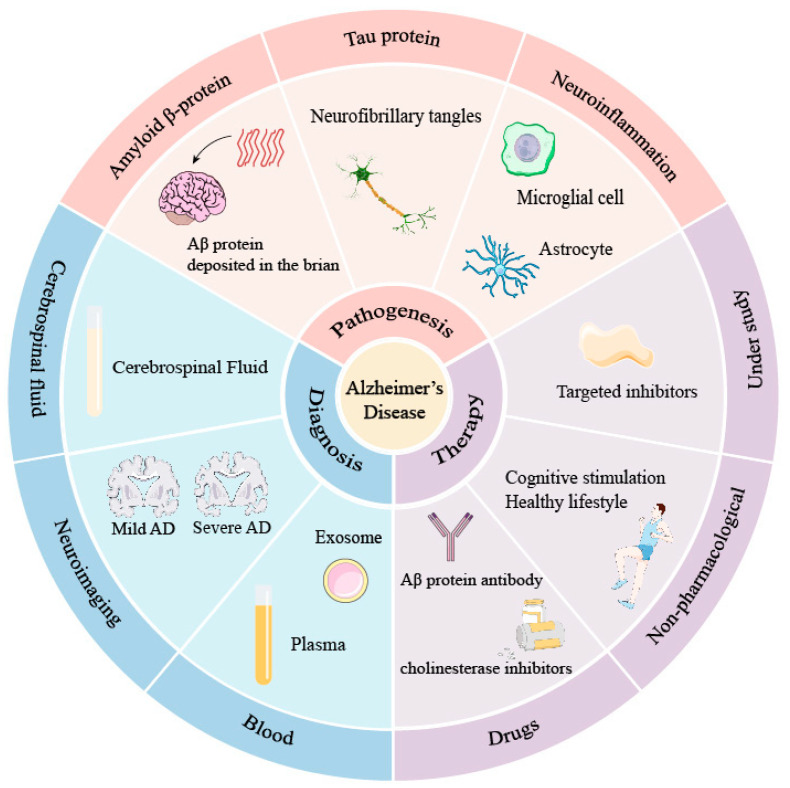 Fig. 1. The pathogeneses, diagnoses, and therapies for AD (Yang Y and Qiu L, et al., 2024).
Comprehensive Alzheimer's Disease Modeling and Assay Platforms

Creative Bioarray offers an integrated platform covering animal models, mechanistic assays, and functional study tools, enabling efficient progression from early discovery to preclinical validation.
We provide a broad spectrum of animal models to replicate key features of Alzheimer's pathology, including amyloid deposition, tau pathology, synaptic dysfunction, and cognitive impairment.
Aging Models
- Natural aging model
- Senescence-accelerated Prone 8 Mouse Model (SAMP8)
- D-galactose-induced model
Applications:
- Sporadic Alzheimer's disease
- Aging-related neurodegeneration

Transgenic Animal Models
- APP transgenic models
- Tau transgenic models
- Double, triple, and five-transgenic models
Applications:
- Amyloid and tau pathology studies
- Evaluation of anti-Aβ and anti-tau therapeutics (e.g., antibodies, biologics)

Induced Damage Models
- Scopolamine induced AD model
- Streptozotocin (STZ)-induced AD model
- Aβ induced AD model
- D-gal and AlCl3-induced AD model
Applications:
- Rapid efficacy screening
- Neurotoxicity and cognitive impairment studies
- Small molecule drug evaluation

Alternative Model Organisms
- Drosophila models
- Caenorhabditis elegans models
- Danio rerio (zebrafish) models
Applications:
- High-throughput screening
- Genetic and pathway studies
Our in vitro platforms support mechanistic studies, target validation, and high-throughput drug screening.

Core Assay Platforms
- Aβ induced neurotoxicity assay
- Amyloid β aggregation inhibition assay
- Secretase inhibitor screening
- Tau hyperphosphorylation assay
- Tau aggregation assay
- Neurite outgrowth assay
Applications:
- Mechanism-of-action studies
- Target validation
- Early-stage drug screening
To ensure robust and translatable outcomes, we provide comprehensive functional, imaging, and electrophysiological assessments.

Behavioral Tests
- Cognitive function tests
- Sensory function tests
- Motor function analysis
- Social interaction studies
Neurological Imaging
- MRI
- PET/CT
- SPECT/CT
Electrophysiology Assays
- Long-term potentiation (LTP) assay
- Patch clamp
- EEG monitoring
Microdialysis
- Real-time neurochemical monitoring
- Neurotransmitter dynamics analysis
Why Choose Creative Bioarray

Comprehensive model portfolio
covering transgenic, induced, and aging models

Integrated in vivo and in vitro platforms
for seamless study progression

Advanced assay systems
including behavioral, molecular, and imaging analyses

Customizable study design
tailored to your drug modality
FAQ
Which is the best animal model to study Alzheimer's disease?
Depends on your target of interest. If you are studying amyloid or tau, transgenic models work best. If you need quick results to screen your compounds, induced models are the way to go.
How do you test Alzheimer's drugs in vivo?
The most common methods to evaluate Alzheimer's drugs in vivo are through behavioral assays, pathological readouts (Aβ/Tau), and biomarkers.
What assay is used to detect amyloid beta?
Common methods include aggregation assays, ELISA, and imaging-based detection.
What is the difference between transgenic and induced models?
Transgenic models are used to model disease pathology. Induced models on the other hand, are faster and cheaper and are used for quick functional readouts.

Start Your Alzheimer's Disease Study Today
Advance your research with reliable Alzheimer's disease models and assay platforms.
Reference
- Yang Y, Qiu L. Research Progress on the Pathogenesis, Diagnosis, and Drug Therapy of Alzheimer's Disease. Brain Sci. 2024. 14(6):590.