
The Essentials of Quantitative Bioanalysis
Quantitative bioanalysis plays a critical role in drug discovery by providing insight into drug exposure, pharmacokinetics/pharmacodynamics (PK/PD), and biological response. Whether derived from the PK/PD profiles of small molecules or the immunogenicity assessment of complex biologics, the data generated in the laboratory directly influences the development of drug candidates.
As a preclinical CRO, we understand that a bioanalytical report is not merely a spreadsheet of concentrations, but a comprehensive interpretation of how a drug behaves within a biological system. This article examines the practical standards that guide our work and the real-world analytical challenges encountered in daily bioanalytical operations.
The Foundation: Method Validation
Method validation is not simply a regulatory requirement, but a critical process for ensuring data robustness, reliability, and reproducibility. Best practices extend beyond basic compliance with ICH M10 guidelines.
Selectivity and Specificity
Can the analyte be accurately detected within a complex biological matrix containing endogenous proteins, lipids, and metabolites? In addition to evaluating normal plasma, methods should also be challenged using hemolyzed and hyperlipidemic samples to ensure assay performance under realistic study conditions.
Matrix Effects
Matrix effects remain a major challenge in LC-MS/MS analysis. Stable isotope-labeled internal standards (SIL-IS) are widely considered one of the most effective approaches for correcting matrix-related ion suppression or enhancement caused by biological matrices.
Dynamic Range
A robust assay must be practical as well as sensitive. Calibration curves should be designed to adequately cover the anticipated concentration range of the study while minimizing additional dilution steps that may introduce variability or human error.
Tailoring the Strategy to the Molecule
Different therapeutic modalities require different bioanalytical strategies, and the analytical platform should be adapted accordingly.
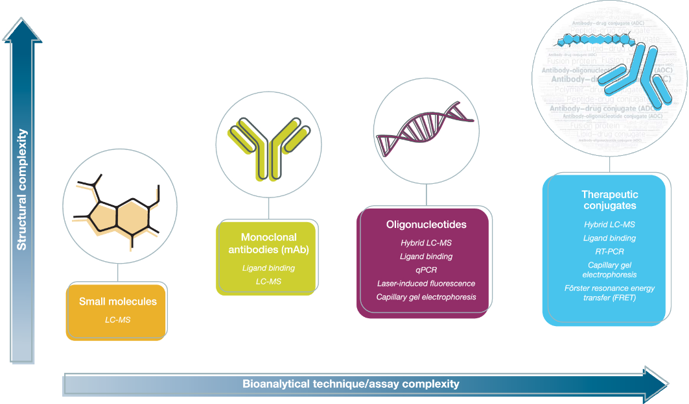
Small Molecules (LC-MS/MS)
For small-molecule bioanalysis, the primary objectives are throughput, sensitivity, and reproducibility. Emphasis is often placed on automating sample preparation workflows, whether through protein precipitation or solid-phase extraction (SPE), using automated liquid-handling systems to reduce variability and improve efficiency.
Large Molecules (LBA and Hybrid LC-MS)
Ligand-binding assays (LBAs) remain the standard platform for large-molecule quantification, although assay performance is highly dependent on reagent quality and specificity. When commercially available antibodies do not provide sufficient selectivity, hybrid LC-MS approaches combining immunoaffinity capture with enzymatic digestion can offer improved analytical specificity and quantitative accuracy.
Cell and Gene Therapies (CGTs)
For cell and gene therapies (CGTs), bioanalysis increasingly involves monitoring mRNA, oligonucleotides, or viral vectors. These applications often require qPCR or ddPCR platforms, where analytical focus extends beyond quantification to include assessment of genetic material integrity and stability.
Solving Real-World Challenges
In a controlled environment, analytical workflows appear straightforward. In practice, bioanalysis must address the complexity and variability of biological systems.
Nonspecific Binding
Hydrophobic compounds frequently adsorb to plastic tubes and pipette tips, leading to analyte loss, particularly in low-concentration samples. Mitigation strategies may include surface pre-treatment with anti-adsorptive agents or the use of specialized low-binding consumables.
Unstable Metabolites
Certain unstable metabolites, including glucuronide conjugates, may revert to the parent compound during sample processing or within the ion source of the mass spectrometer, potentially leading to artificially elevated measurements. Appropriate stabilization strategies include the use of acidified collection tubes and maintaining samples on dry ice throughout handling and processing.
Incurred Sample Reanalysis (ISR) Failures
ISR serves as an important assessment of assay reproducibility. When repeat analyses fail to reproduce the original result, investigations should focus on factors such as sample homogeneity, pipetting accuracy, instrument performance, or potential contamination. The objective is not simply to resolve discrepancies, but to identify and address the underlying cause.
Regulatory Rigor and Data Integrity
In regulated bioanalysis, scientific validity depends heavily on data documentation, traceability, and procedural consistency. Regulatory compliance is not an administrative formality, but an essential component of reliable bioanalytical practice.
The ALCOA+ Principles
Modern bioanalysis follows ALCOA+ principles: data should be Attributable, Legible, Contemporaneous, Original, and Accurate. All procedural modifications, sample preparation deviations, and reinjections should be documented in real time to ensure complete traceability.
Audit Trails and Electronic Records
As laboratories transition toward paperless operations, increasing emphasis is placed on electronic data integrity and software compliance. A well-functioning Laboratory Information Management System (LIMS) is essential for maintaining secure audit trails and ensuring that raw data cannot be modified or deleted without appropriate documentation.
Handling Deviations
No study is entirely free of deviations. Laboratory quality is often reflected in how deviations are investigated, documented, and resolved. Rather than being automatically excluded, outliers should trigger formal Process Deviation (PD) or Corrective and Preventive Action (CAPA) procedures to determine root causes and ensure that final PK assessments are based on scientifically justified data.
Summary and Outlook
Quantitative bioanalysis continues to evolve toward greater sensitivity and increasing molecular complexity. As the industry expands from traditional small molecules to emerging modalities such as oligonucleotides, PROTACs, and viral vectors, the need for accurate and reproducible bioanalytical data remains unchanged.
Successful bioanalysis depends on proactive problem-solving rather than reactive troubleshooting. Predicting nonspecific binding, stabilizing unstable metabolites during collection and processing, and maintaining rigorous data integrity practices can significantly reduce the risk of late-stage study failure. Ultimately, high-quality bioanalysis serves as a critical step in accurately characterizing and advancing promising drug candidates throughout the drug development process.
Creative Bioarray Relevant Recommendations
| Products & Services | Description |
|---|---|
| Bioanalytical Package | Comprehensive bioanalytical services providing reliable method development, validated PK/TK studies, and advanced biomarker analysis to accelerate drug discovery and development. |
Reference
- Mu, R., Yuan, J., et al. Bioanalytical Methods and Strategic Perspectives Addressing the Rising Complexity of Novel Bioconjugates and Delivery Routes for Biotherapeutics. BioDrugs. 2022. 36, 181-196