
Preclinical Workflow for Drug Toxicity Testing
Drug toxicity testing is a critical component of preclinical drug development. Before a drug candidate can enter human clinical trials, its safety profile must be carefully evaluated through a series of laboratory and animal studies. These assessments help researchers identify potential toxic effects, determine safe dosage ranges, and understand how a compound interacts with biological systems.
Building a robust preclinical toxicity testing workflow helps researchers identify safety liabilities as early as possible, optimize promising drug candidates, and generate required toxicology data for regulatory submission. The combination of in vitro assays, in vivo toxicology studies, safety pharmacology evaluations, and toxicokinetic analyses can support confidence in a compound's safety profile before starting human clinical trials.
In this guide, we provide an overview of the typical preclinical workflow for toxicity testing. You will learn about the major study types and strategies used to assess drug safety before initiating clinical studies.
Overview of the Preclinical Toxicity Testing Workflow
Preclinical toxicity assessments are generally performed using a stepwise workflow that progresses from early screening assays to formal GLP toxicology studies. Each stage of testing builds upon previous results to further evaluate potential toxicities throughout the drug development process.
A typical workflow includes the following stages:
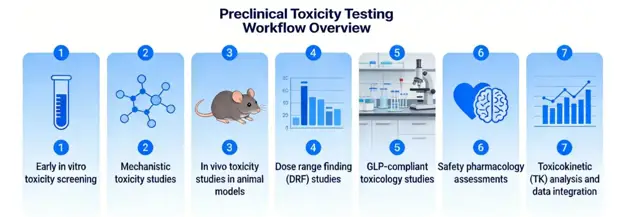
Keep in mind that the overall strategy may vary based on drug modality, therapeutic indication, and intended regulatory pathway. However, this framework is a common approach used to evaluate and characterize toxicities during early drug development.
Step 1: Early In Vitro Toxicity Screening
Early in vitro toxicity screening is often the first stage of preclinical safety evaluation. This type of study is used to quickly evaluate potential toxicities of drug candidates using various cell-based or tissue assays.
Screening assays can be used to prioritize compounds for development and rule out chemical entities with high toxicity risk prior to conducting expensive in vivo studies.
Common in vitro toxicity assays include:
- Cytotoxicity assays, which measure cell viability and membrane integrity
- Hepatotoxicity screening, used to evaluate potential liver injury
- Cardiotoxicity assays, including ion channel and cardiomyocyte models
- Genotoxicity screening, assessing DNA damage or mutagenic potential
- Mitochondrial toxicity assays, which detect disruptions in cellular energy metabolism
Various biological models may be used in these studies, such as:
- Primary human cells
- Immortalized cell lines
- Three-dimensional (3D) tissue cultures
- Organoid-based models
In vitro toxicity screening is valuable because these assays can easily be performed in high throughput formats. Screening allows researchers to quickly assess the safety of large libraries of compounds and identify toxicity liabilities as early as possible during lead optimization.
Step 2: Mechanistic Toxicity Studies
When early screening identifies potential toxicity signals, researchers often conduct mechanistic toxicity studies to better understand the underlying biological processes responsible for the observed effects.
Mechanistic toxicology studies are used to understand how or why a compound causes damage at the cellular level. This information can be used to support medicinal chemistry optimization or help characterize the risk associated with an observation.
Typical investigations may focus on processes such as:
- Oxidative stress and reactive oxygen species generation
- Apoptosis or programmed cell death
- DNA damage and genomic instability
- Inflammatory signaling pathways
- Mitochondrial dysfunction
A variety of analytical techniques can be applied in mechanistic studies, including:
- Molecular assays for gene or protein expression
- High-content imaging systems
- Transcriptomic or proteomic profiling
- Biomarker analysis
Understanding toxicity mechanisms is valuable for determining whether observed effects are target-related, off-target, or dose-dependent, and may provide insights for improving compound design.
Step 3: In Vivo Toxicity Studies
Although in vitro models provide valuable early insights, in vivo studies remain an essential part of preclinical toxicology because they allow researchers to evaluate drug safety within the complexity of a whole organism.
Animal studies help identify systemic toxicities, organ-specific damage, and physiological effects that cannot be fully replicated in cell-based systems.
Common animal models used in toxicity testing include:
- Rodent species, such as mice and rats
- Non-rodent species, including dogs or non-human primates, depending on regulatory requirements
Several types of in vivo toxicity studies may be conducted:
- Acute toxicity studies: Evaluate the effects of a single or short-term exposure to a compound.
- Subacute or subchronic toxicity studies: Assess toxicity following repeated dosing over several weeks.
- Chronic toxicity studies: Examine long-term exposure effects, which may be required for drugs intended for extended clinical use.
During these studies, researchers monitor a wide range of endpoints, including:
- Clinical observations and behavioral changes
- Body weight and food consumption
- Hematology and blood chemistry parameters
- Organ weights and gross pathology
- Histopathological examination of tissues
These data provide critical information about target organs of toxicity and dose-dependent adverse effects.
Step 4: Dose Range Finding (DRF) Studies
Before conducting formal regulatory toxicology studies, researchers typically perform dose range finding (DRF) studies to determine the appropriate dosing levels.
The main objectives of DRF studies include identifying:
- The maximum tolerated dose (MTD)
- The dose-response relationship
- The no observed adverse effect level (NOAEL)
Dose ranging studies are typically performed in a similar manner to GLP studies but are shorter in length and include fewer animals. Identifying proper dose levels is crucial to ensure the GLP studies will provide meaningful toxicity data without unnecessarily harming animals.
Step 5: GLP-Compliant Toxicology Studies
For regulatory submission, toxicity studies must typically be conducted under Good Laboratory Practice (GLP) conditions. GLP ensures that experimental procedures, documentation, and data management follow strict quality standards.
GLP toxicology studies form the core safety package required for investigational new drug (IND) applications and other regulatory filings.
Common GLP studies include:
- Repeated-dose toxicity studies: Evaluate the effects of continuous drug administration over defined periods.
- Reproductive and developmental toxicity studies: Assess potential effects on fertility, embryo-fetal development, and offspring health.
- Genotoxicity studies: Investigate whether a compound can cause genetic mutations or chromosomal damage.
- Carcinogenicity studies: Examine whether long-term exposure increases cancer risk, particularly for chronic therapies.
These studies generate extensive datasets, including:
- Clinical observations
- Laboratory biomarkers
- Organ pathology and histopathology
- Toxicity severity and reversibility
The results help establish safe starting doses for human clinical trials and identify potential risks that must be monitored during clinical development.
Step 6: Safety Pharmacology Assessment
Safety pharmacology studies are completed to determine if there is any unwanted impact on physiologically important systems. Studies are usually required for the following three systems:
Cardiovascular system
Potential cardiac effects are carefully evaluated because drug-induced cardiac toxicity can lead to serious clinical complications.
Common tests include:
- Ion channel assays such as hERG testing
- Electrocardiogram (ECG) monitoring
- Blood pressure and heart rate measurements
Respiratory system
Studies examine whether a compound interferes with normal breathing function.
Central nervous system (CNS)
Behavioral and neurological assessments help detect sedation, convulsions, or motor dysfunction.
Safety pharmacology data help determine whether a compound poses risks to vital organ systems and guide monitoring strategies during clinical trials.
Step 7: Toxicokinetics and Data Integration
Toxicokinetic (TK) analysis is also crucial to understand the findings of toxicology studies. Toxicokinetic studies are used to understand the relationship between drug exposure and the toxicological effects observed.
Key parameters measured in toxicokinetic analysis include:
- Maximum plasma concentration (Cmax)
- Area under the concentration-time curve (AUC)
- Drug accumulation after repeated dosing
By integrating TK data with toxicology results, researchers can determine whether toxicity is associated with systemic drug exposure levels.
This integration helps establish:
- Exposure thresholds associated with toxicity
- Safety margins between therapeutic and toxic doses
- Dose levels appropriate for clinical testing
Combining pharmacokinetic, toxicological, and biomarker data provides a comprehensive understanding of drug safety during the preclinical stage.
How CROs Support Preclinical Toxicity Testing
Preclinical toxicity testing requires specialized infrastructure, technical expertise, and strict regulatory compliance. Many pharmaceutical and biotechnology companies therefore partner with contract research organizations (CROs) to support their safety evaluation programs.
A final word
Drug toxicity testing during the preclinical stage of drug development allows researchers to identify possible safety concerns and determine safe dose ranges. Through in vitro screening assays, mechanistic toxicology studies, in vivo toxicology, safety pharmacology evaluation, and toxicokinetic analysis researchers can work to identify potential liabilities as early as possible. Evaluating drug candidates during preclinical studies helps ensure patient safety and can increase the chances of success in later stages of drug development.
Creative Bioarray Relevant Recommendations
| Products & Services | Description |
|---|---|
| Safety Evaluation Services | With years of expertise, Creative Bioarray serves as a trusted partner in safety evaluation, specializing in preclinical toxicology testing. Our comprehensive testing platform supports applications throughout all stages of product development. |
| In Vivo Toxicity Study | Creative Bioarray's GLP toxicology studies include administration routes ranging from acute to chronic. With internal resources, we can also provide a full range of toxicological assessments. |