
Static vs. Dynamic In Vitro Models
The trajectory of preclinical drug discovery is shaped by a single, critical mandate: predicting human clinical outcomes with maximum accuracy before an asset enters human trials. For decades, standard in vitro testing relied entirely on static models—ranging from traditional 2D cell cultures to 3D spheroids resting in microtiter plates. While these static setups revolutionized early-stage high-throughput screening, their biological limitations are a primary driver of the industry's notoriously high clinical attrition rates.
To bridge this translational gap, dynamic in vitro models, propelled by advances in microfluidics and bioreactor engineering, have emerged as indispensable tools. For biopharmaceutical teams designing a preclinical strategy, understanding when to deploy a static system versus a dynamic micro-physiological system (MPS) is essential to optimizing development timelines and maximizing return on investment (ROI).
Defining the Core Paradigms: Static vs. Dynamic
The fundamental difference between static and dynamic platforms lies in how the cellular microenvironment is controlled over time.
Static In Vitro Models
In static systems, cells or 3D microtissues (such as spheroids or standard organoids) are cultured in stagnant media within wells or dishes.
- Mechanism: Mass transport is governed entirely by passive diffusion. Nutrient concentrations drop over time, and cellular waste products accumulate until the manual media exchange occurs.
- Primary Application: High-throughput target identification and primary compound screening.
Dynamic In Vitro Models
Dynamic models introduce fluid flow, perfusion, and sometimes mechanical strain into the cellular ecosystem, typically via microfluidic channels, rocking platforms, or specialized bioreactors.
- Mechanism: Continuous or pulsed flow delivers a constant supply of fresh nutrients and oxygen while simultaneously clearing metabolic byproducts, precisely mimicking blood and interstitial fluid dynamics.
- Primary Application: Secondary lead optimization, mechanistic safety assessments, and complex human pharmacokinetic/pharmacodynamic (PK/PD) profiling.
Technical Dimensions of Predictivity
Evaluating whether to use a static or dynamic framework requires a deep look at how each platform replicates human physiology across key technical parameters.
1. Fluid Shear Stress and Cellular Phenotype
Many human cell types—particularly vascular endothelial cells, renal tubular epithelial cells, and hepatocytes—are highly shear-sensitive. In the human body, these cells are constantly exposed to mechanical forces generated by fluid movement.
- The Static Limitation: Without fluid flow, shear-sensitive cells quickly lose their differentiated phenotype. For example, endothelial cells in a static well plate lack elongation and fail to form tight, impermeable junctions.
- The Dynamic Advantage: Dynamic platforms introduce physiological fluid shear stress. In barrier assays, this force prompts cells to mature, form robust tight junctions, and express relevant transporter proteins (such as P-glycoprotein), resulting in an infinitely more accurate model for assessing drug permeability.
2. Mass Transport and Biomimetic Diffusion
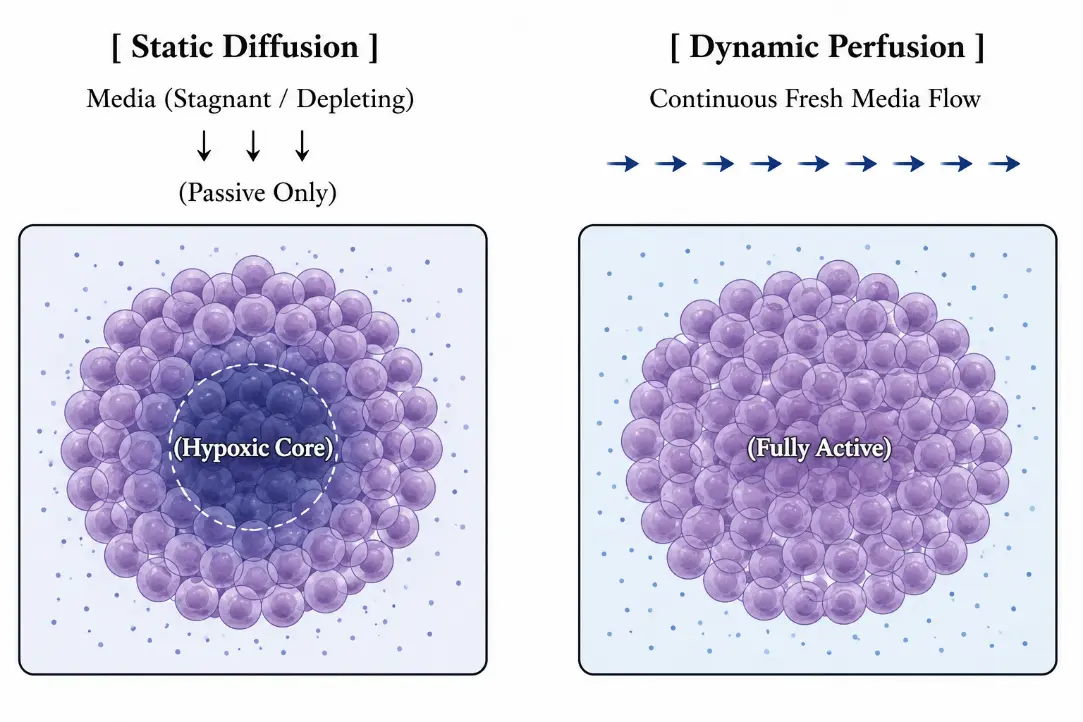
Passive diffusion in a static well plate is highly inefficient for dense, 3D structures.
- In Practice (Static): When a 3D spheroid or organoid exceeds a diameter of approximately 150-200 micrometers in static culture, a hypoxic core inevitably develops due to the inability of oxygen and nutrients to penetrate the center. This artificial necrosis can confound toxicity data.
- In Practice (Dynamic): Dynamic microfluidic perfusion forces media through or around the 3D architecture. This active perfusion maintains optimal oxygenation and nutrient gradients throughout the tissue, allowing for longer-term studies without artifactual cell death.
3. Real-Time Pharmacokinetics (PK) Modeling
In human clinical trials, cells are never exposed to a fixed concentration of a drug indefinitely; instead, concentration spikes post-dose (Cmax) and gradually decays based on metabolic clearance (t1/2).
- The Static Limitation: Static assays can only evaluate fixed drug concentrations over set intervals (e.g., 24 or 48 hours), making it impossible to evaluate time-dependent, concentration-varying cellular responses.
- The Dynamic Advantage: Microfluidic inputs can be precisely programmed to modulate drug concentrations over time. This capability allows researchers to map clinical dosing regimens directly onto in vitro human tissues, capturing dynamic efficacy and toxicity profiles before entering live subjects.
Head-to-Head Comparison for Preclinical Strategy
| Parameter | Static Models (Spheroids / Plates) | Dynamic Models (Microfluidic / Perfused) |
|---|---|---|
| Throughput Capacity | Ultra-High. Compatible with automated liquid handlers and 384-well formats. | Low to Moderate. Requires specialized fluidic hookups and instrumentation. |
| Nutrient & Waste Profile | Fluctuating. Nutrient levels deplete while toxins build up between media changes. | Constant. Homeostatic environment with steady nutrient replenishment. |
| Barrier Integrity (BBB, Gut) | Leaky / Immature. Lacks the mechanical stimuli required for physiological tightening. | Excellent. Shear stress promotes tight junction expression and native barrier resistance. |
| Multi-Organ Connectivity | Impossible. Interactions are restricted to static conditioned-media transfers. | Native Capability. Microfluidic circuits can connect downstream tissue compartments (e.g., Gut-to-Liver). |
Strategic Pipeline Architecture: When to Use Which?
The most cost-effective and translationally sound preclinical pipelines do not view static and dynamic models as competitors; rather, they deploy them as sequential gatekeepers to de-risk assets.
Step 1: Early Discovery via High-Throughput Static Models
During target validation and primary hit-to-lead screens, scale is paramount. Static 3D spheroids or standard organoids cultured in high-density plates allow automated systems to screen thousands of compounds efficiently. At this stage, capturing broad biological reactivity takes precedence over microenvironmental perfection.
Step 2: Advanced Validation via Predictive Dynamic Models
Once a library of thousands is narrowed down to a handful of high-potential lead compounds, the strategy must shift from throughput to predictive precision. Transitioning these select assets into dynamic microfluidic or organ-on-chip systems allows developers to rigorously validate human-specific safety, cross-barrier transport, and dynamic metabolic clearance.
Empowering Translation Through Expert CRO Partnership
Implementing sophisticated dynamic platforms involves a steep learning curve, specialized engineering infrastructure, and validated standard operating procedures. As a dedicated preclinical Contract Research Organization (CRO), our role is to demystify micro-physiological systems and make dynamic modeling fully accessible for your pipeline.
Our laboratory capabilities span both high-throughput static screenings and high-fidelity dynamic fluidic assays. Whether you need a high-volume static organoid panel to run initial compound efficacy or a multi-organ dynamic perfusion system to capture precise human metabolic safety profiles, our scientific team designs and executes regulatory-grade studies customized to your timelines.
Creative Bioarray Relevant Recommendations
| Products & Services | Description |
|---|---|
| Primary Cells | We provide direct access to over 2,500 individual lots of high-quality human and animal primary cells. |
| 3D Spheroid Platform for Drug Development | Creative Bioarray provides advanced 3D spheroid models designed for researchers aiming to explore cell behavior in a more realistic environment. |
| Organoid Platform for Drug Development | Creative Bioarray presents a state-of-the-art Organoid Platform designed to transform drug development and biomedical research. By leveraging advanced organoid and organoid-immune co-culture models, this platform provides highly accurate and predictive solutions that closely replicate human biology. |
| Organ-on-a-Chip Platform for Drug Development | Creative Bioarray focuses on developing specific human disease models and leveraging our organ-on-a-chip platform to identify new therapeutics and clinical biomarkers, promote drug development, and create novel drug delivery systems. |