Cell-based LNP Evaluation
- Capabilities
- Workflow
- Applications
- Features
- FAQ
- Explore Other Options
Lipid nanoparticles (LNPs) have emerged as the leading non-viral delivery platform for mRNA, siRNA, gene-editing systems, and other nucleic acid therapeutics. Successful LNP development, however, is not just about particle characterization, but also about effective cellular uptake, intracellular trafficking, endosomal escape, activity of the payload and suitable safety profile. Creative Bioarray offers complete cell-based LNP screening and evaluation services to help you optimize formulations, select lead candidates and advance preclinical development. Using a variety of cellular models and quantitative analytical methodologies, we evaluate the biological performance of LNP formulations and deliver actionable insights to improve delivery systems.
Our Cell-Based LNP Evaluation Capabilities

Cellular Uptake Analysis
Quantitative and imaging‑based evaluation of LNP internalization.
Available methods
- Flow cytometry
- Fluorescence microscopy
- Confocal microscopy
- High-content imaging

Intracellular Trafficking and Endosomal Escape
Assessment of intracellular transport, endosomal localization, membrane fusion, and cytoplasmic cargo release after uptake.
Available methods
- Endosome/ lysosome co-localization studies
- Intracellular trafficking analysis
- Membrane fusion assays
- Galectin-based endosomal escape assays

Cytotoxicity & Cell Health Assessment
Evaluation of cell viability, metabolism, membrane integrity, and stress responses upon LNP exposure.
Assessment categories
- Cell viability
- Cell proliferation
- Membrane integrity
- Mitochondrial function
- Oxidative stress
- Apoptosis
Payload Functional Activity
Assess the biological activity of nucleic acid cargos following intracellular delivery.
| Payload Type | Typical Assays | Typical Readouts |
| mRNA / saRNA |
|
|
| siRNA / miRNA / ASO |
|
|
| Genome Editing Assessment |
|
|
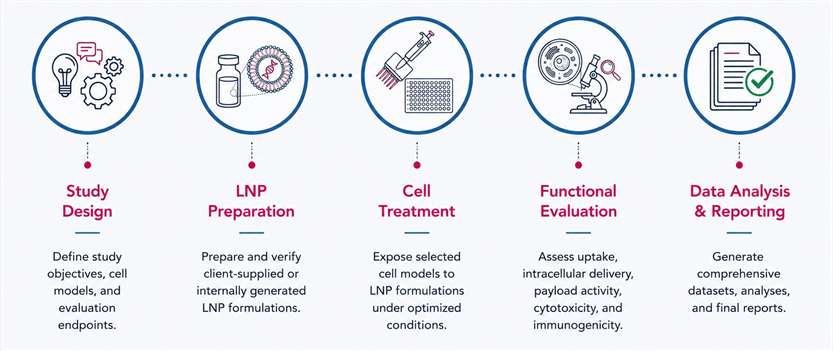
Typical Workflow
Research Applications
- LNP Formulation Optimization
Compare multiple formulations to identify candidates with improved delivery performance and safety profiles.
- mRNA Therapeutics Development
Evaluate intracellular delivery and protein expression of mRNA- and saRNA-based therapeutics.
- RNA Interference Research
Assess target gene silencing efficiency of siRNA-, miRNA-, and ASO-loaded LNPs.
- Gene Editing Delivery Development
Support optimization of CRISPR and other genome-editing delivery platforms.
- Delivery Technology Development
Evaluate novel lipids, targeting ligands, and next-generation nanoparticle systems.
Why Choose Creative Bioarray

Diverse Cell Models
Established cell lines, primary cells, immune cells, and iPSC-derived models.

Comprehensive Functional Readouts
From cellular uptake and endosomal escape to payload activity and safety evaluation.

Flexible Study Design
Customized workflows tailored to different payloads and development goals.

Experienced Scientific Support
Dedicated support from study design through data interpretation.
FAQs
What types of LNP formulations can be evaluated?
We support a wide range of LNP formulations for delivery of mRNA, saRNA, siRNA, miRNA, ASO and plasmid DNA.
Is it possible to compare several LNP formulations inside one study?
Yes. Screening of parallel formulations is frequently carried out to discover alternatives with improved absorption, delivery efficiency and functional activity.
Do you provide endosomal escape evaluations?
Sure. We provide several approaches to quantify intracellular trafficking and endosomal escape, including co-localization experiments and galectin recruitment assays.
Can client-supplied LNP samples be tested?
Yes. We routinely test formulations provided by our clients and we can develop unique studies to suit the needs of the project.
What cell models are there?
We provide established cell lines, primary cells, immune cells and iPSC-derived cell models. More models can be added on request.
Explore Other Options