3D Spheroid Tumor Cell Panel Screening
- Platform
- Applications
- Workflow
- Features
- FAQ
- Explore Other Options
Our 3D spheroid tumor cell panel screening service provides a physiologically relevant platform for evaluating anticancer compounds across a diverse panel of tumor models. Using standardized spheroid culture, high-throughput screening workflows, and multiple analytical endpoints, the platform supports lead identification, candidate selection, mechanism studies, and combination therapy evaluation during oncology drug development.
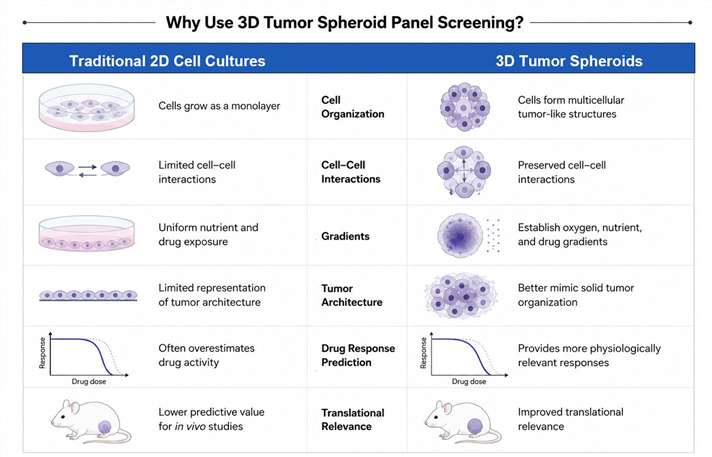
Our 3D Tumor Spheroid Screening Platform

Standardized Spheroid Generation
We generate uniform tumor spheroids under optimized, screening‑ready culture conditions.
Capabilities include:
- Ultra-low attachment (ULA) culture systems
- Scaffold-free spheroid formation
- Consistent spheroid size and morphology
- Adaptable protocols for different tumor cell types

Broad Tumor Cell Panel
Our screening platform includes more than 50 tumor cell lines representing common solid tumor indications.
Representative Tumor Types
- Lung Cancer
- Breast Cancer
- Colorectal Cancer
- Pancreatic Cancer
- Ovarian Cancer
- Gastric Cancer
- Liver Cancer
- Glioblastoma
- Melanoma
(and additional models available upon request)

High-Throughput Screening Capability
We support flexible study designs ranging from focused compound evaluation to larger screening campaigns.
Available Formats
- 96-well and 384-well assays
- Single-agent studies
- Dose-response analysis
- Combination therapy studies
- Multi-cell-line panel screening

Multiparametric Analysis
Multiple endpoints can be incorporated to characterize compound activity and treatment response.
Available Assessments
- Cell viability and growth inhibition
- Spheroid morphology analysis
- Apoptosis assessment
- Drug penetration evaluation
- High-content imaging analysis
Assay Readouts & Endpoints
Viability & Growth Inhibition
- ATP-based viability assays
- IC50 and EC50 determination
- Growth inhibition analysis
High-Content Imaging
- Spheroid size and morphology
- Structural integrity
- Treatment-induced phenotypic changes
Mechanistic Analysis
- Apoptosis
- Proliferation
- Cell cycle and other project-specific biomarkers
Drug Penetration Assessment
- Penetration depth
- Distribution patterns within spheroids
- Evaluation of antibodies, ADCs, and nanoparticle-based therapeutics
Therapeutic Modalities We Support
- Small Molecules
- Monoclonal Antibodies
- Antibody-Drug Conjugates (ADCs)
- Bispecific Antibodies
- Targeted Protein Degraders
- Nanomedicine Platforms
Applications
Lead Identification & Optimization
Evaluate and prioritize compounds across multiple tumor models during early discovery.
Candidate Selection
Generate comparative efficacy data to support preclinical decision-making.
Mechanism-of-Action Studies
Investigate biological responses associated with therapeutic intervention.
Combination Therapy Evaluation
Assess interactions between therapeutic agents in a physiologically relevant 3D model.
Translational Oncology Research
Bridge conventional in vitro studies and downstream in vivo evaluation.
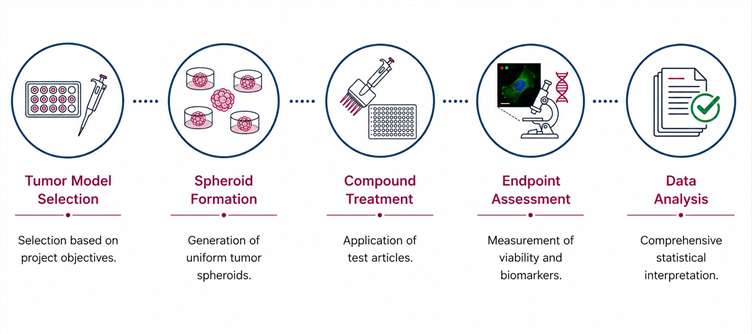
Our Screening Workflow
Why Choose Us

Diverse Tumor Model Resources
More than 50 tumor cell lines covering major solid tumor indications.

Flexible Study Design
Support for customized screening strategies, endpoints, and treatment regimens.

Multiple Readout Options
Integration of viability, imaging, mechanistic, and penetration analyses.

High-Throughput Capability
Efficient screening across multiple compounds, doses, and tumor models.

Dedicated Scientific Support
End‑to‑end project consultation, assay development, and data interpretation.
FAQ
What tumor cell lines are available?
We offer a panel of more than 50 tumor cell lines covering a broad range of solid tumor indications.
Can customer-provided cell lines be used?
Yes. Customer-supplied cell lines can be incorporated following feasibility assessment.
What endpoints can be measured?
Common endpoints include viability, growth inhibition, morphology, apoptosis, and drug penetration.
Can combination therapies be evaluated?
Yes. Combination treatment studies can be designed based on project requirements.
What deliverables are included?
Deliverables typically include raw data, analyzed results, representative images, and a final study report.
Explore Other Options