
Non-Plateable Human Hepatocytes
Cat.No.: CSC-7668W
Species: Human
Source: Liver
Cell Type: Hepatocyte
- Specification
- Background
- Scientific Data
- Q & A
- Customer Review
Human Hepatocytes (Non-Plateable) are cryopreserved primary human liver cells with limited or no attachment potential under normal culture conditions. These cells are usually maintained in suspension and have no use for long-term monolayer culture, unlike plateable hepatocytes, but are used generally for short-term in vitro applications. Although adhesion properties are reduced, non-plateable hepatocytes retain important hepatic metabolic functions, including cytochrome P450 (CYP) enzyme activity, transporter function, and phase I/II drug metabolism capacity.
These hepatocytes are frequently used in pharmaceutical and toxicological research for studies of drug metabolism, identification of metabolites, CYP inhibition and induction assays, screening for hepatotoxicity, and evaluation of drug-drug interactions. Non-plateable hepatocytes provide a convenient and efficient platform for high-throughput ADME and pharmacokinetic studies as they can be rapidly thawed and used directly in suspension-based assays. Modification of extracellular matrix and regulation of signaling pathways have been the focus of recent studies to enhance viability, recovery following cryopreservation, and attachment efficiency of non-plateable hepatocytes. Non-Plateable Human Hepatocytes are an invaluable resource for short-term functional liver assays and pre-clinical drug development pipelines, but are unsuitable for long-term hepatic differentiation or tissue engineering studies.
Fmoc-FF/RGD Supports Hepatocyte Survival and Functionality
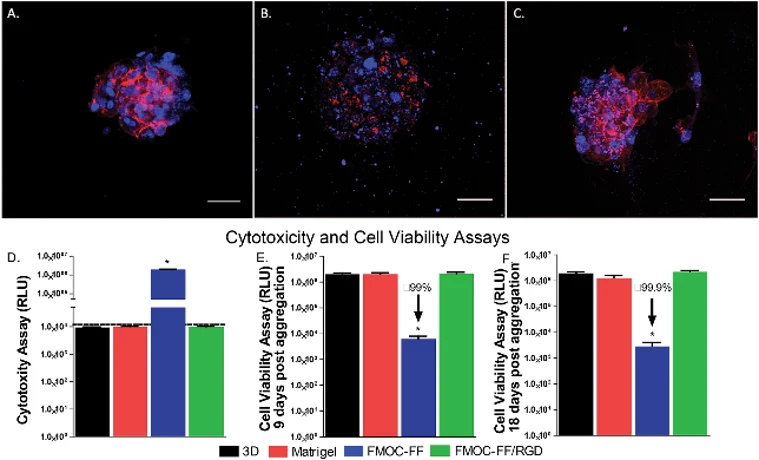
Macpherson et al. evaluated a nanofibrous Fmoc-FF/RGD hydrogel as a 3D scaffold for primary human hepatocyte culture, comparing it against Matrigel (positive control), Fmoc-FF-only hydrogels (negative control), and standard 3D aggregates.
Actin phalloidin and DAPI staining on day 0 revealed that Fmoc-FF/RGD supported hepatocyte morphology and survival comparably to Matrigel, whereas Fmoc-FF hydrogels showed significantly reduced actin signal, fragmented nuclei, and cellular debris (Fig. 1A-C). Cytotoxicity assays confirmed these findings, showing significantly elevated LDH release in Fmoc-FF cultures compared to the low background levels observed in Fmoc-FF/RGD, Matrigel, and 3D aggregate controls (Fig. 1D). Long-term viability assays further demonstrated that Fmoc-FF/RGD maintained hepatocyte viability for up to 18 days, whereas Fmoc-FF hydrogels failed to support cell survival (Fig. 1E, F). These data indicate that RGD functionalization is essential for the biocompatibility of the hydrogel scaffold.
Ask a Question
Write your own review
Description: The liver fulfills many vital processes in mammals. It is the central organ of energy metabolism, biotransformation of xenobiotics, and synthesis of plasma proteins under physiological and ...
Description: Recent research indicates cancer associated fibroblasts (CAFs) significant involvement in crucial aspects of epithelial solid tumor biology, specifically neoplastic progression, tumor growth, ...
Description: Fetal liver is dissociated in an asceptic manner, followed by density separation to enrich the mononuclear cells. The enriched cells are frozen using our optimized cryopreservation medium. Fetal ...
Description: Fetal liver is dissociated in an asceptic manner, followed by density separation to enrich the mononuclear cells. The enriched cells are frozen using our optimized cryopreservation medium. Fetal ...
Description: Human Liver Carcinoma Epithelial Cells from Creative Bioarray are isolated from human liver tumor tissue. Human Liver Carcinoma Epithelial Cells are grown in T25 tissue culture flasks pre-coated with ...
Description: Endothelial cells play multiple physiological functions and are central to many pathological processes. The liver contains two distinct endothelial cell types: vascular and sinusoidal. Sinusoidal ...