
- Specification
- Background
- Scientific Data
- Q & A
- Customer Review
Bovine Kidney Cells, fetal (also Fetal Bovine Kidney Cells, FBK) are kidney-derived primary cells harvested directly from the kidneys of healthy bovine fetuses. These cells are generally polygonal and demonstrate epithelial-like morphology when cultured as adherent monolayers under normal cell culture conditions (37 °C, 5% CO2). Like other primary cells, they retain much of their physiology from the tissue of origin including metabolic activities and viral host permissiveness. They are often used in veterinary virus studies to isolate and propagate various bovine viruses such as bovine viral diarrhea virus (BVDV) and foot-and-mouth disease virus (FMDV). They are also a common substrate for vaccine production and research into renal cell biology, drug metabolism, and cytotoxicity studies. Generally considered to have a short lifespan in vitro, these cells are often used for short-term applications due to the high degree of physiological relevance they provide. Immortalized derivatives of these cells (often through transfection with SV40 T-antigen or hTERT) are available for long-term propagation.
3A-Chimeric Virus Exhibited Pathogenic Ability in Natural Host Cells
The non-structural protein 3A of foot-and-mouth disease virus (FMDV) is critical for viral replication, virulence, and host range. Previously, genomic changes in the 3A gene were identified between the attenuated ZBatt strain and its parental virulent strain during attenuation. Gao's team investigated how 3A protein changes affect replication and infection of the rabbit-attenuated ZBatt virus.
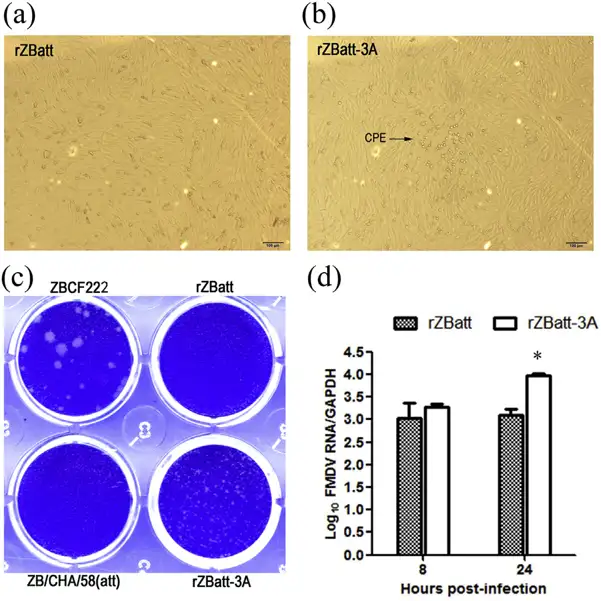
A chimeric virus, rZBatt-3A, was constructed by introducing the 3A gene from virulent ZB virus into the attenuated ZB vaccine strain, and its biological characteristics were compared with the parental rZBatt virus. To compare pathogenicity, rZBatt-3A and rZBatt were infected in primary fetal bovine kidney (BK) cells. rZBatt-3A replicated and induced cytopathic effects (CPEs), whereas rZBatt did not (Fig. 1a). Plaque assays showed rZBatt-3A formed observable plaques similar to virulent ZBCF222, though smaller, while rZBatt produced no plaques (Fig. 1b). RT-qPCR at 8 and 24 hpi showed stable viral RNA for rZBatt, but significantly increased RNA copies for rZBatt-3A at 24 hpi (P < .05). These results demonstrate that 3A substitution rescued pathogenic ability, enabling CPE induction, plaque formation, and enhanced viral RNA synthesis in natural host cells.
Ask a Question
Write your own review
Description: The Bovine Brain Microvascular Endothelial Cell System is a model of the Blood Brain Barrier. The system is designed to significantly improve a researcher's ability to study active and passive ...
Description: Glutaraldehyde stabilized red blood cells are produced from freshly washed bovine RBCs by brief exposure to a glutaraldehyde-buffer solution and exhaustive washing in saline. This treatment largely ...
Description: Bovine Parathyroid Gland Cells from Creative Bioarray are isolated from the bovine parathyroid tissue. The method we use to isolate bovine parathyroid gland cells was developed based on a combination ...
Description: Bovine muscle-derived fibro-adipogenic progenitor cells from Creative Bioarray are isolated from muscle of bovine. Bovine muscle-derived fibro-adipogenic progenitor cells are grown in a T25 tissue ...
Description: Bovine Lung Cells, fetal are isolated from lung tissue of a bovine fetus. It is often used as a model to study various bovine respiratory viruses including bovine parainfluenza virus, bovine viral ...
Description: Bovine lung fibroblasts from Creative Bioarray are isolated from the bovine lung tissue. The method we use to isolate bovine lung fibroblasts were developed based on a combination of established and ...