
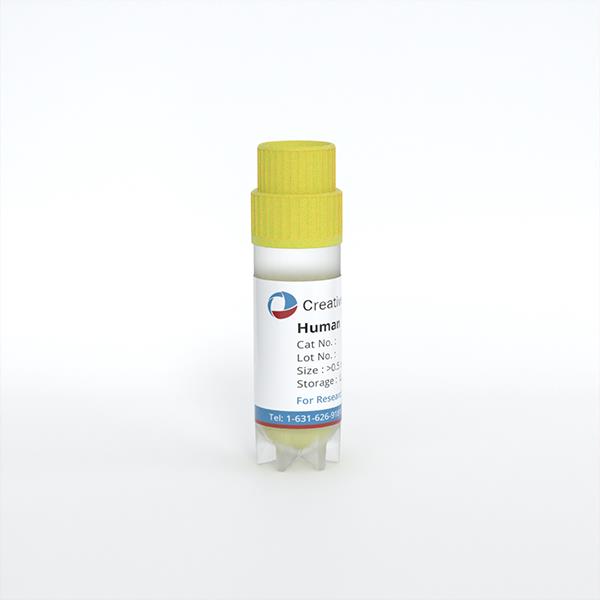
Human Bone Marrow Mononuclear Cells-CML+
Cat.No.: CSC-C8143L
Species: Human
Source: Bone Marrow
Cell Type: Mononuclear Cell
- Specification
- Background
- Scientific Data
- Q & A
- Customer Review
Desease: chronic myeloid leukemia, Philadelphia positive (CML(+))
Application: These cells can be used to investigate stem cell properties in tissue engineering, regenerative medicine, and developmental studies.
Human Bone Marrow Mononuclear Cells-CML+ are primary mononuclear cells isolated from the bone marrow of patients with chronic myeloid leukaemia (CML) known to carry the Philadelphia chromosome and the characteristic BCR-ABL1 fusion gene. These heterogeneous cell populations include leukemic stem cells (LSCs), progenitor cells, lymphocytes, monocytes and other bone marrow-derived immune cells. These cells are a highly relevant ex vivo model for the study of CML pathogenesis and bone marrow microenvironment interactions. CML+ bone marrow mononuclear cells are commonly used for studies of leukemic stem cell biology, tyrosine kinase inhibitor (TKI) resistance, disease progression and molecular signaling pathways related to BCR-ABL activity. These primary cells retain patient specific genetic and phenotypic characteristics and provide a useful platform for the study of mechanisms of drug resistance, regulation of apoptosis, autophagy and cytokine mediated survival signaling.
Human Bone Marrow Mononuclear Cells-CML+ are also commonly utilized in studies on leukemia-stromal interactions, immune dysregulation and bone marrow niche remodeling. They are also used in translational research to evaluate novel targeted therapies, combination treatment strategies and personalized medicine approaches. The CML-derived bone marrow mononuclear cells are of clinical relevance and biological complexity, which makes them an important model for both basic leukaemia research and therapeutic development in haematological malignancies.
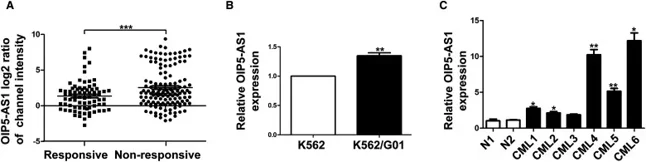
OIP5-AS1 was Highly Expressed in LSCs From CML Patients with Poor Response to TKI and K562/G01 Cells
Despite tyrosine kinase inhibitors (TKIs) transforming CML treatment, resistance-often linked to cytoprotective autophagy-remains a major challenge. While lncRNAs contribute to drug resistance, their role in modulating autophagy in CML is unclear. This study investigates how the lncRNA OIP5-AS1 influences autophagy and TKI resistance.
Analyzing single-cell sequencing data (GSE76312), they found that OIP5-AS1 expression was significantly higher in leukemic stem cells (LSCs) from TKI poor-responders (defined by failure to achieve MMR) compared to good-responders (Fig. 1A). This was validated by RT-qPCR, which showed elevated OIP5-AS1 levels in the imatinib-resistant K562/G01 cell line versus parental K562 cells (Fig. 1B). Furthermore, OIP5-AS1 expression was upregulated in bone marrow mononuclear cells (BMMNCs) from CML patients relative to normal controls (Fig. 1C). These data suggest a correlation between OIP5-AS1 and TKI resistance in CML.
Ask a Question
Write your own review
- You May Also Need
Description: Origin: HumanDesease: Pancytopenia (PCP)Application: These cells can be used to investigate stem cell properties in tissue engineering, regenerative medicine, and developmental studies.
Description: Origin: HumanDesease: Autoimmune Hemolytic Anemia (AHA)Application: These cells can be used to investigate stem cell properties in tissue engineering, regenerative medicine, and developmental studies.

Description: GFP Expressing Human Bone Marrow-Derived Endothelial Cells (GFP-HBMDECs) provided by Creative Bioarray are-puromycin selected from Human Bone Marrow-Derived Endothelial Cells infected with lentivirus ...
Description: Multiple Myeloma-Bone Marrow-Mononuclear Cells are isolated by diluting Multiple Myeloma-bone marrow with phosphate-buffered saline and using gradient separation. Multiple Myeloma Bone ...
Description: Human Bone Marrow-Derived Endothelial Cells from Creative Bioarray are isolated from human bone marrow tissue. Human Bone Marrow-Derived Endothelial Cells are grown in T25 tissue culture flasks ...
Description: Chronic Myeloid Leukemia-Bone Marrow-CD34+ Cells are isolated from the bone marrow using a direct CD34 MicroBead labeling system. Chronic Myeloid Leukemia-Bone Marrow-CD34+ Cells are available in the ...