
Normal Human Bronchial/Tracheal Epithelial Cells
Cat.No.: CSC-C4125X
Species: Human
Source: Bronchus; Trachea
Cell Type: Epithelial Cell
- Specification
- Background
- Scientific Data
- Q & A
- Customer Review
Cell Features:
HBTEC are cryopreserved as primary cells. Cells are isolated from human bronchi/trachea and expanded once in culture vessels before being harvested for cryopreservation.
HSAEC are cryopreserved after primary cells are isolated from human lung tissue and expanded once in culture vessels before being harvested for cryopreservation.
Creative Bioarray's Human Airway Epithelial Cells are not exposed to retinoic acid during isolation or expansion.
Human Airway Epithelial Cells are extensively tested for quality and optimal performance.
Creative Bioarray guarantees performance and quality.
Normal Human Bronchial/Tracheal Epithelial Cells (NHBE cells), are primary epithelial cells derived from bronchial or tracheal epithelium obtained from healthy human donors. NHBE cells are the predominant structural and functional cell type lining the conducting airways. They serve as an established in vitro model of human respiratory epithelium.
Bronchial and tracheal epithelial cells line the conducting airways in vivo and provide a physical and immunologic barrier against airborne particles, pathogens and pollutants. They participate in mucociliary clearance and innate immune defense via secretion of cytokines, chemokines and antimicrobial peptides.
NHBE cells express this same diverse mucosal immune phenotype in vitro when polarized under defined conditions including differentiation at an air-liquid interface (ALI) to form a pseudostratified epithelium with ciliated, goblet and basal cells.
Typical applications include: (a) Airway inflammation / cytokine secretion; (b) Infection studies (viruses including influenza virus, respiratory syncytial virus, bacteria, etc.); (c) Toxicology / inhalation exposure (cigarette smoke, particulate matter, etc.); (d) Asthma/COPD-related studies; (e) Drug transport studies.
ModA2 Regulates Adherence of NTHi to Mucus
Non-typeable Haemophilus influenzae (NTHi) adherence to airway epithelium initiates colonization and disease. The ModA phasevarion regulates virulence, but its role in adherence regulation remains unclear. Garai et al. investigated how ModA phasevarions control NTHi adherence to specific host airway substrates.
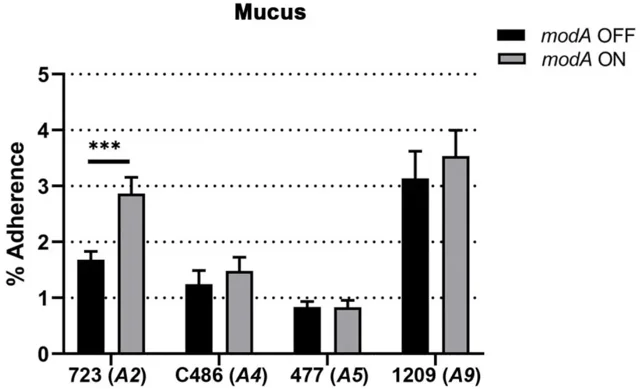
Nontypeable Haemophilus influenzae (NTHi) clinical strains 723 (modA2), C486 (modA4), 477 (modA5), and 1209 (modA9) were selected to represent distinct phasevarions. Mucus adherence is crucial for NTHi colonization and pathogenesis in the respiratory tract. Using mucus from differentiated normal human primary bronchial-tracheal epithelial cells (nhPBTEs) grown at air-liquid interface, they assessed modA variant adherence. The modA2 ON variant of strain 723 adhered significantly more than modA2 OFF (Fig. 1), while no significant differences were observed between modA variants of strains C486, 477, or 1209. Strain 477 showed lowest and 1209 highest overall adherence regardless of modA status. Thus, ModA2 specifically regulates NTHi mucus adherence, indicating an important role for the ModA2 phasevarion in airway epithelial colonization.
Our Bronchial/Tracheal Epithelial Cells are also available from Air-Liquid Interface pre-screened, Hypertension, and COPD/Asthma donors.
Creative Bioarray’s Bronchial/Tracheal Epithelial Cells are isolated from the epithelial cells that line the airway of the bifurcation of the lungs and small sections of the bronchia and trachea just off of the bifurcation.
Microbial infection and pathogenesis; airway inflammation and wound healing; asthma; pulmonary fibrosis, chronic obstructive pulmonary disease; chronic bronchitis; toxicology/other testing of pharmaceuticals.
Creative Bioarray has a range of bronchial epithelial cell media to choose from (SuperCult® Bronchial Epithelial Cell Growth Basal Medium, SuperCult® Bronchial Epithelial Cell Growth Meidum Supplement Kit, and SuperCult® Human Bronchial Epithelial Cell Growth Medium Kit).
Check all containers for leakage or breakage. Directly and immediately transfer the cells from dry ice to liquid nitrogen and keep the cells in liquid nitrogen until they are needed for experiments.
Ask a Question
Average Rating: 5.0 | 1 Scientist has reviewed this product
A good experience
The cells from Creative Bioarray were in great condition. The customer service was also excellent, with quick responses to any questions I had.
12 Oct 2023
Ease of use
After sales services
Value for money
Write your own review
Description: Human Bronchial Epithelial Cells are isolated from normal human bronchial tissue.
Description: The most abundant cell type in the bronchus is fibroblasts. They resemble a mesenchymal stem cell phenotype and their principle function is the production of type III collagen, elastin, and ...
Description: Human hypertension tracheal epithelial cells are isolated from the tracheal tissues of human donor that has been diagnosed with Hypertension. Human Hypertension Tracheal Epithelial Cells are grown in ...
Description: Human hypertension brochial smooth muscle cells are isolated from the Brochi of human donor that has been diagnosed with hypertension. Human hypertension brochial smooth muscle cells are grown in T25 ...
Description: The WI-38 human diploid cell line was derived by Leonard Hayflick from normal embryonic (3 months gestation) lung tissue.