
Human Dopaminergic Neuronal Precursor Cell
Cat.No.: CSC-C9341W
Species: Human
Source: Brain
Morphology: Multipolar
Cell Type: Neuron
- Specification
- Background
- Scientific Data
- Q & A
- Customer Review
Human Dopaminergic Neuronal Precursor Cells (hDNPs) are lineage-restricted neural progenitors that differentiate into dopamine-producing neurons of the midbrain. These cells are often derived from human pluripotent stem cells (hESCs or hiPSCs) or fetal neural tissues and represent an important intermediate stage between neural stem cells and mature dopaminergic neurons. hDNPs typically express early neuronal and dopaminergic lineage markers, like Nestin, SOX2, LMX1A, FOXA2, and NURR1, and gradually gain the ability to express tyrosine hydroxylase (TH), the rate-limiting enzyme for dopamine synthesis.
Functionally, hDNPs exhibit high proliferative capacity and can be efficiently induced to differentiate into mature, electrically active dopaminergic neurons under defined culture conditions. Upon differentiation, these neurons exhibit characteristic morphology, elaborate complex neurites, and synthesize and release dopamine. hDNPs are widely used as in vitro models to study midbrain development, neuronal differentiation and dopaminergic lineage specification because of their developmental relevance. These cells are especially valuable for studying neurodegenerative diseases, like Parkinson's, where the loss of dopaminergic neurons is a key feature. They are also used in drug screening, neurotoxicity testing and cell replacement therapy research providing a promising platform for regenerative medicine and CNS drug discovery.
Uptake of LUHMES-Derived EVs by Astrocytes (ACs) and Microglia (MG)
Psychological stress and depression are linked to elevated interleukin-6 (IL-6), which modulates extracellular vesicle (EV) secretion. MicroRNAs (miRNAs) within EVs regulate gene expression in recipient cells upon endocytosis. Here, Nishi et al. investigated the effect of IL-6 on EVs secreted by the human dopaminergic neuronal precursor cell line (LUHMES cells).
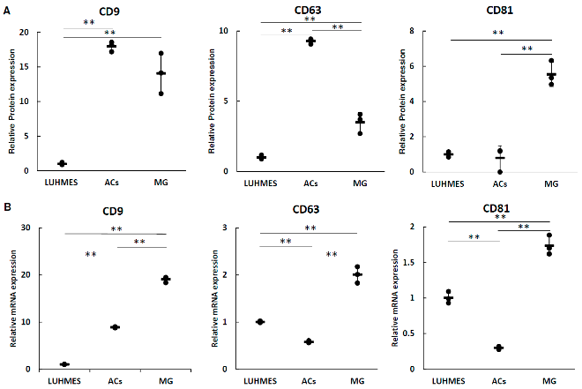
They first characterized EV markers by measuring tetraspanin proteins in media and mRNA levels in LUHMES, astrocytes (ACs), and microglia (MG) using ELISA (Fig. 1A) and real-time PCR (Fig. 1B). While all cells expressed the three tetraspanins, no correlation was found between protein levels in the medium and cellular mRNA expression.
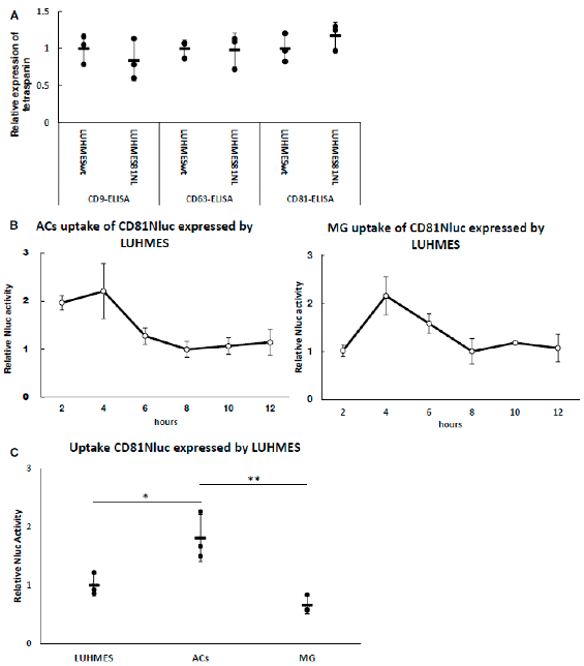
Next, they assessed EV uptake. Media from LUHMES cells expressing CD81-Nluc was applied to ACs and MG. Expression of CD81-Nluc did not alter endogenous tetraspanin levels in EVs (Fig. 2A), suggesting normal uptake kinetics. NanoLuc (Nluc) activity reflects the net balance of EV uptake, degradation, and recycling. Time-course analysis showed that Nluc activity in both ACs and MG peaked at 4 h and stabilized after 8 h (Fig. 2B), indicating an equilibrium state. Consequently, we compared EV uptake at the 8‑h time point. As shown in Figure 2C, ACs exhibited higher Nluc activity than MG, suggesting that astrocytes receive more EV-mediated signals from LUHMES cells than microglia.
Ask a Question
Write your own review
Description: Human dopaminergic neurons (HDNs) from Creative Bioarray are isolated from fetal brain tissue. The method we use to isolate endothelial cells was developed based on a combination of established and ...
Description: GFP Expressing Human Astrocytes (GFP-HAs) provided by Creative Bioarray are puromycin-selected from primary human astrocytes infected with lentivirus expressing GFP. GFP-HAs are negative for ...
Description: Human Neurons-hippocampal (HN-h) from Creative Bioarray are isolated from hippocampal tissue of the brain. HHN are cryopreserved at primary cultures and delivered frozen. Each vial contains >1 x 10^6 ...
Description: Human Astrocytes-midbrain (HA-mb) from Creative Bioarray are isolated from human midbrain (mesencephalon). HA-mb are cryopreserved at passage one and delivered frozen. Each vial contains >5 x 10^5 ...
Description: Human Schwann Cells (HSC) from Creative Bioarray are isolated from human spinal nerves. HSC are cryopreserved at passage one and delivered frozen. Each vial contains >5 x 10^5 cells in 1 ml volume. ...
Description: HN are isolated from the human brain. HN are cryopreserved at primary cultures and delivered frozen. Each vial contains >1 x 10^6 cells in 1 ml volume. HN are characterized by immunofluorescent ...