
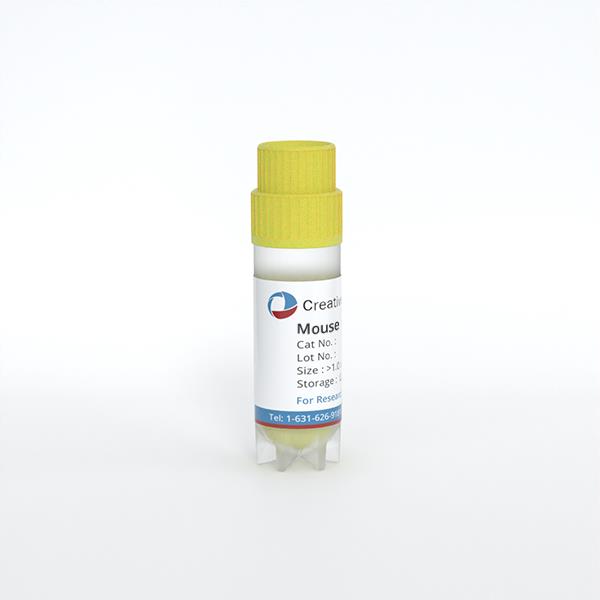
mouse cardiac fibroblasts
Cat.No.: CSC-C1850
Species: Mouse
Source: Heart
Cell Type: Fibroblast
- Specification
- Background
- Scientific Data
- Q & A
- Customer Review
MCF are isolated from postnatal day 2 C57BL/6 mouse heart. MCF are cryopreserved at P0 and delivered frozen. Each vial contains >5 x 10^5 cells in 1 ml volume. MCF are characterized by immunofluorescence with antibody specific to fibronectin. MCF are negative for mycoplasma, bacteria, yeast, and fungi. MCF are guaranteed to further expand for 5 population doublings under the conditions provided by Creative Bioarray.
Mouse cardiac fibroblasts (MCFs) represent the principal stromal cell type in the mammalian heart, constituting approximately 60-70% of all cardiac cells. These mesenchymal cells regulate extracellular matrix (ECM) turnover, maintain tissue homeostasis, and provide structural support for cardiomyocytes. Primary cultures are routinely identified by positive immunostaining for vimentin, discoidin domain receptor 2 (DDR2), and transcription factor 21 (TCF21). Upon passaging, MCFs undergo phenoconversion into myofibroblasts characterized by α-smooth muscle actin (αSMA)-positive stress fibers, necessitating the use of early-passage cells for physiological studies.
The primary advantage of MCFs lies in their high biological relevance. They preserve in vivo-like characteristics, including adrenergic receptor expression (β1 and β2 ARs) and TGF-β/Smad signaling responsiveness. This renders them superior to immortalized lines for studying fundamental mechanisms underlying cardiac fibrosis, myocardial injury repair, and pathological remodeling. MCFs are relatively easy to culture and genetically manipulate. Furthermore, the availability of genetically modified mouse strains enables lineage tracing and dissection of fibroblast-specific gene functions in health and disease. MCFs also serve as a robust platform for high-throughput drug screening and the development of anti-fibrotic therapeutic strategies. Despite their limited proliferation capacity and propensity for phenotypic drift, optimized culture conditions on elastic substrata can maintain quiescence for extended periods, making MCFs an indispensable ex vivo model for cardiovascular pathophysiology and translational research.
PFKM-Driven Lactate Overproduction Promotes Atrial Fibrillation via Triggering Cardiac Fibroblasts Histone Lactylation
Atrial fibrosis represents the fundamental pathological feature of the persistence of atrial fibrillation (AF) and has been recognized as the typical hallmark of AF. Atrial fibrosis is induced by activated cardiac fibroblasts (CF), targeting CF activation has emerged as a potential therapeutic target for AF. Recent studies have shown that histone lactylation drives fibrotic progression in pulmonary diseases and cancer by activating lung fibroblast and tumor-associated fibroblast proliferation. However, the role of histone lactylation in cardiac fibroblast activation in AF has not been investigated.
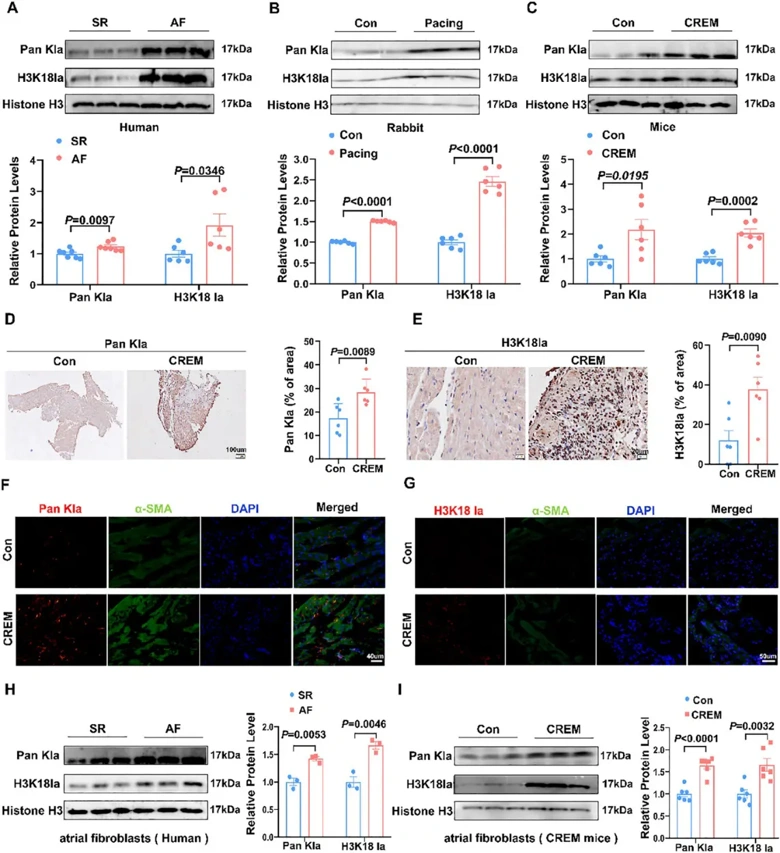
Western blot analysis revealed that global lactylation levels in atrial tissue from AF patients, rapid atrial pacing rabbits and 7-month-old CREM mice (a spontaneous AF mouse model) were significantly increased compared to the sinus rhythm control group. We subsequently examined histone H3K18 lactylation (H3K18la), which exhibited a similar trend to global lactylation levels (Fig. 1A-C). Immunohistochemical staining of atrium from 7-month-old CREM mice showed significantly increased levels of global lactylation and H3K18la (Fig. 1D,E). Interestingly, immunofluorescence staining of 7-month-old CREM atrial tissue showed that global lactylation and H3K18la were localized to the nuclear region of activated CF (Fig. 1F,G). We further validated the expression of global lactylation and H3K18la in atrial fibroblasts isolated from individuals with AF and 7-month-old CREM mice through western blot analysis, which demonstrated elevated levels of these proteins compared to the control groups (Fig. 1H,I). Additionally, the regulator effect of glycolysis on global lactylation and H3K18la levels in both atrial tissue and fibroblasts isolated from atrial tissue was confirmed by AAV-mediated overexpression and knockdown of atrial phosphofructokinase muscle type (PFKM), establishing a direct mechanistic link between metabolic remodeling and epigenetic in AF pathogenesis. Collectively, these data indicated that enhanced glycolysis promotes cardiac fibroblasts histone lactylation in the atrium.
Ask a Question
Write your own review
Description: C57BL/6-GFP Mouse Skeletal Muscle Microvascular Endothelial Cells from Creative Bioarray are isolated from C57BL/6-Tg (CAG-EGFP) 1Osb/J mouse skeletal muscle tissue of pathogen-free laboratory mice. ...
Description: eNOS KO Mouse Stomach Epithelial Cells from Creative Bioarray are isolated from stomach tissue of pathogen-free laboratory mice. eNOS KO Mouse Stomach Epithelial Cells are grown in a T25 tissue ...
Description: eNOS KO Mouse Liver Fibroblasts from Creative Bioarray are isolated from liver tissue of pathogen-free laboratory mice. eNOS KO Mouse Liver Fibroblasts are grown in T75 tissue culture flasks ...
Description: C57BL/6-GFP Mouse Corneal Epithelial Cells from Creative Bioarray are isolated from C57BL/6-GFP-Tg(CAG-EGFP)1Osb/J mouse corneal tissue of pathogen-free laboratory mice. C57BL/6-GFP Mouse Corneal ...

Description: BALB/c Mouse Retinal Microvascular Endothelial Cells from Creative Bioarray are isolated from retinal tissue of pathogen-free laboratory mice. BALB/c Mouse Retinal Microvascular Endothelial Cells are ...