
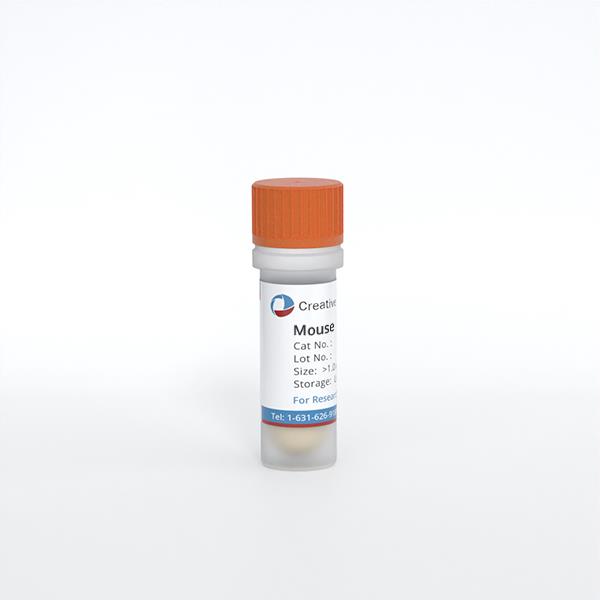
Mouse Tumor-Associated Endothelial Cells-CT26
Cat.No.: CSC-C8630W
Species: Mouse
Source: Colon; Intestine
Cell Type: Endothelial Cell
- Specification
- Background
- Scientific Data
- Q & A
- Customer Review
Mouse Tumor-Associated Endothelial Cells-CT26 are primary endothelial cells derived from CT26 murine colon cancer tumors. These cells are derived from the tumor vasculature and exhibit endothelial features related to the tumor microenvironment. In comparison to endothelial cells coming from normal tissues, tumor-associated endothelial cells may have different patterns of gene expression, cellular activity, and responsiveness to angiogenic stimuli.
Mouse Tumor-Associated Endothelial Cells-CT26 can be utilized to study biological processes in tumor angiogenesis, endothelial cell proliferation, migration and vascular remodeling. They are also useful for investigations investigating interactions between endothelial cells and tumor cells, immune cells, or extracellular matrix components inside the tumor microenvironment. In vitro uses include cell adhesion experiments, migration investigations, tube formation assays, trans-endothelial resistance assessments, and molecular studies of endothelial signaling pathways. These cells could be useful for studies on angiogenic signaling pathways such as VEGF-induced vascular responses, and for studies of tumor vascular function and endothelial activation.
Ultra-High Concentration Nitric Oxide Enhances PD-L1 Expression and Synergizes with Immune Checkpoint Blockade
Immune checkpoint inhibitors (ICIs) achieve durable responses in only a subset of patients. Building on prior work showing that ultra-high-concentration gaseous nitric oxide (UNO) stimulates antitumor immunity when combined with surgery, Confino et al. investigated whether UNO enhances the efficacy of PD-1 blockade.
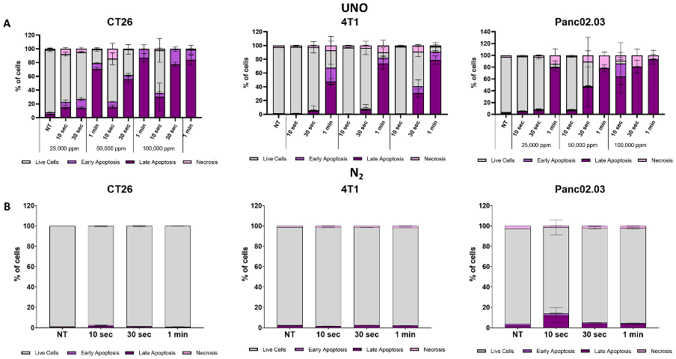
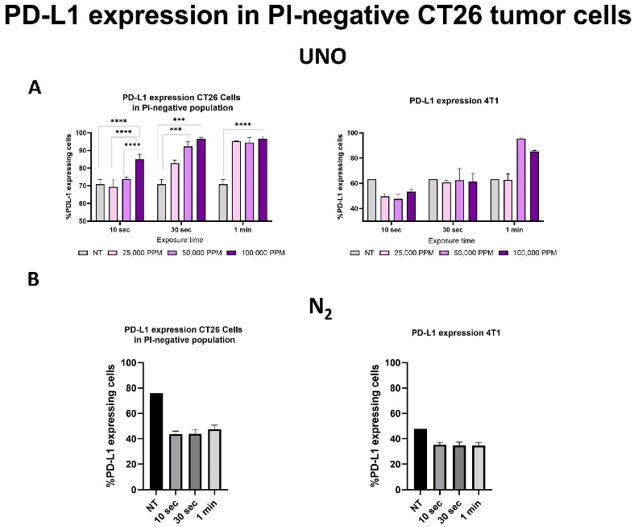
CT26 colorectal cancer cells were treated with 25,000-100,000 ppm UNO in vitro for 10-60 seconds. Annexin V/PI staining showed time- and dose-dependent apoptosis: 30 seconds of 100,000 ppm UNO caused near-complete cell death (99.6%), and 1 minute of exposure at all levels resulted in >79% apoptosis (Fig. 1A). Specificity was confirmed in that exposure to nitrogen gas had no effect (Fig. 1B). UNO treatment also upregulated PD-L1 expression on viable and early apoptotic cells. A 10-second exposure to 100,000 ppm UNO increased PD-L1 positivity from 70.9% to 85.1%; extending exposure to 30 seconds raised this to 96.7%, with lower concentrations also inducing significant upregulation (Fig. 2A). One-minute exposures at all doses maintained PD-L1 expression above 94%. Nitrogen exposure did not increase PD-L1 and instead reduced baseline levels (Fig. 2B). Similar effects were observed in 4T1 triple-negative breast cancer cells, albeit requiring higher UNO thresholds. These results reveal that short-term exposure to UNO preferentially kills tumor cells and up-regulates PD-L1 in surviving cells. That double whammy could turn immunologically "cold" cancers "hot," making them more vulnerable to PD-1 inhibitors. These findings, together with previously reported UNO-mediated increases in tumor-infiltrating T cells, dendritic cells, and B cells, suggest UNO as a potent adjuvant to boost ICI efficacy.
Ask a Question
Write your own review
Description: C57BL/6-GFP Mouse Skeletal Muscle Microvascular Endothelial Cells from Creative Bioarray are isolated from C57BL/6-Tg (CAG-EGFP) 1Osb/J mouse skeletal muscle tissue of pathogen-free laboratory mice. ...
Description: eNOS KO Mouse Stomach Epithelial Cells from Creative Bioarray are isolated from stomach tissue of pathogen-free laboratory mice. eNOS KO Mouse Stomach Epithelial Cells are grown in a T25 tissue ...
Description: eNOS KO Mouse Liver Fibroblasts from Creative Bioarray are isolated from liver tissue of pathogen-free laboratory mice. eNOS KO Mouse Liver Fibroblasts are grown in T75 tissue culture flasks ...
Description: C57BL/6-GFP Mouse Corneal Epithelial Cells from Creative Bioarray are isolated from C57BL/6-GFP-Tg(CAG-EGFP)1Osb/J mouse corneal tissue of pathogen-free laboratory mice. C57BL/6-GFP Mouse Corneal ...
Description: BALB/c Mouse Retinal Microvascular Endothelial Cells from Creative Bioarray are isolated from retinal tissue of pathogen-free laboratory mice. BALB/c Mouse Retinal Microvascular Endothelial Cells are ...