

Human Umbilical Cord Cells (Wharton's Jelly)
Cat.No.: CSC-C2860
Species: Human
Source: Umbilical Cord
- Specification
- Background
- Scientific Data
- Q & A
- Customer Review
Development period: Postnatal
Human Wharton's Jelly Mesenchymal Stem Cells (hWJ-MSCs) are derived from Wharton's Jelly, the gelatinous extracellular matrix found within the human umbilical cord. As fetal tissue obtained at birth, these perinatal stem cells have several advantages compared to adult-derived counterparts: they can be harvested non-invasively and without ethical concerns. Cells derived from this tissue are considered to be more primitive than adult-derived MSCs, giving them a higher proliferative ability along with lower immunogenicity and stronger secretome.
Similar to adult MSCs isolated from bone marrow and adipose tissue, hWJ-MSCs express mesenchymal markers (CD73, CD90, CD105) and lack expression of HLA class II, leading to low likelihood for rejection upon allogeneic transplantation. Numerous studies have shown that hWJ-MSCs possess powerful differentiation potential, particularly along chondrocytic and osteogenic lineages. Early studies into Wharton's Jelly focused on its ability to generate mesodermal tissue-types. However, the current literature highlights the major therapeutic effects of MSC administration as being paracrine-mediated. Along with expressing growth factors and cytokines, hWJ-MSCs secrete extracellular vesicles (exosomes) that have been shown to have immune-modulating, anti-inflammatory, antifibrotic, pro-angiogenic, and endogenous progenitor-cell activating effects.
In preclinical and clinical studies, hWJ-MSCs have shown promise in treating diseases affecting many tissues and organs. Major fields of study include osteoarthritis and other degenerative joint diseases, Graft-versus-Host Disease, wound healing, and neurologic disorders. Human WJ-MSCs possess a major advantage over other stem cells in safety due to their relative "immune-privileged" status. This allows for hWJ-MSCs to serve as an accessible, powerful tool in regenerative medicine.
Chondrogenic Differentiation of Human Wharton's Jelly of Umbilical Cord Derived Mesenchymal Stem Cells for Osteoarthritis Therapy
Osteoarthritis (OA) is a degenerative joint disease that commonly affects elderly or obese individuals. Treatment varies depending on severity and physician recommendation. Nadeem et al. aims to differentiate human Wharton's jelly-derived mesenchymal stem cells (hWJ-MSCs) into chondrocytes that could potentially be used for transplantation to treat OA.
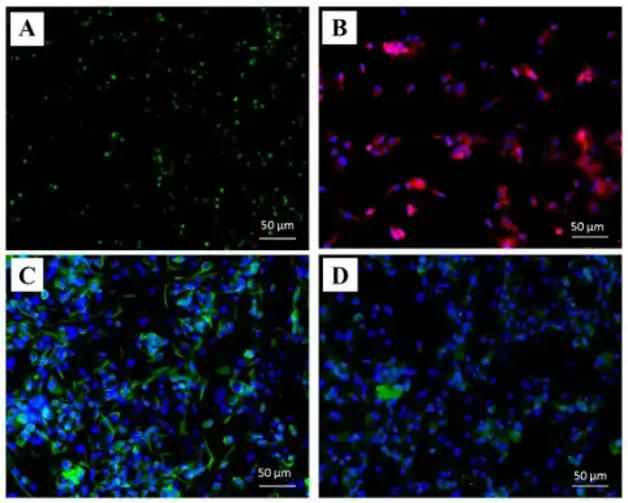
hWJ-MSCs were isolated by explant culture. Proliferation rate, phenotype, and differentiation potential of hWJ-MSCs were determined. Expression of Sox9 (early-stage chondrocyte marker) and Col2a1 (mature stage chondrocyte marker) were high while expression of ACAN (mature stage chondrocyte marker) and Col10a1 (hypertrophic stage chondrocyte marker) were low in hWJ-MSCs following 28 days of chondrogenic induction media (Fig. 1A-D).
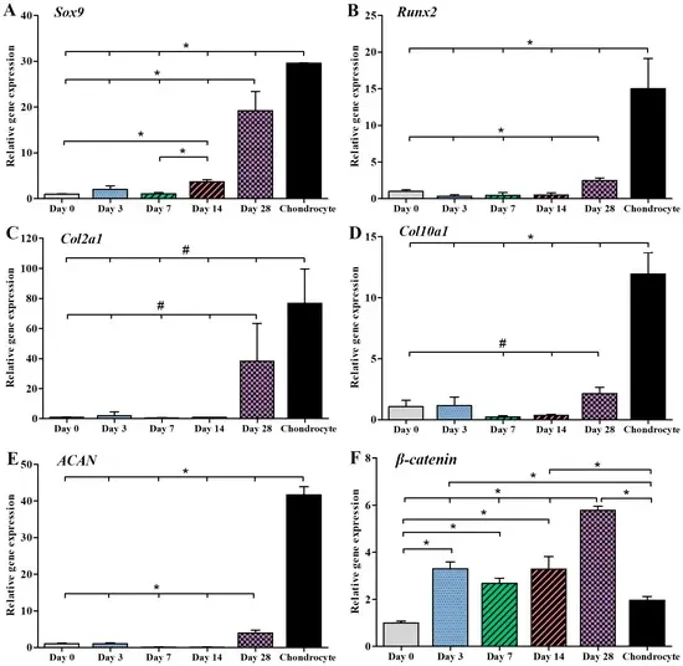
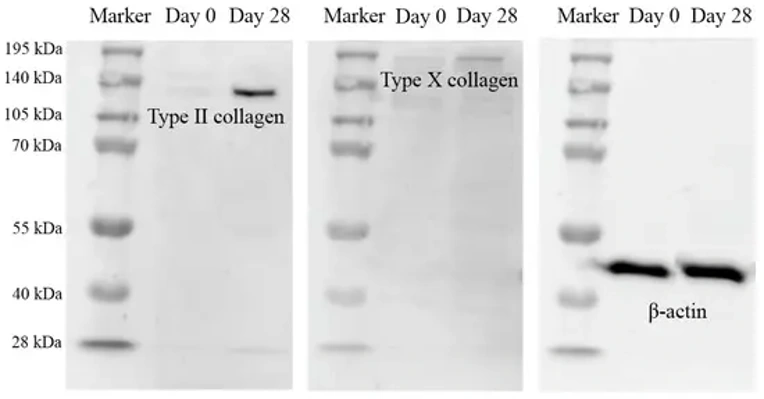
Gene expression over the course of differentiation (days 0, 3, 7, 14, 28) was compared to primary human knee chondrocytes serving as a positive control. Beta-catenin was significantly increased in day 28 samples compared to days 0-14 and positive control (Fig. 2). Sox9 expression was significantly higher at day 28 compared to days 0-14. Runx2 expression did not change significantly between days 3-14 however there was a significant increase in expression at day 28 compared to undifferentiated MSCs. This trend was similar for Col2a1, Col10a1, and ACAN however all remained significantly lower than the positive control. Immunoblot analysis showed that type II collagen protein was significantly increased in day-28 samples compared to undifferentiated MSCs while type X collagen protein remained low (Fig. 3).
Ask a Question
Write your own review

Description: GCaMP3 is a synthetic fusion of green fluorescent protein (GFP), calmodulin (CaM), and M13, a peptide sequence from myosin light-chain kinase. When bound to Ca2+, GCaMP3 fluoresces green with a peak ...
Description: Human Cord Blood Mononuclear Cells from Creative Bioarray are isolated from normal cord blood. The Mononuclear Cells are cryopreserved Immediately after isolation.Each cryo vial contains more than 25 ...
Description: RFP Expressing Human Umbilical Vein Endothelial Cells (RFP-HUVECs) provided by Creative Bioarray are Zeocin-selected from Human Umbilical Vein Endothelial Cells infected with lentivirus expressing ...

Description: Human umbilical cord veins are obtained from healthy donors. Each cord vein is individually processed (or pooled for mixed products) to isolate endothelial cells through collagenase digestion and ...
Description: Cord Blood-CD133+ Stem/Progenitor cells are positively isolated using a direct immunomagnetic CD133 MicroBead labeling system. The majority of CD133+ stem/progenitor cells express the CD34 cell ...
Description: Mitochondria GFP Tag Human Umbilical Vein Endothelial Cells (Mitochondria-GFP-HUVECs) provided by Creative Bioarray are puromycin-selected from Human Umbilical Vein Endothelial Cells infected with ...