
IGROV-1
Cat.No.: CSC-C7102J
Species: Homo sapiens (Human)
Source: Ovary
Morphology: Epithelial
Culture Properties: Adherent
- Specification
- Background
- Scientific Data
- Q & A
- Customer Review
The IGROV-1 cell line is a well-characterized human ovarian adenocarcinoma line, originally established in 1985 from a stage III solid primary tumor of a 47-year-old female patient with no prior chemotherapy treatment. It exhibits an epithelial morphology, adheres as a monolayer in culture, and possesses a doubling time of approximately 20 hours.
A key advantage of the IGROV-1 cell line lies in its distinctive genetic and mutational profile, which uniquely spans both Type I and Type II ovarian cancer signatures. It harbors heterozygous mutations in TP53, BRCA1, PTEN, PIK3CA and ARID1A, and is considered a likely representative of the Type II high-grade serous carcinoma (HGSC) with SET-like morphology. The line is also identified by specific cytogenetic markers, including a paracentric inversion of chromosome 3 and a translocation between chromosomes 2 and 5. Furthermore, it exhibits a hypermutation phenotype, making it an excellent model for genomic instability and DNA damage response research.
From a research application perspective, the IGROV-1 cell line is widely recognized as an established model for drug-resistant ovarian carcinoma. While it retains sensitivity to cisplatin, it demonstrates low to moderate resistance to various other chemotherapeutics, making it an ideal platform for investigating drug resistance mechanisms. Moreover, beyond oncology, it has emerged as a robust in vitro system for virology, with notable susceptibility to SARS-CoV-2 and the ability to mount innate immune responses.
Targeting Deubiquitinase USP14 to Circumvent Cisplatin Resistance in Ovarian Carcinoma
This study aims to investigate the biological role of the proteasome-associated deubiquitinase ubiquitin-specific protease 14 (USP14) in ovarian carcinoma drug resistance and to identify novel USP14 inhibitors (USP14i) for further preclinical development.
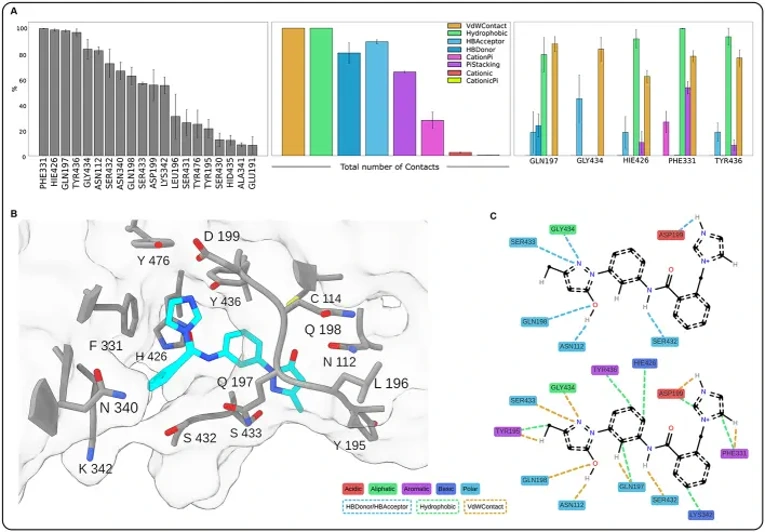
Functional studies, including gain- and loss-of-function assays, migration and invasion, and apoptosis induction assays, were conducted using cisplatin-sensitive IGROV-1 cells and their cisplatin-resistant derivative IGROV-1/Pt1. A library of 1,056 small molecules was screened using an optimized hydrolysis assay. Docking and molecular dynamics simulations were employed to predict binding modes of candidate inhibitors within the USP14 domain.
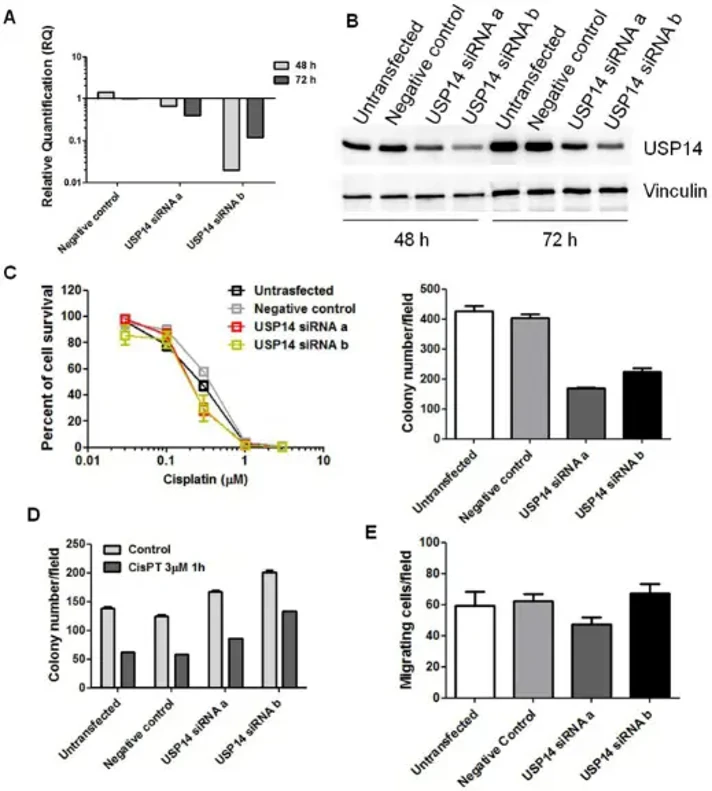
Exogenous overexpression of USP14 enhanced the survival of cisplatin-resistant IGROV-1/Pt1 cells, but not parental IGROV-1 cells, upon cisplatin exposure. USP14 knockdown by small interfering RNAs in resistant cells reduced aggressive features and restored cisplatin sensitivity, whereas no sensitization was observed in IGROV-1 cells. Medium-throughput screening identified five candidate molecules, among which ARN12502 showed the strongest inhibitory activity against USP14. ARN12502 exhibited an IC50 of 18.4 µM, and molecular dynamics simulations confirmed stable binding in two distinct modes.
Ask a Question
Write your own review
Description: The A2780 human ovarian cancer cell line was established from tumour tissue from an untreated patient. Cells grow as a monolayer and in suspension in spinner cultures. A2780 is the parent line to the ...
Description: Japanese ovarian serous adenocarcinoma. Said CA125 producing. Cell growth is slow.
Description: Established post-hysterectomy from the tumor tissue of a 65-year-old Japanese woman with malignant ovarian carcinoma (stage: FIGO IIIc; histology: poorly differentiated serous papillary ...
Description: Established from the ascitic fluid of a 56-year-old Caucasian woman with dedifferentiated serous cystadenocarcinoma of the ovary in 1979
- Adipose Tissue-Derived Stem Cells
- Human Neurons
- Mouse Probe
- Whole Chromosome Painting Probes
- Hepatic Cells
- Renal Cells
- In Vitro ADME Kits
- Tissue Microarray
- Tissue Blocks
- Tissue Sections
- FFPE Cell Pellet
- Probe
- Centromere Probes
- Telomere Probes
- Satellite Enumeration Probes
- Subtelomere Specific Probes
- Bacterial Probes
- ISH/FISH Probes
- Exosome Isolation Kit
- Human Adult Stem Cells
- Mouse Stem Cells
- iPSCs
- Mouse Embryonic Stem Cells
- iPSC Differentiation Kits
- Mesenchymal Stem Cells
- Immortalized Human Cells
- Immortalized Murine Cells
- Cell Immortalization Kit
- Adipose Cells
- Cardiac Cells
- Dermal Cells
- Epidermal Cells
- Peripheral Blood Mononuclear Cells
- Umbilical Cord Cells
- Monkey Primary Cells
- Mouse Primary Cells
- Breast Tumor Cells
- Colorectal Tumor Cells
- Esophageal Tumor Cells
- Lung Tumor Cells
- Leukemia/Lymphoma/Myeloma Cells
- Ovarian Tumor Cells
- Pancreatic Tumor Cells
- Mouse Tumor Cells