
HSC-5
Cat.No.: CSC-C6901J
Species: Homo sapiens (Human)
Source: Skin
Morphology: Epithelial-Like
- Specification
- Background
- Scientific Data
- Q & A
- Customer Review
The HSC-5 cell line is an essential human cell model derived from a cutaneous squamous cell carcinoma (cSCC), providing a highly relevant system for investigating the molecular drivers of skin malignancy, tumor invasion, and therapeutic resistance. As cSCC remains one of the most common and aggressive forms of skin cancer, HSC-5 serves as a critical in vitro tool for bridging the gap between basic oncogenic signaling and preclinical drug validation.
- Defined Carcinogenic Phenotype: HSC-5 cells retain the hallmarks of SCC, including abnormal epithelial architecture and dysregulated proliferation. This makes them a superior model for studying epidermal growth factor receptor (EGFR) signaling and the epithelial-mesenchymal transition (EMT) process.
- Robust Invasion and Metastasis Assays: Unlike primary keratinocytes, HSC-5 cells demonstrate high invasive potential in Matrigel-coated Boyden chamber assays, providing an ideal platform for screening compounds aimed at inhibiting metastatic dissemination and extracellular matrix degradation.
- Exceptional Genetic Manipulability: These cells are highly amenable to CRISPR/Cas9-mediated gene knockout and stable lentiviral transduction. Their plasticity allows researchers to generate reporter lines for monitoring kinase activity or evaluating the synergistic effects of combination therapies.
- High-Throughput Compatibility: Characterized by rapid and predictable growth kinetics in standard media, HSC-5 is well-suited for high-throughput pharmacological screenings, ensuring consistent and reproducible sensitivity profiles across multi-well formats.
By integrating the HSC-5 cell line into your oncology workflow, you leverage a well-authenticated, patient-derived model that captures the complexity of squamous cell carcinoma, accelerating your research from target discovery to preclinical success.
Novel Small Molecules KY19382 and KY19334 Inhibit the Migration, Invasion, Proliferation and Transformation of Human cSCC Cells
The Wnt/β-catenin pathway is an attractive target for drug development in various diseases; however, efforts to target it have been limited due to its concerning role in cancer. We previously developed KY19382 and KY19334, small molecules that inhibit the cytosolic function of CXXC-type zinc finger protein 5 (CXXC5), as safe therapeutic agents to restore the suppressed Wnt/β-catenin signaling in several intractable diseases, but the effects of these small molecules on cancer have not been determined.
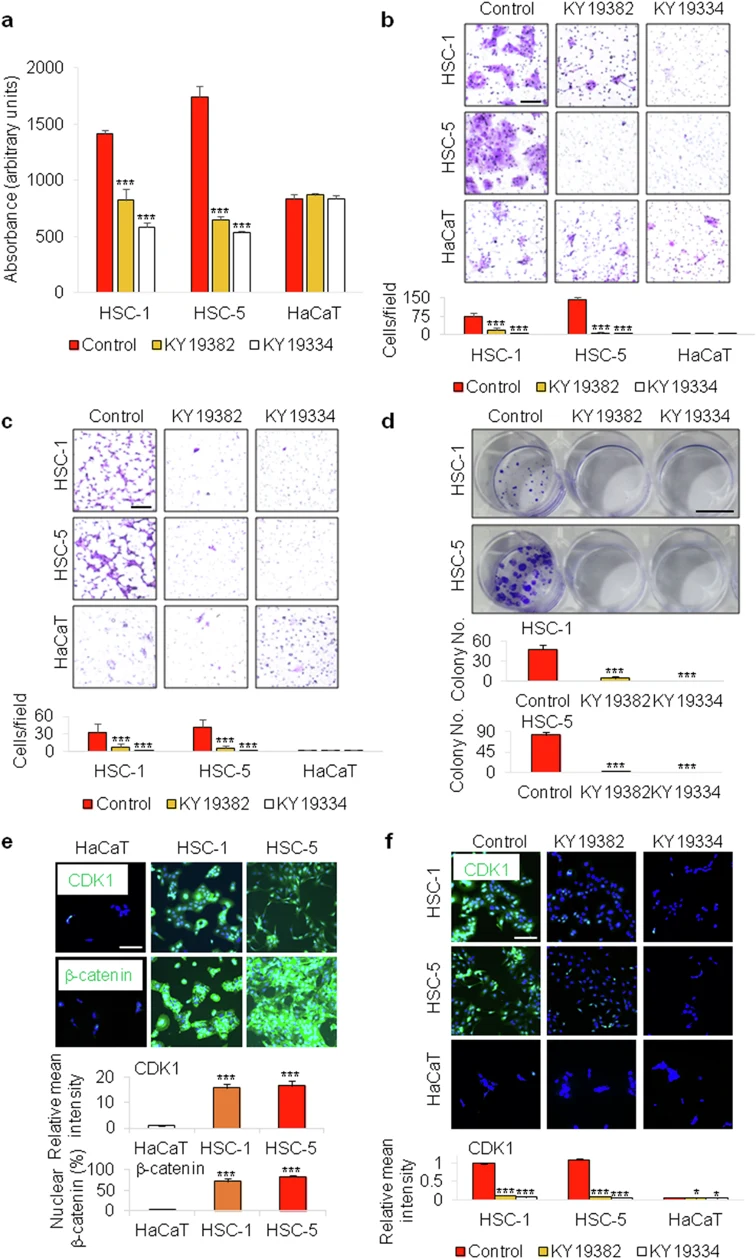
To investigate any effect of these compounds on cancer progression, we treated human cSCC cells with KY19382 or KY19334. HaCaT cell line was used as a control for normal keratinocytes. Intriguingly, KY19382 or KY19334 inhibited the proliferation of the two human cSCC cell lines (Fig. 1a). Boyden chamber assay using human cSCC cell lines and a normal keratinocyte cell line also revealed that these two compounds significantly inhibited migration and invasion of the two human cSCC cell lines (Fig. 1b, c). Likewise, KY19382 and KY19334 markedly inhibited the transformation of both HSC-1 and HSC-5 cells (Fig. 1d).
To better understand the inhibitory effects of these compounds on cancer progression, we next monitored the expression levels of cytosolic CXXC5 and CDK1, potential targets of these compounds, and their associated markers in human cSCC cell lines. Differently from normal HaCaT cells, the expression level of CXXC5, especially within the cytoplasm, was very low in both HSC-1 and HSC-5 cells, supporting that cytosolic CXXC5 is not a functional target of the compounds in cSCC cells. The expression of CDK1 was significantly increased in both HSC-1 and HSC-5 cells (Fig. 1e). KY19382 and KY19334 effectively downregulated CDK1 expression, particularly in two human cSCC cell lines (Fig. 1f). Overall, KY19382 and KY19334 inhibit cellular transformation of human cSCC cells, but not normal cells, with suppression of CDK1 expression.
Ask a Question
Write your own review
- You May Also Need
Description: Species: human - male, 60 years old, CaucasianTumorigenecity: Yes, in nude mice; forms malignant melanomaIsoenzyme: PGM3,1;PGM1,1;ES-D,1;AK-1,1;GLO-1,2;G6PD,BHistopathology: malignant melanoma; from ...
Description: Derived from a 14-18 week old human foetus. The cells support growth of CMV and HSV. This cell line has a finite life span.
Description: Species: human male 65 year old; Tissue: skin; Tumor: melanoma; Derived from: a lymph node metastasis
Description: Malignant trichilemmal cyst cells. Strongly laminin positive on cell surface. Serum-free culturable.
Description: Species: human, Caucasian male; Tissue: metastatic cutaneous nodule; Tumor: melanoma
Description: Species: human male; Tissue: subcutaneous metastasis; Tumor: malignant melanoma
- Adipose Tissue-Derived Stem Cells
- Human Neurons
- Mouse Probe
- Whole Chromosome Painting Probes
- Hepatic Cells
- Renal Cells
- In Vitro ADME Kits
- Tissue Microarray
- Tissue Blocks
- Tissue Sections
- FFPE Cell Pellet
- Probe
- Centromere Probes
- Telomere Probes
- Satellite Enumeration Probes
- Subtelomere Specific Probes
- Bacterial Probes
- ISH/FISH Probes
- Exosome Isolation Kit
- Human Adult Stem Cells
- Mouse Stem Cells
- iPSCs
- Mouse Embryonic Stem Cells
- iPSC Differentiation Kits
- Mesenchymal Stem Cells
- Immortalized Human Cells
- Immortalized Murine Cells
- Cell Immortalization Kit
- Adipose Cells
- Cardiac Cells
- Dermal Cells
- Epidermal Cells
- Peripheral Blood Mononuclear Cells
- Umbilical Cord Cells
- Monkey Primary Cells
- Mouse Primary Cells
- Breast Tumor Cells
- Colorectal Tumor Cells
- Esophageal Tumor Cells
- Lung Tumor Cells
- Leukemia/Lymphoma/Myeloma Cells
- Ovarian Tumor Cells
- Pancreatic Tumor Cells
- Mouse Tumor Cells