
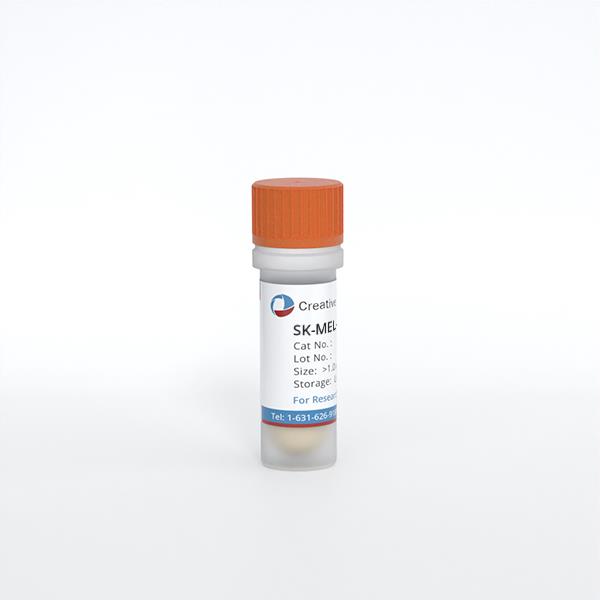
SK-MEL-2
Cat.No.: CSC-C9605L
Species: Homo sapiens (Human)
Source: Skin
Morphology: polygonal
Culture Properties: monolayer
- Specification
- Background
- Scientific Data
- Q & A
- Customer Review
Tumorigenecity: Yes, in nude mice; forms malignant melanoma
Isoenzyme: PGM3,1;PGM1,1;ES-D,1;AK-1,1;GLO-1,2;G6PD,B
Histopathology: malignant melanoma; from metastatic site
vWA:
FGA:
Amelogenin:
TH01:
TPOX:
CSF1P0:
D5S818:
D13S317:
D7S820:
Shipping Condition: Room Temperature
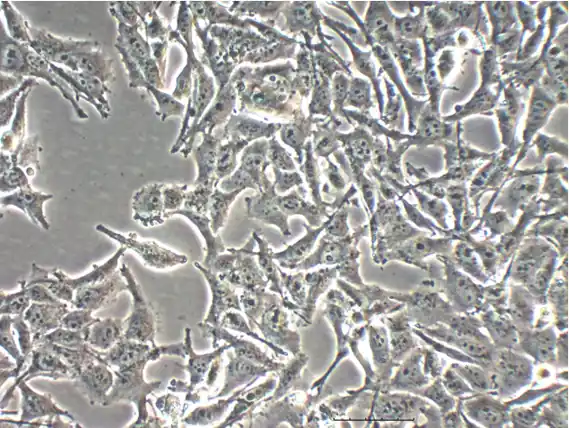
A metastatic melanoma cell line derived from a lesion of a melanoma patient. The cells are of melanocytic origin, and display characteristics of aggressive melanoma, including high motility, invasive potential, and marked phenotypic heterogeneity. SK-MEL-2 is epithelial-like in morphology and adherent, with some variable pigmentation (due to the presence of functional melanosomes and melanocytic differentiation dynamics).
The cells carry an activating NRAS Q61R mutation that confers constitutive MAPK and PI3K signaling. The cells do not have the BRAF V600E mutation, as is the case for many other melanoma models. This makes SK-MEL-2 a useful system to study the biology and drug sensitivity of NRAS-mutant melanoma. The line is positive for the melanocytic markers S100, HMB-45, MITF, and MART-1, and retains lineage specificity while displaying transcriptional plasticity associated with metastatic potential.
The line exhibits a strong response to stress signals, inflammatory stimuli, and targeted inhibitors. SK-MEL-2 is broadly used for the study of tumor progression and metastatic regulation, drug resistance, and tumor-microenvironment dynamics. The molecular profile and aggressive phenotype are useful for preclinical testing of MEK/ERK inhibitors, combination therapy, and immunomodulatory compounds, as well as for studies of immune evasion mechanisms.
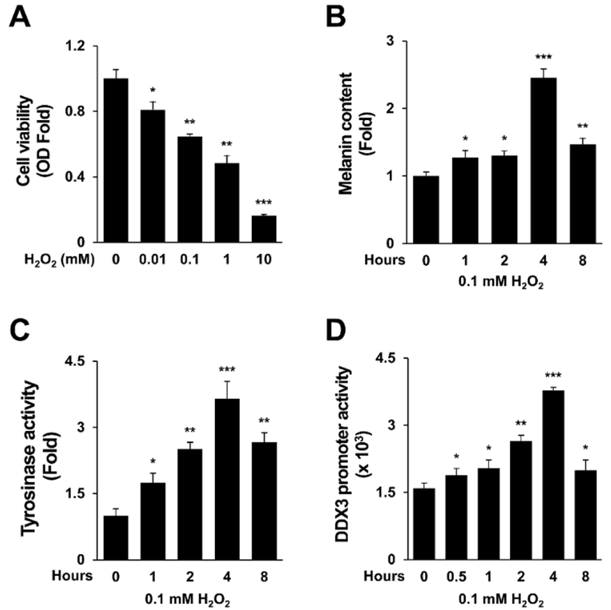
H2O2 Activates Melanogenesis and DDX3 Promoter Activity
DDX3 is a DEAD-box RNA helicase with diverse functions. Eom et al. investigated its role in regulating melanogenesis and explores the involved signaling pathways in SK-Mel-2 human melanoma cells.
H2O2 has been reported to induce the expression of melanogenesis-related genes (CREB, MITF, tyrosinase, PAH) in SK-Mel-2 and B16F10 cells. This study determined the effects of various H2O2 concentrations on SK-Mel-2 cell viability (Fig. 1A) and selected 0.1 mM H2O2 for further experiments. Melanin expression in SK-Mel-2 cells significantly increased after 4 h of 0.1 mM H2O2 treatment (Fig. 1B). A one-way repeated measures post hoc test confirmed that 0.1 mM H2O2 increased tyrosinase activity 2.53-fold compared to controls. DDX3 has been reported to be involved in cell cycle regulation. This molecule was previously studied for its effect on apoptosis in sanguinarine-treated HeLa cells. In this study, the effect of DDX3 on H2O2-induced melanogenesis was examined. Cells transfected with pGL2 basic/DDX3 promoter were cultured for 24 h, followed by treatment with 0.1 mM H2O2 for 4 h and a luciferase assay. DDX3 promoter activity was found to increase in a time-dependent manner in 0.1 mM H2O2-treated cells (Fig. 1D), indicating that DDX3 was involved in H2O2-induced melanogenesis in human melanoma cells.
Ask a Question
Write your own review
- You May Also Need
Description: Established in 1990 from the right axillary lymph node of a 48-year-old woman with metastatic malignant melanoma in the right chest
Description: Established from the primary tumor (right cervical) of a 64-year-old woman with cutaneous melanoma
Description: Species: human, Caucasian male adult; Tissue: skin; Tumor: melanoma
- Adipose Tissue-Derived Stem Cells
- Human Neurons
- Mouse Probe
- Whole Chromosome Painting Probes
- Hepatic Cells
- Renal Cells
- In Vitro ADME Kits
- Tissue Microarray
- Tissue Blocks
- Tissue Sections
- FFPE Cell Pellet
- Probe
- Centromere Probes
- Telomere Probes
- Satellite Enumeration Probes
- Subtelomere Specific Probes
- Bacterial Probes
- ISH/FISH Probes
- Exosome Isolation Kit
- Human Adult Stem Cells
- Mouse Stem Cells
- iPSCs
- Mouse Embryonic Stem Cells
- iPSC Differentiation Kits
- Mesenchymal Stem Cells
- Immortalized Human Cells
- Immortalized Murine Cells
- Cell Immortalization Kit
- Adipose Cells
- Cardiac Cells
- Dermal Cells
- Epidermal Cells
- Peripheral Blood Mononuclear Cells
- Umbilical Cord Cells
- Monkey Primary Cells
- Mouse Primary Cells
- Breast Tumor Cells
- Colorectal Tumor Cells
- Esophageal Tumor Cells
- Lung Tumor Cells
- Leukemia/Lymphoma/Myeloma Cells
- Ovarian Tumor Cells
- Pancreatic Tumor Cells
- Mouse Tumor Cells