
HS-PSS
Cat.No.: CSC-C6310J
Species: Homo sapiens (Human)
Source: Prostate
Morphology: other
Culture Properties: Adherent cells
- Specification
- Background
- Scientific Data
- Q & A
- Customer Review
Store in liquid nitrogen.
HS-PSS is a human malignant peripheral nerve sheath tumor (MPNST) cell line derived from a patient with sporadic MPNST. Malignant peripheral nerve sheath tumors are rare, very aggressive soft tissue sarcomas that originate from peripheral nerves or from nerve sheath-related cells. Because of their invasive behavior and lack of therapeutic alternatives, MPNSTs are an important subject of translational cancer research. HS-PSS provides an important in vitro model to study the molecular and cellular pathways involved in this disease.
HS-PSS cells display features of malignant nerve sheath-derived tumor cells and have been incorporated in several genomic and molecular profiling investigations of MPNST. Genomic studies have shown changes frequently related with the aetiology of MPNST such as loss of tumor suppressor loci and chromosomal aberrations in tumor growth. HS-PSS has been employed for the assessment of signaling pathways involved in cell proliferation, survival and malignant transformation.
Besides molecular characterization investigations, HS-PSS has been included in drug sensitivity screening programs to find possible therapeutic vulnerabilities in MPNST. This cell line has been used by researchers to examine responsiveness to targeted inhibitors, chemotherapeutic and new anti-cancer drugs. The combination of a well-defined tumor genesis and the availability of genetic data make HS-PSS a suitable experimental model for investigations on MPNST biology, tumor genomics, finding of therapeutic targets and preclinical drug evaluation.
Genomic Profiling and Ploidy Analysis of Authenticated Human MPNST Cell Lines
Malignant peripheral nerve sheath tumors (MPNSTs) are aggressive soft-tissue sarcomas arising sporadically or in neurofibromatosis type 1 (NF1). To support translational research, Magallón-Lorenz et al. authenticated and characterized eight rigorously validated human MPNST cell lines.
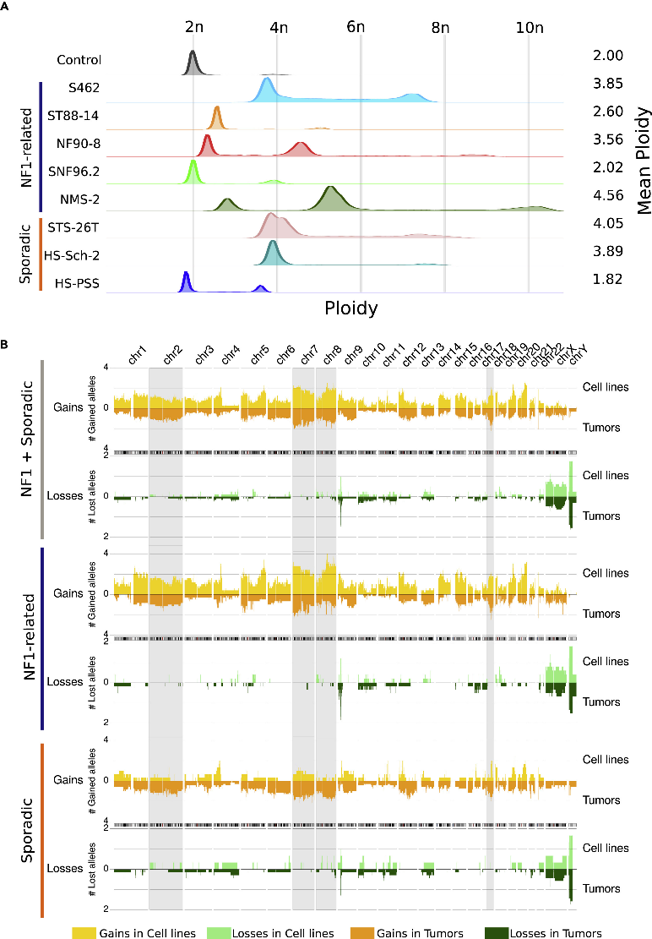
Initial interspecies PCR excluded non-human contamination. STR profiling confirmed matches to reference databases but identified identical profiles between ST88-14 and T265. Archival vial analysis and the primary tumor of origin confirmed ST88-14 as authentic, displaying the NF1 germline mutation (c.1649dupT) and expected somatic alterations. T265 was excluded due to misidentification. Comprehensive genomic profiling-including flow cytometry, SNP arrays, whole-exome, and whole-genome sequencing-revealed diverse ploidy and copy-number landscapes. Spectral karyotyping and G-banding proved inconsistent due to genomic complexity, prompting flow cytometric analysis of DNA content. Ploidy ranged strikingly: three lines clustered near tetraploidy (S462, HS-Sch-2, STS-26T), while sNF96.2 and HS-PSS were diploid or hypodiploid. NF90-8 and NMS-2 exhibited bimodal ploidy distributions, suggesting genome duplication events, and STS-26T contained two subpopulations with distinct ploidies (Fig. 1A). These data provide a curated, high-confidence genomic resource for selecting MPNST models aligned with specific genetic and chromosomal contexts.
Ask a Question
Write your own review
- You May Also Need
Description: Species: human female; Tissue: lymphocyte, B; Pathology: paroxysmal nocturnal hemoglobinuria; Transformed by: Epstein-Barr
Description: This cell line was established from a local recurrence of a sacrococcygeal after radiotherapy 4 years after initial surgery.
Description: HCEC-B4G12 is a clonal subpopulation started in 2005 from the parental cell line HCEC-12 established from normal cells of the posterior epithelium of the cornea of a 91-year-old Caucasian woman ...
Description: Species: human - female, 20 years old, CaucasianVirus Resistance: partially resistant to poliovirus and vesicular stomatitis virusesIsoenzyme: G6PD, BProduction: Epstein-Barr virus ...
- Adipose Tissue-Derived Stem Cells
- Human Neurons
- Mouse Probe
- Whole Chromosome Painting Probes
- Hepatic Cells
- Renal Cells
- In Vitro ADME Kits
- Tissue Microarray
- Tissue Blocks
- Tissue Sections
- FFPE Cell Pellet
- Probe
- Centromere Probes
- Telomere Probes
- Satellite Enumeration Probes
- Subtelomere Specific Probes
- Bacterial Probes
- ISH/FISH Probes
- Exosome Isolation Kit
- Human Adult Stem Cells
- Mouse Stem Cells
- iPSCs
- Mouse Embryonic Stem Cells
- iPSC Differentiation Kits
- Mesenchymal Stem Cells
- Immortalized Human Cells
- Immortalized Murine Cells
- Cell Immortalization Kit
- Adipose Cells
- Cardiac Cells
- Dermal Cells
- Epidermal Cells
- Peripheral Blood Mononuclear Cells
- Umbilical Cord Cells
- Monkey Primary Cells
- Mouse Primary Cells
- Breast Tumor Cells
- Colorectal Tumor Cells
- Esophageal Tumor Cells
- Lung Tumor Cells
- Leukemia/Lymphoma/Myeloma Cells
- Ovarian Tumor Cells
- Pancreatic Tumor Cells
- Mouse Tumor Cells