
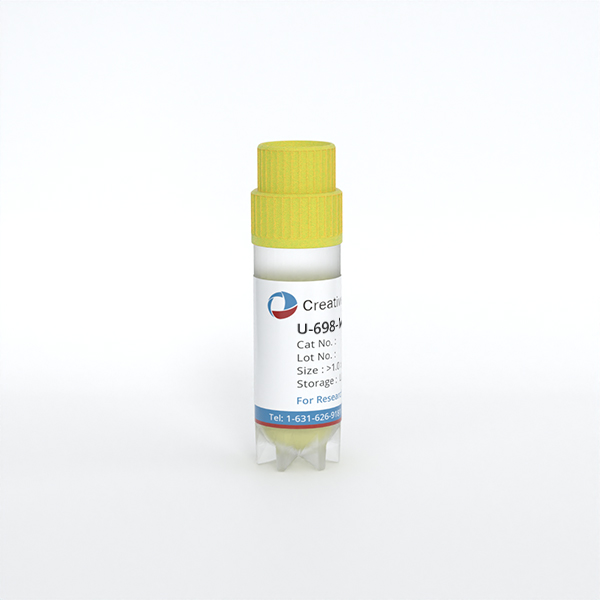
U-698-M
Cat.No.: CSC-C0101
Species: Homo sapiens (Human)
Morphology: single or clumped cells in suspension; some cells adhere to plastic
Culture Properties: suspension
- Specification
- Background
- Scientific Data
- Q & A
- Customer Review
Immunology: CD3 -, CD10 +, CD13 -, CD19 +, CD20 +, CD34 -, CD37 +, CD38 +, CD138 -, HLA-DR +, sm/cyIgG -, sm/cyIgM +, sm/cykappa +, sm/cylambda -
Viruses: ELISA: reverse transcriptase negative;
The U-698-M cell line is a human B-cell lymphoma cell line established in 1972 from the involved tonsil of a 7-year-old male patient diagnosed with lymphoblastic lymphoma before any therapeutic intervention. It is genetically hyperdiploid (modal number 49; range 44-50) and EBV negative.
Morphologically, the cells are lymphoblast-like, growing in suspension as single cells or small clumps, with a minority loosely adhering to the plastic surface. They have mature B cell immunophenotype, and are positive for CD10, CD19, CD20, CD37, CD38, HLA-DR and surface IgM (smIgM) and negative for CD3 and CD34. The U-698-M cells are grown under standard conditions (37°C, 5% CO2) in a nutrient-rich basal media fortified with serum. These cells have a doubling time of ~48 h and are sub-cultured by seeding at 0.5 × 10⁶ cells/mL and splitting at a ratio of 1:2 to 1:5 every 2-3 days.
U-698-M cells are frequently used as a model system for the study of B-cell lymphomagenesis, immune cell signaling pathways, and for screening of targeted therapies and immunological reagents in hematologic malignancy research due to their unique B-lineage properties and genetic stability.
Neoantigen-Specific TCRs Display In Vivo Antitumor Potential
Neoantigens generated by somatic mutations are promising targets for personalized immunotherapy, but the association between TCR functionality and in vivo efficacy remains to be further characterized. Bräunlein et al. examined neoantigen-specific TCRs in a detailed case study of metastatic melanoma using a xenograft model.
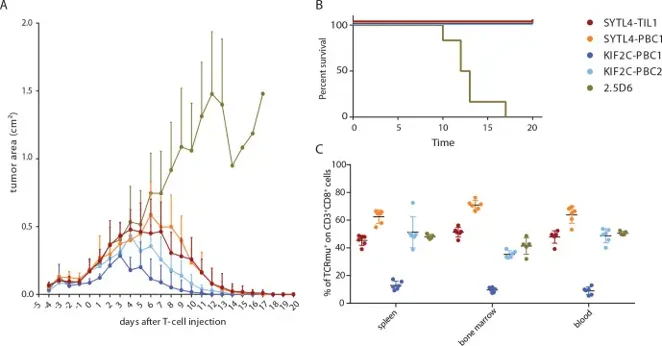
U-698-M lymphoma cells transduced with minigene (MG) constructs encoding defined neoantigens were injected subcutaneously into NSG mice. Next, they evaluated the antitumor activity of four neoantigen-specific TCRs (SYTL4-TIL1, SYTL4-PBC1, KIF2C-PBC1, KIF2C-PBC2) versus a control TCR (2.5D6).
TCR-transduced T cells were given intravenously. Control TCR recipients exhibited progressive tumor growth, while mice treated with neoantigen-specific TCRs completely rejected the tumor (Fig. 1A). Importantly, KIF2C-PBC1 (~14% transduction efficiency) and KIF2C-PBC2 (~62%) induced strong kinetics of rejection. Survival analysis confirmed that neoantigen-specific TCRs significantly prolonged survival compared to the control cohort euthanised for ulcerating tumor burden (Fig. 1B). Flow cytometry showed that TCR-transgenic T cells efficiently infiltrated the tumors by day 4 and were still detected in the spleen, bone marrow and blood at day 20 (Fig. 1C). These data indicate that neoantigen-specific TCRs can induce potent and durable antitumor immunity, independent of small differences in transduction efficiency.
Ask a Question
Write your own review
- You May Also Need
Description: Established in 2007 from the bone marrow mononuclear cells of an 82-year-old Japanese man with diffuse large B-cell lymphoma in the leukemic phase
Description: Established from the bone marrow of a 28-year-old man who developed the terminal leukemic phase of lymphosarcoma in 1976
Description: This cell line was derived from the bone marrow aspirate of a 59 year old male with erythroleukemia that became acute myelogenous leukaemia.The cells form colonies in soft-agar in the presence of ...
Description: Established from the pleural effusion of a 24-year-old woman with recurrent anaplastic large cell lymphoma (ALCL); cells were described to clonally derive from T-lineage lymphoid cells and to be ...
Description: Established from a 37-year-old man at second (refractory/terminal) relapse of Hodgkin lymphoma (nodular sclerosing -> lymphocyte depleted/stage IIISA -> stage IV) after both combined chemo- and ...
Description: Established from the peripheral blood of a 10-year-old Caucasian boy with acute lymphoblastic leukemia (pre B-ALL) at diagnosis in 1993
- Adipose Tissue-Derived Stem Cells
- Human Neurons
- Mouse Probe
- Whole Chromosome Painting Probes
- Hepatic Cells
- Renal Cells
- In Vitro ADME Kits
- Tissue Microarray
- Tissue Blocks
- Tissue Sections
- FFPE Cell Pellet
- Probe
- Centromere Probes
- Telomere Probes
- Satellite Enumeration Probes
- Subtelomere Specific Probes
- Bacterial Probes
- ISH/FISH Probes
- Exosome Isolation Kit
- Human Adult Stem Cells
- Mouse Stem Cells
- iPSCs
- Mouse Embryonic Stem Cells
- iPSC Differentiation Kits
- Mesenchymal Stem Cells
- Immortalized Human Cells
- Immortalized Murine Cells
- Cell Immortalization Kit
- Adipose Cells
- Cardiac Cells
- Dermal Cells
- Epidermal Cells
- Peripheral Blood Mononuclear Cells
- Umbilical Cord Cells
- Monkey Primary Cells
- Mouse Primary Cells
- Breast Tumor Cells
- Colorectal Tumor Cells
- Esophageal Tumor Cells
- Lung Tumor Cells
- Leukemia/Lymphoma/Myeloma Cells
- Ovarian Tumor Cells
- Pancreatic Tumor Cells
- Mouse Tumor Cells