
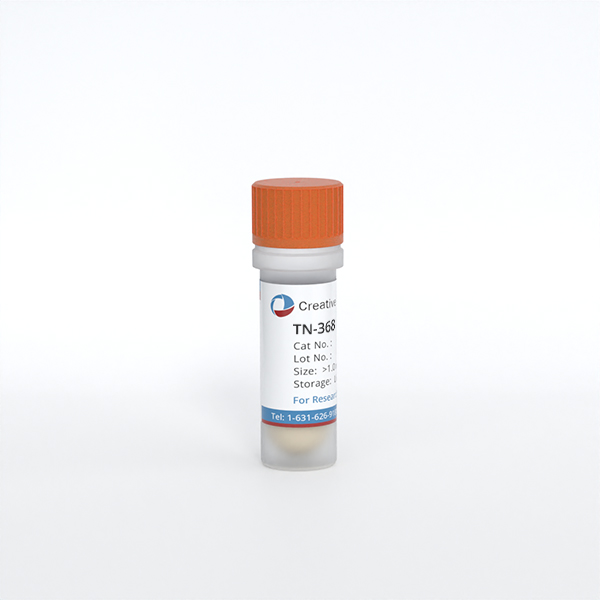
TN-368
Cat.No.: CSC-C6208X
Species: Trichoplusia ni (Cabbage looper)
Source: Ovary
Morphology: spindle-shaped cells growing in suspension (90%); cells tend to cluster in aggregates
Culture Properties: suspension
- Specification
- Background
- Scientific Data
- Q & A
- Customer Review
Viruses:PCR: SMRV -
TN-368 is a lepidopteran insect cell line established from ovarian tissue of the cabbage looper moth, Trichoplusia ni. It is one of the classical insect cell lines used in baculovirus expression methods for recombinant protein production. The TN-368 cells enable productive baculovirus infection and have been used historically to study viral replication, host-virus interactions and heterologous protein expression. The cell line grows adherently and is kept at 27°C under conventional insect cell culture conditions in serum-containing or serum-free medium. Although the TN-368 cell line is less employed in the current industrial applications compared to other more popular insect cell lines like Sf9 and High Five (Tn5), it is still a good model for comparative studies on the effectiveness of baculovirus infection, promoter activity and protein expression performance.
Research applications of TN-368 cells have included the assessment of recombinant protein production, glycosylation and cellular stress responses after viral infection. These are widely used as a reference cell line in investigations aiming at the optimization of the baculovirus-mediated expression system.
Novel Tn-NVN Cell Line Characterized Using TN-368 as Positive Control for Viral Clearance
To overcome viral contamination in existing Trichoplusia ni(Tn) cell lines, Maghodia et al. isolated a novel virus-free line, Tn-NVN. Single-cell clones were treated with ribavirin, adapted to serum-free suspension culture in ESF-921, and passaged for over 1.5 years. One clone stabilized at a 26.6-hour doubling time after ~100 passages.
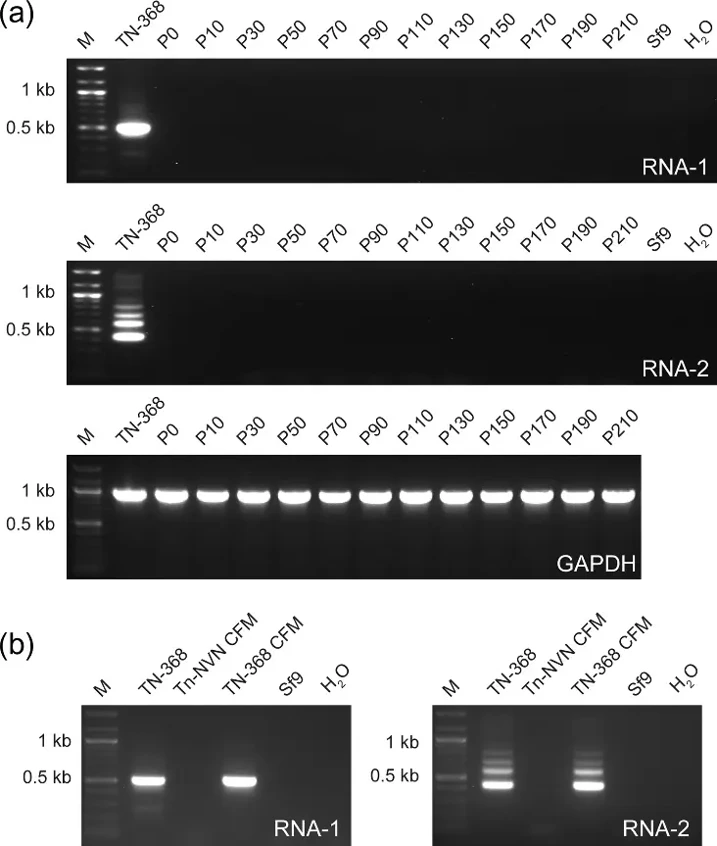
Rigorous validation confirmed the absence of TnCLV (a nodavirus). Nested RT-PCR detected no viral RNA in Tn-NVN cells over 210 serial passages (Fig. 1a). Crucially, TN-368 cells (known to be TnCLV-positive) served as the positive control, yielding strong amplimers for TnCLV RNA segments 1 and 2, while Sf9 cells served as the negative control (Fig. 1a).
To exclude the possibility of viral shedding, cell-free medium (CFM) from passage 55 was ultracentrifuged. No TnCLV RNA was detected in the Tn-NVN CFM pellet (Fig. 1b). In contrast, CFM from TN-368 cells served as the positive control and produced strong amplimers for both viral segments, confirming that Tn-NVN does not shed virions (Fig. 1b). The specificity of the assay was further validated by the absence of signal in the no-template control (H₂O) and the presence of the GAPDH housekeeping gene in all samples (Fig. 1a). Tn-NVN was also confirmed free of >60 mycoplasma species and other lepidopteran viruses.
Ask a Question
Write your own review
Description: UMNSAH/DF-1 is a spontaneously immortalized chicken cell line derived from 10 day old East Lansing Line (ELL-0) eggs.
Description: Established from the larvae of the butterfly Mamestra brassicae (family Noctuidae, subfamily Noctuinae) (cabbage moth; Kohleule)
Description: This cell line is a subclone of the original cell line R1 established after elimination of mycoplasma with BM-Cyclin (tiamulin & minocycline)
Description: Derived from pupal ovarian tissue of spodoptera frugiperda. The cells are highly susceptible to Baculovirus infection and are used in the production of protein products genetically manipulated into ...
Description: Established from the embryonal (stage 52/53) normal heart endothelium (tadpole heart) of a South African clawed frog (Xenopus laevis Daudin) in 1979; cells were described to synthesize ...
Description: Established from the larvae of the Acrea Moth (Estigmene acrea; family Arctiidae, order Lepidoptera) (Bärenspinner)
- Adipose Tissue-Derived Stem Cells
- Human Neurons
- Mouse Probe
- Whole Chromosome Painting Probes
- Hepatic Cells
- Renal Cells
- In Vitro ADME Kits
- Tissue Microarray
- Tissue Blocks
- Tissue Sections
- FFPE Cell Pellet
- Probe
- Centromere Probes
- Telomere Probes
- Satellite Enumeration Probes
- Subtelomere Specific Probes
- Bacterial Probes
- ISH/FISH Probes
- Exosome Isolation Kit
- Human Adult Stem Cells
- Mouse Stem Cells
- iPSCs
- Mouse Embryonic Stem Cells
- iPSC Differentiation Kits
- Mesenchymal Stem Cells
- Immortalized Human Cells
- Immortalized Murine Cells
- Cell Immortalization Kit
- Adipose Cells
- Cardiac Cells
- Dermal Cells
- Epidermal Cells
- Peripheral Blood Mononuclear Cells
- Umbilical Cord Cells
- Monkey Primary Cells
- Mouse Primary Cells
- Breast Tumor Cells
- Colorectal Tumor Cells
- Esophageal Tumor Cells
- Lung Tumor Cells
- Leukemia/Lymphoma/Myeloma Cells
- Ovarian Tumor Cells
- Pancreatic Tumor Cells
- Mouse Tumor Cells