
TM4
Cat.No.: CSC-C9739L
Species: Mus musculus (Mouse)
Source: Testis
Morphology: epithelial
Culture Properties: monolayer
- Specification
- Background
- Scientific Data
- Q & A
- Customer Review
Strain: BALB/c nu/+
Receptor: follicle stimulating hormone (FSH); androgen; estrogen; progesterone
Histocompatibility: H-Y
Production: transferrin; H-Y antigen; retinol binding protein; plasminogen activator
Histopathology: normal
Note: the TM4 cell line responds to FSH with an increase in cAMP production, but does not respond to luteinizing hormone (LH); the FSH responsiveness is much reduced compared to primary Sertoli cell cultures; constitutive plasminogen activator production is low, but is stimulated by FSH and, to a greater extent, by retinoic acid; tested and found negative for ectromelia virus (mousepox)
TM4 Cells are immortalized mouse Sertoli cells isolated from the testes of prepubertal mice and used as an in vitro model system for testicular biology and spermatogenesis. In culture, TM4 cells grow adherently and show epithelial like morphology. They contact each other through tight cell-cell interactions and form confluent monolayers. TM4 Cells express Sertoli cell markers and functional proteins that characterize the Sertoli cell phenotype including markers of the supportive nature of Sertoli cells (vimentin, transferrin) cell adhesion proteins (androgen receptor or AR) and proteins that participate in forming tight junctions (occludin and claudins). Like primary Sertoli cells, TM4 cells also produce many growth factors, cytokines and hormones important for germ cell survival and differentiation.
TM4 cells have been used to study aspects of Sertoli cell biology including cell-cell interactions in the testis and regulation of spermatogenesis. TM4 cells are used to study hormonal regulation of Sertoli cells (androgen and FSH signaling), oxidative stress, apoptosis and cellular toxicology. In particular, they are one of the most common models used in reproductive toxicology and endocrine disruption assay testing environmental chemicals, pharmaceuticals, or nanoparticles for male reproductive toxicity.
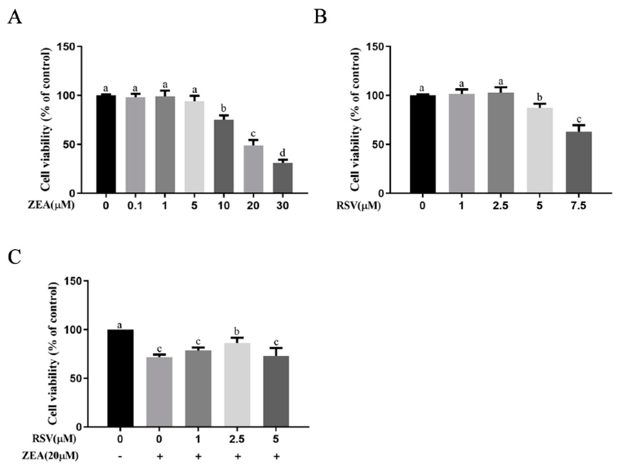
Effects of RSV on ZEA-Induced TM4 Cytotoxicity
Zearalenone (ZEA) is one of the most prevalent mycotoxins. ZEA exposure could cause oxidative stress (OS) and male reproductive dysfunctions in animals. Resveratrol (RSV) is an antioxidant and activated Nrf2 by the PI3K/Akt pathway to protect cells from injury. Xu's team aimed to determine whether RSV could protect against ZEA-induced OS and apoptosis in TM4 cells and further explored the underlying mechanism. LY294002, an inhibitor of PI3K/Akt signaling, was used.
TM4 cells were cultured with serial concentrations of ZEA and RSV, respectively, followed by CCK-8 assay. Cell viability decreased in response to the increment of ZEA concentrations (all concentrations ≥10 μmol·L⁻¹, p < 0.05) (Fig. 1A). RSV showed slight inhibition on TM4 cell viability at high concentrations and significant inhibition at 5 and 7.5 μmol·L⁻¹ (p < 0.05) (Fig. 1B). More importantly, 2.5 μmol·L⁻¹ RSV pretreatment rescued ZEA-induced cytotoxicity significantly (p < 0.05) (Fig. 1C). Therefore, 2.5 μmol·L⁻¹ and 20 μmol·L⁻¹ RSV were chosen for the following experiments.
Ask a Question
Write your own review
- You May Also Need
Description: Described as secreting a mouse monoclonal antibody (IgG2a) detecting all fibers in skeletal muscle and myosin heavy chains on Western blots and detecting mammalian, chicken, zebrafish, axolotl, ...
Description: Animals were immunized with the B6.1 mouse cytotoxic T cell line.
Description: neuroglial and neuronal character coexpressing ependymoma cell line.
Description: Established by irradiation of the adherent cells in long-term bone marrow cultures derived from C3H/HeNSlc strain mice
- Adipose Tissue-Derived Stem Cells
- Human Neurons
- Mouse Probe
- Whole Chromosome Painting Probes
- Hepatic Cells
- Renal Cells
- In Vitro ADME Kits
- Tissue Microarray
- Tissue Blocks
- Tissue Sections
- FFPE Cell Pellet
- Probe
- Centromere Probes
- Telomere Probes
- Satellite Enumeration Probes
- Subtelomere Specific Probes
- Bacterial Probes
- ISH/FISH Probes
- Exosome Isolation Kit
- Human Adult Stem Cells
- Mouse Stem Cells
- iPSCs
- Mouse Embryonic Stem Cells
- iPSC Differentiation Kits
- Mesenchymal Stem Cells
- Immortalized Human Cells
- Immortalized Murine Cells
- Cell Immortalization Kit
- Adipose Cells
- Cardiac Cells
- Dermal Cells
- Epidermal Cells
- Peripheral Blood Mononuclear Cells
- Umbilical Cord Cells
- Monkey Primary Cells
- Mouse Primary Cells
- Breast Tumor Cells
- Colorectal Tumor Cells
- Esophageal Tumor Cells
- Lung Tumor Cells
- Leukemia/Lymphoma/Myeloma Cells
- Ovarian Tumor Cells
- Pancreatic Tumor Cells
- Mouse Tumor Cells