
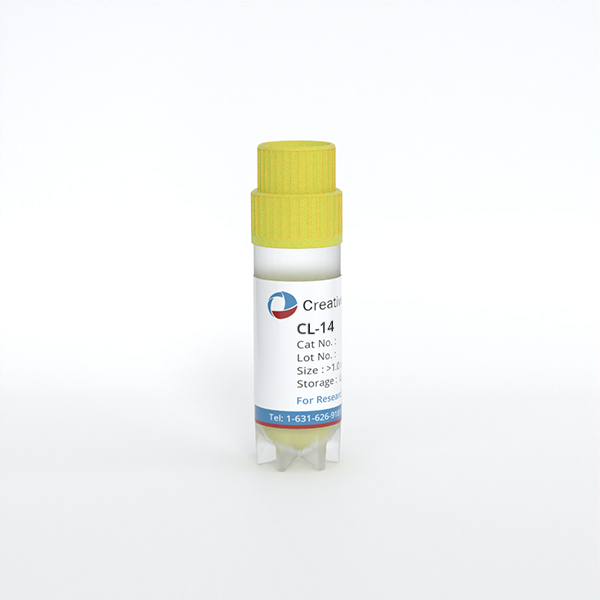
CL-14
Cat.No.: CSC-C0514
Species: Homo sapiens (Human)
Source: Intestine; Colon
Morphology: strongly adherent epitheloid cells growing in monolayers and forming islets
Culture Properties: monolayer
- Specification
- Background
- Scientific Data
- Q & A
- Customer Review
Immunology: cytokeratin +, cytokeratin-7 -, cytokeratin-8 +, cytokeratin-17 -, cytokeratin-18 +, cytokeratin-19 +, desmin -, endothel -, EpCAM +, GFAP -, neurofilament -, vimentin -
Viruses: PCR:
The CL-14 cell line is a human colorectal adenocarcinoma cell line developed from the main tumor of the sigmoid colon of a male patient with a well-differentiated adenocarcinoma (TNM stage T3N0M0). Morphologically it grows as highly adherent epithelial cells creating compact islets or monolayers. It has a hypotetraploid karyotype (modal number 78-85) with homozygous TP53 mutation (p.Arg273Cys). This is an EBV-negative and microsatellite-stable (MSS) line.
CL-14 is well characterized for its very high vulnerability to SARS-CoV and SARS-CoV-2 infection, which makes it an important model for coronavirus entry and antiviral studies. It is also used for chemosensitivity profiling, drug metabolism assays, and studies of Wnt/β-catenin and p53 pathway changes in gastrointestinal malignancies in colorectal cancer research. Culturally, CL-14 needs to be a 1:1 mixture of DMEM and Ham's F12 with serum, and incubated at 37°C with 5% CO2. Cells are slow-growing (doubling time ~1 week) and can be difficult to detach, hence it is advised to use prolonged trypsin/EDTA treatment and avoid mechanical scraping.
ACE2/TMPRSS2 Expression is Insufficient to Predict SARS-CoV-2 Permissiveness
To systematically identify robust cellular models for SARS-CoV-2 infection, researchers screened the Cancer Cell Line Encyclopedia (CCLE) RNA-seq database for expression of the receptor ACE2and priming protease TMPRSS2, followed by rigorous experimental validation of viral permissiveness in vitro. Though these two factors are canonical mediators of viral entry, their sufficiency and the possible involvement of alternative receptors are still discussed. In order to better understand the correlation between receptor expression and actual infection outcome, the study defined permissiveness as the ability of a host cell to support the complete viral replication cycle and the release of mature virions.
Experimental infection with wild-type SARS-CoV-2 across the screened panel showed remarkable discordance between receptor expression and viral replication. Unexpectedly, most cell lines (15 of 29) failed to support detectable virus replication in spite of expressing both ACE2and TMPRSS2 (Fig. 1A). An additional 11 lines gave rise to infectious titers which never exceeded the input inoculum. Only 3 cell lines, i.e. the colon carcinoma lines CL-14 and CL-40 and the breast carcinoma line CAL-51, were found to be highly permissive with an increase of 2 to 500-fold in the initial viral load at 1-4 days post infection (dpi). The infectious titers obtained in CL-14 and CAL-51 were similar to those in gold-standard cell lines including the lung carcinoma CALU-3, colon carcinoma CACO-2 and African green monkey kidney VERO cells (Fig. 1B). Interestingly, CAL-51 and CACO-2 showed a steady increase of viral titers until day three while VERO cells and CL-14 peaked within 24 hours. The newly identified CL-40 line, expressing high levels of NRP1 in addition to ACE2and TMPRSS2 showed titers close to the inoculum level despite clear replication. These results underscore that ACE2and TMPRSS2expression alone is not sufficient for productive infection and reveal novel cell-type-specific replication kinetics in cancer cell lines.

Ask a Question
Write your own review
- You May Also Need
Description: Established from an adenocarcinoma located in the ascending colon of a 68 year-old male patient. The adenocarcinoma was well differentiated and determined to be Dukes' stage B. Imperial College ...
Description: This is one cell line out of a series of colon carcinoma cell lines established by PD Dr. Michael Linnebacher.
Description: Rectal carcinoma from a Japanese patient. Cell growth is slow.
Description: The C80 cell line was established from a 69-year old male patient with a moderately well differentiated adenocarcinoma of the rectum classified as Dukes' stage D.
Description: RKO is a poorly differentiated colon carcinoma cell line developed by Michael Brattain.
- Adipose Tissue-Derived Stem Cells
- Human Neurons
- Mouse Probe
- Whole Chromosome Painting Probes
- Hepatic Cells
- Renal Cells
- In Vitro ADME Kits
- Tissue Microarray
- Tissue Blocks
- Tissue Sections
- FFPE Cell Pellet
- Probe
- Centromere Probes
- Telomere Probes
- Satellite Enumeration Probes
- Subtelomere Specific Probes
- Bacterial Probes
- ISH/FISH Probes
- Exosome Isolation Kit
- Human Adult Stem Cells
- Mouse Stem Cells
- iPSCs
- Mouse Embryonic Stem Cells
- iPSC Differentiation Kits
- Mesenchymal Stem Cells
- Immortalized Human Cells
- Immortalized Murine Cells
- Cell Immortalization Kit
- Adipose Cells
- Cardiac Cells
- Dermal Cells
- Epidermal Cells
- Peripheral Blood Mononuclear Cells
- Umbilical Cord Cells
- Monkey Primary Cells
- Mouse Primary Cells
- Breast Tumor Cells
- Colorectal Tumor Cells
- Esophageal Tumor Cells
- Lung Tumor Cells
- Leukemia/Lymphoma/Myeloma Cells
- Ovarian Tumor Cells
- Pancreatic Tumor Cells
- Mouse Tumor Cells