
- Specification
- Background
- Scientific Data
- Q & A
- Customer Review
The C80 cell line is a human colorectal adenocarcinoma cell line obtained from a rectal tumor of a 69-year-old male patient with a moderately well-differentiated adenocarcinoma of the Dukes' grade D. It shows epithelial shape and develops in an adherent way, creating typical polygonal monolayers in vitro. The line shows characteristics of gastrointestinal malignancy and is free of mycoplasma infection in certified stocks.
C80 cells are usually grown under standard conditions (37°C, 5% CO2) in a basal medium (e.g. IMDM or RPMI-1640) supplemented with 10% fetal bovine serum and 2 mM L-glutamine. Cells are subcultured at 70-80% confluency using 0.05% trypsin/EDTA and are usually split at a ratio of 1:3 to 1:6. The doubling time is approximately 24 to 48 hours, depending on the density of the culture.
C80 cell line is a typical model of colorectal cancer (CRC) and is utilized for anticancer drug screening, chemosensitivity assay, tumor cell invasion and metastasis, and molecular research of Wnt/β-catenin or EGFR signaling pathways in gastrointestinal oncology.
Microenvironment-Driven Polarity Switches Determine Chemoresistance via ABCB1 Localization
Colonic epithelial polarity is critical for function and prognosis, yet how the tumor microenvironment regulates this in 3D remains unclear. Ashley et al. investigated how extracellular matrix (ECM) and serum dynamically regulate polarity and the localization of the multidrug transporter ABCB1 in colon cancer spheroids.
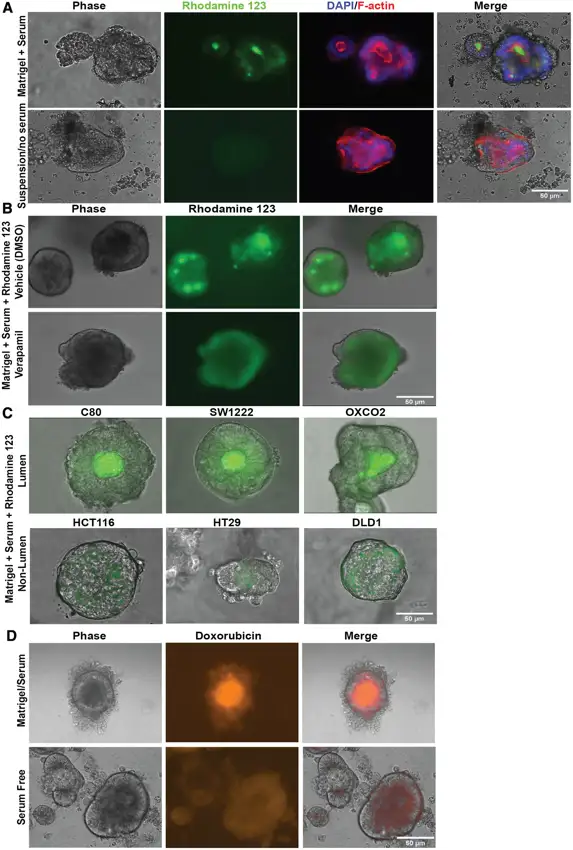
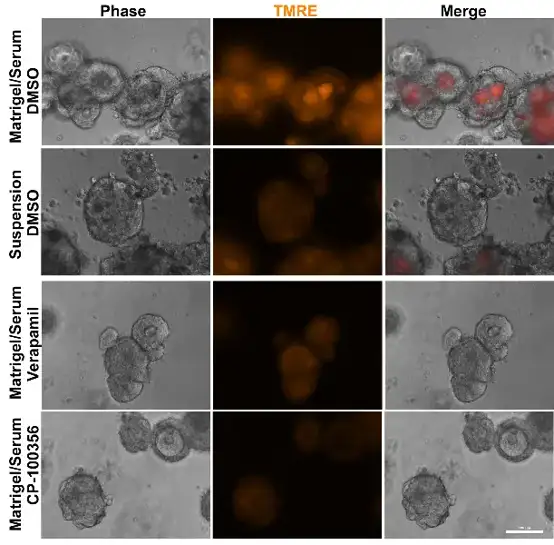
Using Matrigel-embedded cultures, they observed that lumen-forming cell lines (C80, OXCO2, SW1222) actively pumped the ABCB1 substrate Rhodamine 123 (R123) into their lumens, whereas non-lumen-forming lines (HCT116, HT29, DLD1) did not (Fig. 1C). This polarized efflux was confirmed using the ABCB1 substrates TMRE and doxorubicin, which accumulated within the lumens of ECM/serum-grown C80 and primary C105251 colonies (Fig. 1D, Fig. 2). Specific ABCB1 inhibitors (verapamil, CP-100356) blocked this luminal accumulation (Fig. 2). Notably, ABCB1 expression levels were unchanged between ECM/serum and serum-free suspension cultures. Instead, polarity dictated drug distribution: ECM/serum attachment induced apical-in polarity, sequestering drugs within lumens, while serum-free suspension cultures exhibited apical-out polarity, expelling drugs outward. This differential localization provides a structural basis for microenvironment-dependent chemoresistance.
Ask a Question
Write your own review
Description: Established from an adenocarcinoma located in the ascending colon of a 68 year-old male patient. The adenocarcinoma was well differentiated and determined to be Dukes' stage B. Imperial College ...
Description: This is one cell line out of a series of colon carcinoma cell lines established by PD Dr. Michael Linnebacher.
Description: Rectal carcinoma from a Japanese patient. Cell growth is slow.
Description: RKO is a poorly differentiated colon carcinoma cell line developed by Michael Brattain.
Description: Species: human - male, 70 years old, CaucasianTumorigenecity: yes, in nude miceIsoenzyme: G6PD,B;PGM1,1-2;PGM3,1-2;6PGD,A;ES-D,1-2;PEP-D,1Histopathology: adenocarcinomaNote: CSAp negative (CSAp-); ...
- Adipose Tissue-Derived Stem Cells
- Human Neurons
- Mouse Probe
- Whole Chromosome Painting Probes
- Hepatic Cells
- Renal Cells
- In Vitro ADME Kits
- Tissue Microarray
- Tissue Blocks
- Tissue Sections
- FFPE Cell Pellet
- Probe
- Centromere Probes
- Telomere Probes
- Satellite Enumeration Probes
- Subtelomere Specific Probes
- Bacterial Probes
- ISH/FISH Probes
- Exosome Isolation Kit
- Human Adult Stem Cells
- Mouse Stem Cells
- iPSCs
- Mouse Embryonic Stem Cells
- iPSC Differentiation Kits
- Mesenchymal Stem Cells
- Immortalized Human Cells
- Immortalized Murine Cells
- Cell Immortalization Kit
- Adipose Cells
- Cardiac Cells
- Dermal Cells
- Epidermal Cells
- Peripheral Blood Mononuclear Cells
- Umbilical Cord Cells
- Monkey Primary Cells
- Mouse Primary Cells
- Breast Tumor Cells
- Colorectal Tumor Cells
- Esophageal Tumor Cells
- Lung Tumor Cells
- Leukemia/Lymphoma/Myeloma Cells
- Ovarian Tumor Cells
- Pancreatic Tumor Cells
- Mouse Tumor Cells