
- Specification
- Background
- Scientific Data
- Q & A
- Customer Review
b.End5 cells are a murine brain microvascular endothelial cell line established from mouse cerebral cortex. Because of their cellular properties, b.End5 cells have been used extensively as an in vitro model of the blood-brain barrier (BBB). They retain many important structural and functional attributes of brain endothelial cells and are commonly used for experiments involving cerebrovascular biology and central nervous system (CNS) research.
b.End5 cells culture as adherent monolayers, exhibiting a typical endothelial cell cobblestone appearance. The cells express endothelial markers including CD31 (PECAM-1), von Willebrand factor (vWF), and tight junction-associated molecules such as claudins and occludin. When cultured under optimal conditions, tight intercellular junctions can be formed and selective permeability is evident. Therefore, b.End5 cells can be used to model both BBB transport as well as paracellular regulation.
The wide array of applications for b.End5 cells includes modeling blood-brain barrier function, neuroinflammation, and CNS drug delivery. They are used to examine endothelial cell responses to inflammatory cytokines, hypoxia, oxidative stress, and neurotoxic compounds. In addition, because of their reproducibility and ease of cell culture along with their physiological relevance to the BBB, b.End5 cells can be used as an effective in vitro model for studying BBB function and screening potential therapeutics to target the CNS.
Six Drugs Presented no Toxicity to BMECs and did not Increase BCCs Viability
BCBM is a severe condition with limited therapeutic options, highlighting the need for preventive strategies. Here, Godinho-Pereira et al. used BCCs (4T1) and BBB endothelial cells (b.End5) to identify drugs toxic to 4T1 cells but safe for b.End5 cells.
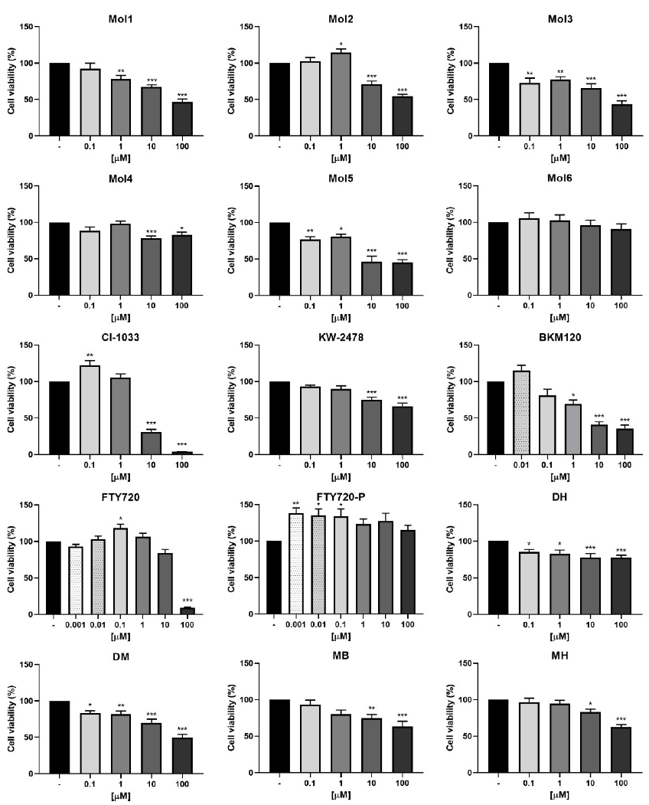
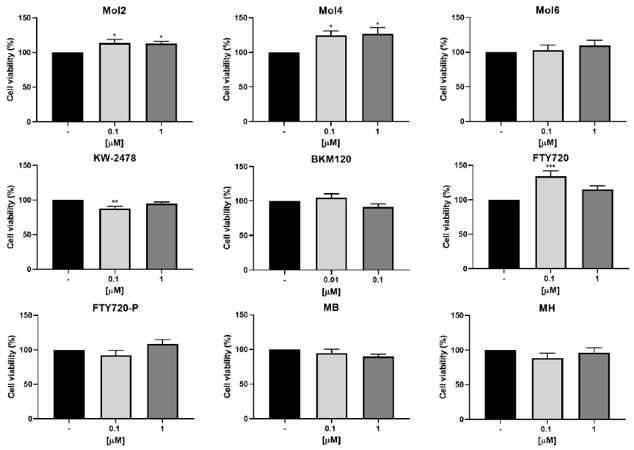
To ensure the safety of drugs targeting the blood-brain barrier (BBB) for brain microvascular endothelium, an initial viability assay using the MTT test was performed on b.End5 cells to determine safe concentrations for 15 drugs (Fig. 1). The results showed that Mol3, Mol5, DH, and DM exhibited toxic effects at all tested concentrations. Mol1 and BKM120 were toxic at 1 µM, while most drugs showed toxicity at concentrations ≥10 µM (Mol2, Mol4, CI-1033, KW-2478, MB, and MH). FTY720 was toxic only at 100 µM. Mol6 and FTY720-P showed no toxicity at any tested concentration and even increased cell viability at low concentrations (0.001, 0.01, and 0.1 µM). Based on these findings, Mol2, Mol4, Mol6, KW-2478, BKM120, FTY720, FTY720-P, MB, and MH were selected for further screening with 4T1 cells to ensure they did not promote an increase in tumor cell viability (Fig. 2). These drugs were tested at 0.1 and 1 µM, except for BKM120, which was tested at 0.01 and 0.1 µM. The results indicated that Mol2 and Mol4 increased tumor cell viability, with FTY720 only increasing BCCs viability at the lowest concentration. Mol6, BKM120, FTY720-P, MB, and MH had no effect, while KW-2478 decreased viability at 0.1 µM.
Ask a Question
Write your own review
Description: Described as secreting a mouse monoclonal antibody (IgG2a) detecting all fibers in skeletal muscle and myosin heavy chains on Western blots and detecting mammalian, chicken, zebrafish, axolotl, ...
Description: Animals were immunized with the B6.1 mouse cytotoxic T cell line.
Description: neuroglial and neuronal character coexpressing ependymoma cell line.
Description: Established by irradiation of the adherent cells in long-term bone marrow cultures derived from C3H/HeNSlc strain mice
- Adipose Tissue-Derived Stem Cells
- Human Neurons
- Mouse Probe
- Whole Chromosome Painting Probes
- Hepatic Cells
- Renal Cells
- In Vitro ADME Kits
- Tissue Microarray
- Tissue Blocks
- Tissue Sections
- FFPE Cell Pellet
- Probe
- Centromere Probes
- Telomere Probes
- Satellite Enumeration Probes
- Subtelomere Specific Probes
- Bacterial Probes
- ISH/FISH Probes
- Exosome Isolation Kit
- Human Adult Stem Cells
- Mouse Stem Cells
- iPSCs
- Mouse Embryonic Stem Cells
- iPSC Differentiation Kits
- Mesenchymal Stem Cells
- Immortalized Human Cells
- Immortalized Murine Cells
- Cell Immortalization Kit
- Adipose Cells
- Cardiac Cells
- Dermal Cells
- Epidermal Cells
- Peripheral Blood Mononuclear Cells
- Umbilical Cord Cells
- Monkey Primary Cells
- Mouse Primary Cells
- Breast Tumor Cells
- Colorectal Tumor Cells
- Esophageal Tumor Cells
- Lung Tumor Cells
- Leukemia/Lymphoma/Myeloma Cells
- Ovarian Tumor Cells
- Pancreatic Tumor Cells
- Mouse Tumor Cells