
UV-2237M
Cat.No.: CSC-C9748L
Species: Mus musculus (Mouse)
Culture Properties: monolayer
- Specification
- Background
- Scientific Data
- Q & A
- Customer Review
Shipping Condition: Room Temperature
UV-2237M is a highly metastatic murine fibrosarcoma cell line isolated from a chemically induced soft tissue sarcoma of C3H mice. The cell line is a widely accepted experimental model for the investigation of tumor metastasis, invasion, angiogenesis and therapeutic response of aggressive mesenchymal cancers. UV-2237M cells are rapidly growing and have a high metastatic potential, especially to the lungs, and are particularly useful for the study of mechanisms of tumor dissemination and metastatic colonization.
This cell line has been widely used in cancer biology research to study the roles of extracellular matrix remodeling, tumor-stromal interactions, and immune modulation in tumor progression. UV-2237M cells are also frequently used in studies of radiation biology, chemotherapy sensitivity, hyperthermia treatment and anti-metastatic drug development. They show reproducible metastatic behavior in vivo, and therefore can be used as a reliable platform for preclinical therapeutic assessment and experimental metastasis models.
Moreover UV-2237M has been used in the study of angiogenic signaling pathways, hypoxia-induced tumor adaptation and cancer cell migration. The model is particularly useful for the study of the effect of tumor microenvironmental factors on metastatic efficiency and resistance to therapy. In conclusion, UV-2237M is a valuable murine sarcoma model for fundamental cancer research and for translational oncology research focusing on mechanisms of metastatic disease and therapeutic intervention strategies.
Synergistic Liposomal Co-delivery of Paclitaxel and Pantoprazole Overcomes Multidrug Resistance
Multidrug resistance (MDR) mediated by P-glycoprotein (P-gp), V-ATPase and other factors still poses a major obstacle to successful chemotherapy. To tackle this, Lee et al. designed a "multidrug-resistant nanocracker" (MDRC) which is a liposomal system co-loading paclitaxel (PTX) and pantoprazole (PZ).
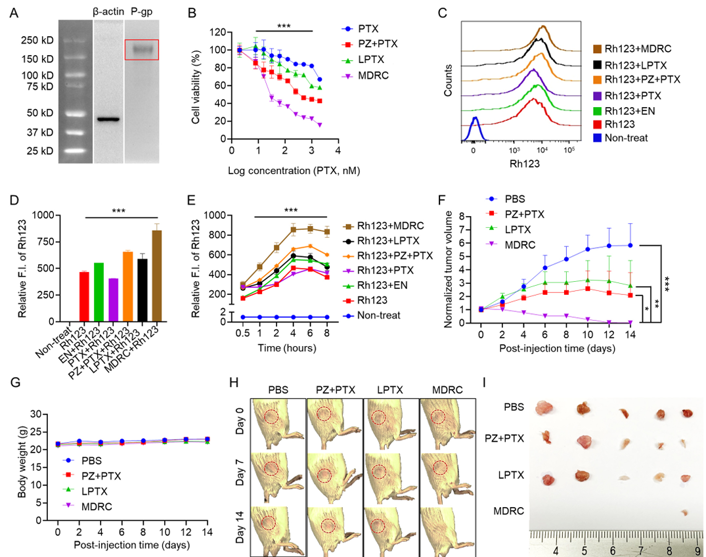
They created an in vivo MDR tumor model with the P-gp-expressing murine fibrosarcoma cell line UV-2237M (Fig. 1A). In vitro, MDRC exhibited higher cytotoxicity than free drug combinations (PZ + PTX) and single drug liposomes (LPZ, LPTX), with an IC50 17.2 folds lower than PZ + PTX group (Fig. 1B). This efficacy was associated with the capacity of MDRC to inhibit Rh123 efflux, confirming the modulation of P-gp (Fig. 1C-E).
MDRC administration via intravenous injection in vivo significantly inhibited tumor growth without weight loss, which was superior to PBS, PZ + PTX and LPTX controls (Fig. 1F, G). Optical imaging showed a remarkable shrinkage of the tumor (Fig. 1H), and 80% of MDRC were completely remitted, which is rare for MDR tumors (Fig. 1I). Such extraordinary efficacy is attributed to the synergistic delivery of PZ and PTX through the EPR effect, where PZ inhibits P-gp efflux and regulates intracellular pH to sensitize the cancer cells to PTX.
Ask a Question
Write your own review
- You May Also Need
Description: Described as secreting a mouse monoclonal antibody (IgG2a) detecting all fibers in skeletal muscle and myosin heavy chains on Western blots and detecting mammalian, chicken, zebrafish, axolotl, ...

Description: Animals were immunized with the B6.1 mouse cytotoxic T cell line.



Description: neuroglial and neuronal character coexpressing ependymoma cell line.

Description: Established by irradiation of the adherent cells in long-term bone marrow cultures derived from C3H/HeNSlc strain mice
- Adipose Tissue-Derived Stem Cells
- Human Neurons
- Mouse Probe
- Whole Chromosome Painting Probes
- Hepatic Cells
- Renal Cells
- In Vitro ADME Kits
- Tissue Microarray
- Tissue Blocks
- Tissue Sections
- FFPE Cell Pellet
- Probe
- Centromere Probes
- Telomere Probes
- Satellite Enumeration Probes
- Subtelomere Specific Probes
- Bacterial Probes
- ISH/FISH Probes
- Exosome Isolation Kit
- Human Adult Stem Cells
- Mouse Stem Cells
- iPSCs
- Mouse Embryonic Stem Cells
- iPSC Differentiation Kits
- Mesenchymal Stem Cells
- Immortalized Human Cells
- Immortalized Murine Cells
- Cell Immortalization Kit
- Adipose Cells
- Cardiac Cells
- Dermal Cells
- Epidermal Cells
- Peripheral Blood Mononuclear Cells
- Umbilical Cord Cells
- Monkey Primary Cells
- Mouse Primary Cells
- Breast Tumor Cells
- Colorectal Tumor Cells
- Esophageal Tumor Cells
- Lung Tumor Cells
- Leukemia/Lymphoma/Myeloma Cells
- Ovarian Tumor Cells
- Pancreatic Tumor Cells
- Mouse Tumor Cells