
Rabbit Bone Marrow Mesenchymal Stem Cells
- Specification
- Background
- Scientific Data
- Q & A
- Customer Review
Never can cryopreserved cells be kept at -21 °C.
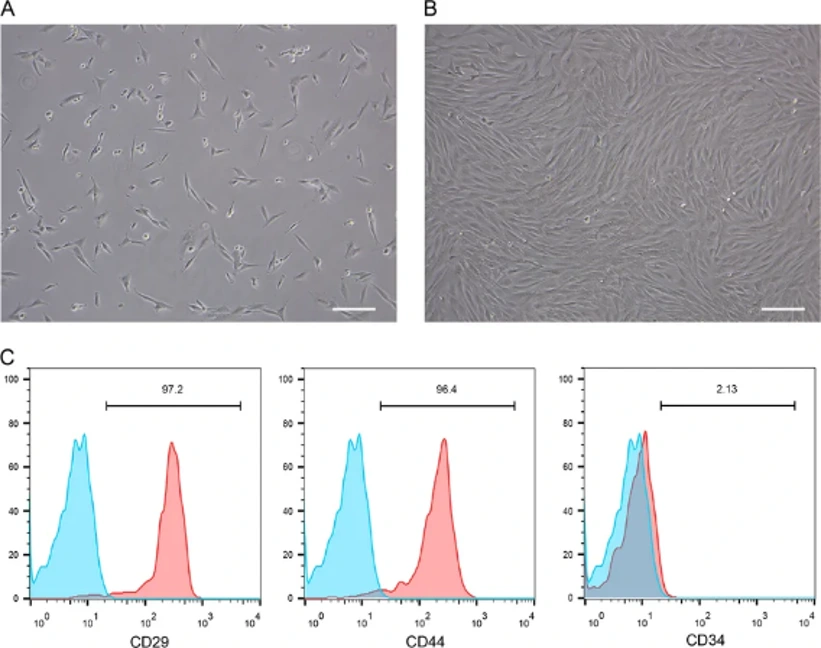
Rabbit Bone Marrow Mesenchymal Stem Cells (rBM-MSCs) are primary multipotent stromal cells taken from bone marrow of rabbits. The New Zealand White rabbit is heavily used because they have been well characterized in the orthopaedic and cartilage repair fields. rBM-MSCs express standard MSC traits including tri-lineage differentiating capabilities into osteocytes, chondrocytes, and adipocytes in vitro. These cells also test positive for standard MSC markers (i.e. CD90, CD73) and negative for hematopoietic markers (i.e. CD34, CD45). Of note, rabbits serve as a highly relevant size and physiologically appropriate preclinical model of musculoskeletal regeneration. Therefore, much of what we learn through basic research using rBM-MSCs feeds directly into creating human therapies.
The most notable use for rBM-MSCs is in tissue engineering and regenerative medicine purposes. Cells are used to study bone defect repair, articular cartilage repair (typically using osteochondral defect models), tendon healing, and spinal fusion, in combination with scaffolds, growth factors, and bioreactors. Variables to consider when working with this cell type include donor variation (since these are primary cells), passage-dependent senescence, and extensive cell isolation and characterization.
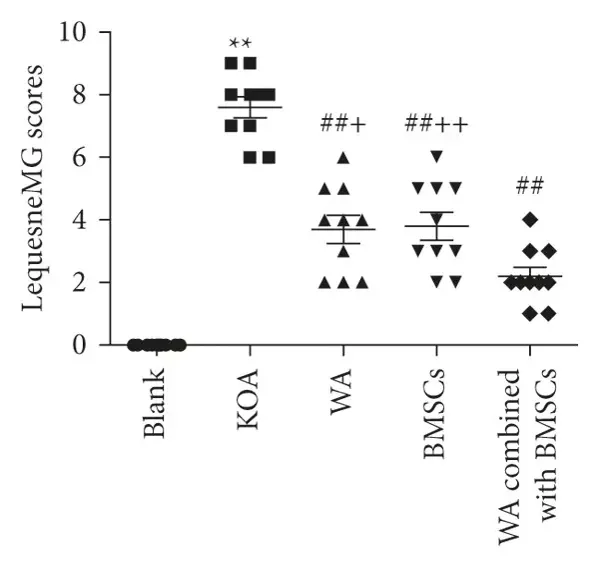
Warm Acupuncture Combined with BMSCs Improved Knee Joint Behavior Deficiency Caused by KOA
Knee osteoarthritis (KOA) involves cartilage degeneration and chondrocyte apoptosis. Warm acupuncture and bone marrow mesenchymal stem cell (BMSC) transplantation show individual therapeutic benefits, but their combined effect remains unexplored. Liu's team investigated whether warm acupuncture combined with BMSCs enhances cartilage repair in a rabbit KOA model.
50 rabbits were randomized into blank control group, KOA group, warm acupuncture group, BMSCs group (rabbit bone marrow mesenchymal stem cells transplantation group), and warm acupuncture combined with BMSCs group. Joint function was scored by Modified Lequesne MG scale; articular cartilage histomorphology was evaluated by Taiping Peng score and H&E staining, safranin O staining and toluidine blue staining. Cell apoptosis was analyzed by TEM and TUNEL assay; expression of apoptosis-related genes/proteins were detected by immunohistochemistry and qPCR. KOA rabbits showed a higher behavior score than the blank group (Fig. 1, p < 0.01). However, the increase in the Lequesne MG score was reduced significantly (Fig. 1, p < 0.01) in the warm acupuncture combined with the BMSCs group compared to that in the KOA group. In addition, the effect of the warm acupuncture combined with BMSCs is better than that of warm acupuncture group and BMSCs group separately (Fig. 1, p < 0.05 and p < 0.01).
Ask a Question
Write your own review
- You May Also Need
- Adipose Tissue-Derived Stem Cells
- Human Neurons
- Mouse Probe
- Whole Chromosome Painting Probes
- Hepatic Cells
- Renal Cells
- In Vitro ADME Kits
- Tissue Microarray
- Tissue Blocks
- Tissue Sections
- FFPE Cell Pellet
- Probe
- Centromere Probes
- Telomere Probes
- Satellite Enumeration Probes
- Subtelomere Specific Probes
- Bacterial Probes
- ISH/FISH Probes
- Exosome Isolation Kit
- Human Adult Stem Cells
- Mouse Stem Cells
- iPSCs
- Mouse Embryonic Stem Cells
- iPSC Differentiation Kits
- Mesenchymal Stem Cells
- Immortalized Human Cells
- Immortalized Murine Cells
- Cell Immortalization Kit
- Adipose Cells
- Cardiac Cells
- Dermal Cells
- Epidermal Cells
- Peripheral Blood Mononuclear Cells
- Umbilical Cord Cells
- Monkey Primary Cells
- Mouse Primary Cells
- Breast Tumor Cells
- Colorectal Tumor Cells
- Esophageal Tumor Cells
- Lung Tumor Cells
- Leukemia/Lymphoma/Myeloma Cells
- Ovarian Tumor Cells
- Pancreatic Tumor Cells
- Mouse Tumor Cells