
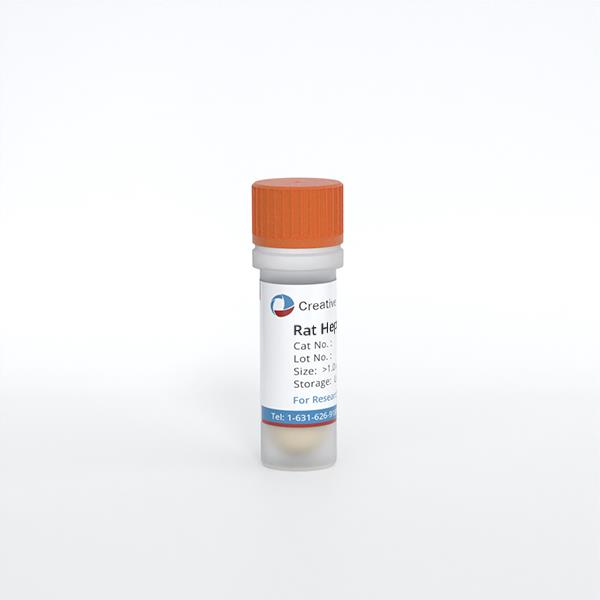
Rat Hepatic Stellate Cells
Cat.No.: CSC-C1808
Species: Rat
Source: Liver
Cell Type: Hepatic Stellate Cell
- Specification
- Background
- Scientific Data
- Q & A
- Customer Review
RHSteC are isolated from neonate day 2 rat liver tissue. RHSteC are cryopreserved immediately after purification and delivered frozen. Each vial contains >5 x 10^5 cells in 1 ml volume. RHSteC are characterized by immunofluorescent method with antibodies to desmin and α-actin. RHSteC are negative for mycoplasma, bacteria, yeast and fungi. RHSteC are guaranteed to further expand for 5 population doublings in the conditions provided by Creative Bioarray.
Rat hepatic stellate cells (HSCs) are non-parenchymal, perisinusoidal cells residing in the space of Disse, characterized by cytoplasmic lipid droplets rich in retinoids (vitamin A). In the healthy liver, HSCs remain in a quiescent state, playing key roles in retinoid storage and extracellular matrix (ECM) homeostasis. Upon liver injury, however, they undergo a process known as activation, transdifferentiating into α-smooth muscle actin (α-SMA)-positive myofibroblasts that become the principal source of scar-forming type I collagen in the fibrotic liver.
The major advantages of rat HSCs lie in their faithful recapitulation of the in vivo fibrogenic response when cultured on uncoated plastic. This culture-induced activation closely parallels the cellular and molecular changes of HSCs following liver injury, allowing precise dissection of the signaling pathways, cytokine networks, and intracellular mechanisms that drive fibrogenesis. Indeed, rat HSCs are widely regarded as the gold-standard in vitro model for studying the molecular mechanisms of hepatic fibrosis. Furthermore, established protocols for isolating rat HSCs - typically involving collagenase/pronase perfusion of the liver followed by density gradient centrifugation based on their low buoyant density - yield highly viable, quiescent populations amenable to functional assays. The rat system also offers substantial tissue availability and reduced batch-to-batch variability compared to their human counterparts, making them particularly suitable for high-throughput drug screening and mechanistic studies. Consequently, rat HSCs remain an indispensable tool in antifibrotic drug discovery and fibrosis biology.
Branched-Chain Amino Acids and Their Metabolites Decrease Human and Rat Hepatic Stellate Cell Activation
End-stage liver diseases (ESLDs) are a significant global health challenge due to their high prevalence and severe health impacts. In ESLDs patients, branched-chain amino acids (BCAAs, leucine, isoleucine and valine) levels are decreased, and supplementation has been proposed to attenuate liver fibrosis and improve regeneration. However, their effects on hepatic stellate cells (HSCs)-the key drivers of extracellular matrix accumulation during liver injury-warrant further investigation.
Primary HSCs from rats and cirrhotic and non-cirrhotic human livers, were cultured and treated with branched-chain amino acids (BCAAs) or branched-chain α-keto acids (BCKAs) to assess their effects on both preventing and reversing HSCs activation.
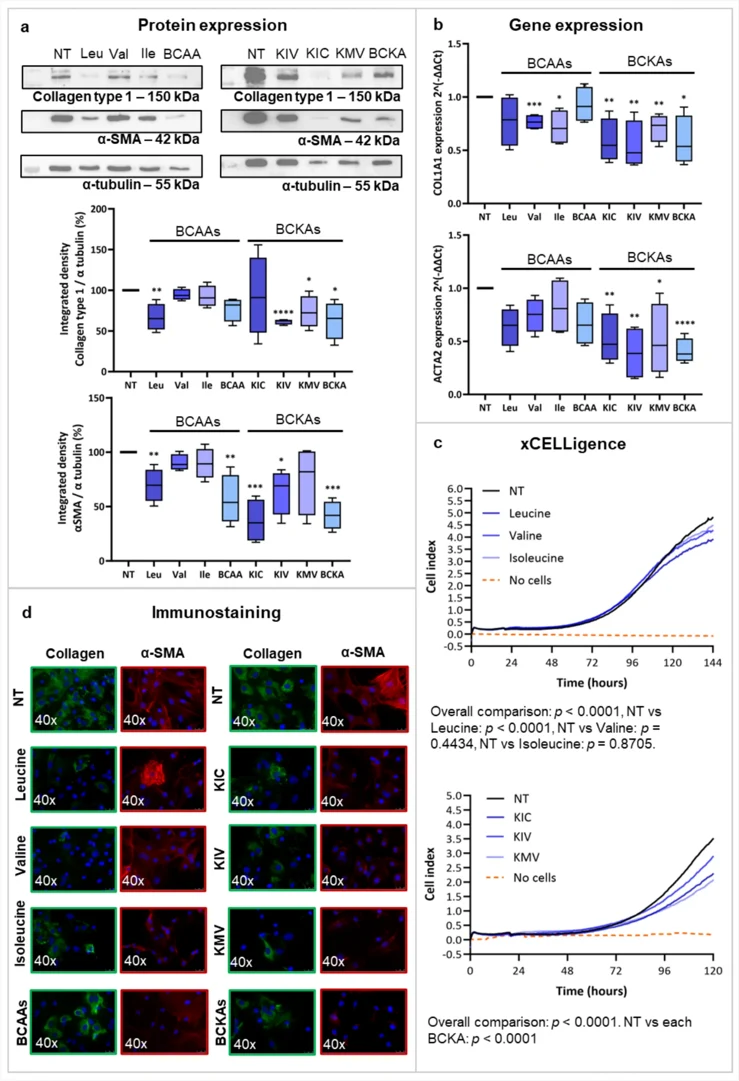
BCAAs and BCKAs did not show toxicity after 72 h of treatment. Leucine significantly reduced Collagen type 1 and α-SMA protein expression, confirmed by immunofluorescence. Valine and isoleucine downregulated Col1a1 gene expression, whereas leucine, valine, and BCAAs downregulated the expression of Acta2 without reaching statistical significance. Leucine reduced rat HSCs proliferation.
α-ketoisovalerate (KIV), α-keto-β-methylvalerate (KMV), and BCKAs decreased protein expression of Collagen type 1. Moreover, Col1a1 was significantly downregulated under all conditions. α-SMA protein expression was reduced with α-ketoisocaproate (KIC), KIV, and BCKAs, and Acta2 was significantly downregulated in all conditions. Col1a1 and Acta2 were also downregulated with increasing concentrations of BCKAs. BCKAs reduced Collagen type 1 and α-SMA immunofluoerescence and decreased cell proliferation for all the conditions.
Ask a Question
Write your own review
Description: Characterization: 1. Cell Activity; Recovery Viability ≥ 80%. 2. Cell Purity; - GFAP-positive cell percentage ≥ 70%. - β-tubulin III- or doublecortin- (Dcx-) positive cell percentage ≤ 10%. - ...
Description: Chondrocytes are the cells responsible for cartilage formation, and they are crucial for the process of endochondral ossification, which is useful for bone development. Ear chondrocytes represent the ...
Description: The thoracic aorta is located in the chest cavity and gives off arteries that branch to the esophagus, pericardium, lungs, and trachea. The thoracic aorta can be subdivided into the ascending aorta, ...
Description: Human Thymic Fibroblasts are isolated from human healthy thymus. HTyF are cryopreserved at passage one and delivered frozen. They are guaranteed to further expand for 15 population doublings ...
Description: Rat Bone Marrow Neutrophils are derived from the tibias and femurs of week-5 Sprague–Dawley Rats. Rat Bone Marrow Neutrophils are immediately cryo-preserved or fresh cells in suspension after ...
Description: Rat Bone Marrow Macrophages are derived from the tibias and femurs of 5 weeks old Sprague–Dawley Rats. Rat Bone Marrow Macrophages are grown in 100 mm treated tissue culture dish and incubated in ...