
Rat Bone Marrow Neutrophils
Cat.No.: CSC-C4190X
Species: Rat
Source: Bone Marrow
Cell Type: Neutrophil; Granulocyte
- Specification
- Background
- Scientific Data
- Q & A
- Customer Review
Rat Bone Marrow Neutrophils are negative for bacteria, yeast, fungi, and mycoplasma and are ready for experiments under the cell culture conditions specified by Creative Bioarray. Repeated freezing and thawing of cells is not recommended.
Standard biochemical procedures performed include the assays of cell to cell interaction, PCR, Western blotting, immunoprecipitation, immunofluorescent staining, immunofluorescent flow cytometry or generating cell derivatives for desired research applications.
Rat Bone Marrow Neutrophils can be used in standard biochemical procedures include PCR, Western blotting, immunoprecipitation, or cell derivatives for desired research applications.
Rat Bone Marrow Neutrophils are bone marrow-isolated primary innate immune cells. Rat bone marrow-derived neutrophils are a major component of the host first line of defense. As the most abundant type of circulating leukocytes in rodents, neutrophils are crucial for acute inflammatory responses and are among the first responders at the site of infection or tissue damage. They are used as a physiologically relevant in vitro neutrophil model to study neutrophil development, activation and effector functions in a controlled experimental setting.
Rat Bone Marrow Neutrophils have multilobed nuclei, high numbers of cytoplasmic granules, and a high level of responsiveness to chemotactic and inflammatory mediators. They can carry out all major antimicrobial and inflammatory functions upon activation, including phagocytosis, degranulation, ROS production, and NETosis. As bone marrow-derived cells, Rat Bone Marrow Neutrophils are also used to study neutrophil maturation and mobilization, mechanisms regulating granulopoiesis and effects of various cytokines and growth factors such as G-CSF on neutrophils.
Rat Bone Marrow Neutrophils are commonly used in the study of inflammation, infection, autoimmune disease, and tissue injury. They are an important model for studying innate immune signaling mechanisms, host-pathogen interactions and inflammatory tissue damage in models of cardiovascular, pulmonary, hepatic and neurological diseases. These cells are also frequently used in pharmacological and toxicological studies to examine drug effects on neutrophil activation, chemotaxis, oxidative burst, and survival.
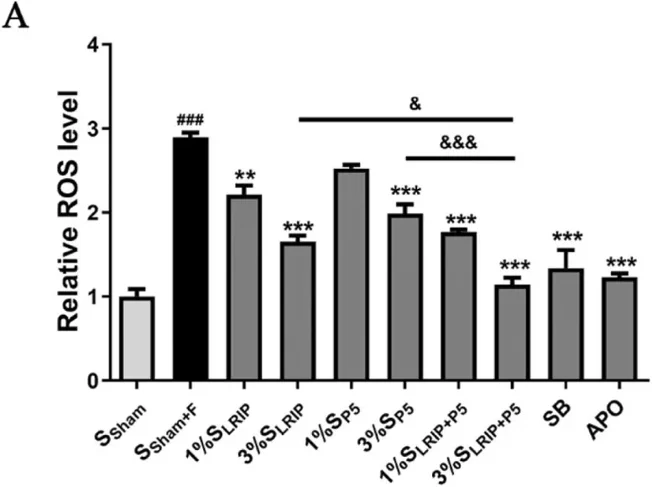
LRIP Combined with PF Serum Inhibits the Release of ROS Induced by fMLP in Rat Bone Marrow Neutrophils
Limb remote ischemic postconditioning (LRIP) and paeoniflorin (PF) both improve cerebral ischemia reperfusion (I/R) injury. Wu's team explored whether combining LRIP and PF enhances therapeutic effects on cerebral I/R injury in rats.
Rat bone marrow neutrophils were incubated with serum from treated rats and stimulated with fMLP. ROS production and protein expression were detected. Figure 1 shows that compared to the Ssham group, the Ssham + F group had a significant increase in ROS generation in neutrophils stimulated by fMLP. Except for the 1% SP5 group, all other groups significantly inhibited fMLP-induced ROS generation compared to Ssham + F, with the 3% SLRIP + P5 group showing the best inhibitory effect. This indicates that LRIP combined with PF serum significantly inhibits fMLP-induced ROS release, with a better effect than either alone.
Ask a Question
Write your own review
Description: The thoracic aorta is located in the chest cavity and gives off arteries that branch to the esophagus, pericardium, lungs, and trachea. The thoracic aorta can be subdivided into the ascending aorta, ...
Description: Rat Podocytes are isolated from normal rat kidney. The cells are characterized by immunofluorescence with antibodies specific to podocin, Ang1, Nephrin, ACTN4, NPHS2. T25 flasks is required for cell ...
Description: Rat Bronchial Smooth Muscle Cells are isolated from normal rat bronchi tissue. Rat Bronchial Smooth Muscle Cells are characterized by immunofluorescence with antibodies specific to alpha-actin. T25 ...
Description: Guinea Pig Endothelial Cells from Creative Bioarray are isolated from guinea pig tissue. Prior to shipping, cells at passage 2 are detached from flasks and immediately cryopreserved in vials. Each ...
Description: Rat Lung Epithelial Cells are isolated from normal rat lung tissue. The cells are characterized by immunofluorescence with antibodies specific to CK-18, CK-19. T25 flasks is required for cell ...
Description: Rat Vein Endothelial Cells from Creative Bioarray are isolated from inferior vena cava tissue of 6-8 week old laboratory Sprague-Dawley rat. Rat Vein Endothelial Cells are grown in T75 tissue culture ...