
Rat Bone Marrow Progenitor Endothelial Cells
Cat.No.: CSC-C8693W
Species: Rat
Source: Bone Marrow
Cell Type: Endothelial Progenitor Cell; Progenitor Cell
- Specification
- Background
- Scientific Data
- Q & A
- Customer Review
Rat bone marrow progenitor endothelial cells are endothelial progenitor-like cells derived from the bone marrow of rats. They are important precursor cells that contribute to vasculogenesis and vascular repair. When they undergo differentiation, they are able to generate mature endothelial cells.
In culture, rat bone marrow progenitor endothelial cells are generally adherent cells with spindle-shaped or cobblestone-like morphology depending on differentiation state. These cells express endothelial markers such as CD31 (PECAM-1), vascular endothelial growth factor receptor 2 (VEGFR-2/Flk-1), CD34 and von Willebrand factor (vWF). Primitive progenitor populations may also express stem/progenitor markers such as CD133. Functionally, these progenitor ECs exhibit endothelial characteristics such as Ac-LDL uptake, production of nitric oxide, and ability to form capillary tubes in angiogenesis assays.
Rat bone marrow progenitor endothelial cells contribute to postnatal neovascularization through vascular repair after ischemia, injury and inflammation. When needed, these cells migrate to damaged or oxygen-starved tissues, helping to mend vessels via angiogenesis and remodeling. Abnormal regulation or recruitment of BM Progenitor ECs have been associated with cardiovascular disease, impaired wound healing, tumor angiogenesis and diabetic vascular pathologies.
In the lab, rat BM progenitor endothelial cells can be used as an in vitro model to study endothelial differentiation and endothelial cell biology. These include studies of angiogenic signaling pathways such as VEGF, Notch and PI3K/AKT, endothelial cell migration, vascular homeostasis and maintenance. They have also been widely used to study ischemia-reperfusion injury, regenerative medicine and cell-based therapies. Furthermore, rat BM progenitor ECs can be used for assays to determine compounds with pro-angiogenic or anti-angiogenic capabilities.
High Density Cultured Cells Express Higher Levels of EPC Markers
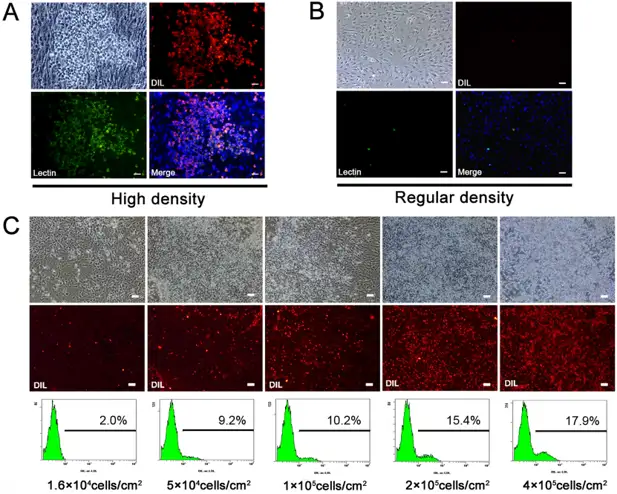
In vitro expansion of endothelial progenitor cells (EPCs) remains challenging. Lu's team hypothesized that high-density culture could expand EPCs by mimicking bone marrow niche cell-cell interactions. To test this, rat bone marrow cells were cultured at high density (2×10⁵ cells/cm²) in six dots versus regular density (1.6×10⁴ cells/cm²) with equal total cell numbers.
After 3 days, a population of small bright cells appeared in high-density culture. These cells uptook DiI-ac-LDL and bound UEA lectin (Fig. 1A), suggesting EPC identity, whereas few were observed in regular-density culture (Fig. 1B). Flow cytometry confirmed increased DiI-ac-LDL-positive cells with higher seeding density (2.0% to 17.9%) (Fig. 1C). Densities of 1.6×10⁴ and 2×10⁵ cells/cm² were selected for subsequent experiments.
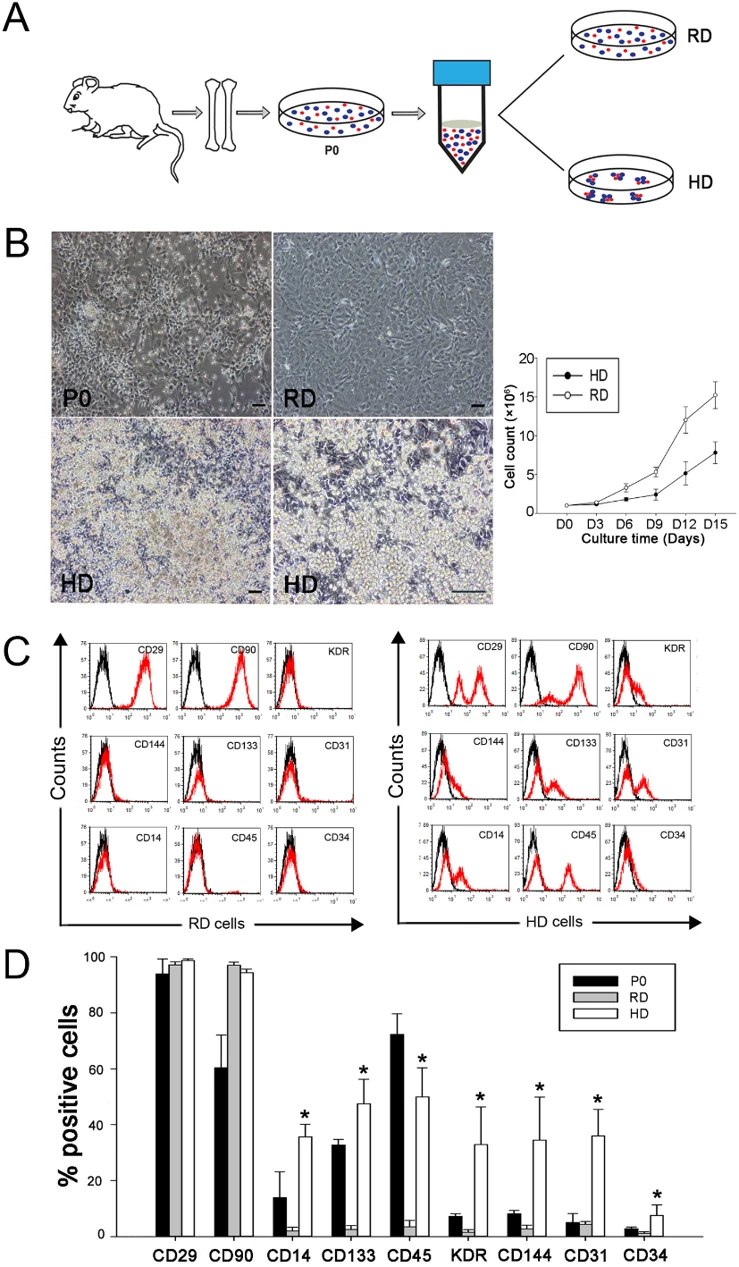
To prevent nutrient exhaustion in high-density conditions, they developed a dot culture system: 9×10⁵ cells were seeded into six high-density dots (2×10⁵ cells/cm²) versus evenly distributed controls (1.6×10⁴ cells/cm²) in 10-cm dishes (Fig. 2A). After 15 days, high-density culture yielded significantly more small bright cells growing atop spindle-shaped cells, though total expansion was lower (Fig. 2B). Flow cytometry revealed that primary cells (P0) highly expressed CD29 (92%), CD90 (60%), CD45 (73%), and CD133 (32%), but showed low EPC markers (<15% for CD14, KDR, CD144, CD31, CD34) (Fig. 2C, D). Notably, high-density culture upregulated EPC markers (CD14, CD133, KDR, CD144, CD31, CD34) compared to P0, whereas regular-density culture decreased these markers. CD45 expression was maintained in high-density but reduced in regular-density culture. These results indicate that high-density culture enriches for EPCs.
For the Rat Bone Marrow Progenitor Endothelial cells that you are looking for, F344, norway brown or Lewis Rats, we can do custom service.
Ask a Question
Write your own review
Description: The thoracic aorta is located in the chest cavity and gives off arteries that branch to the esophagus, pericardium, lungs, and trachea. The thoracic aorta can be subdivided into the ascending aorta, ...
Description: Rat Podocytes are isolated from normal rat kidney. The cells are characterized by immunofluorescence with antibodies specific to podocin, Ang1, Nephrin, ACTN4, NPHS2. T25 flasks is required for cell ...
Description: Rat Bronchial Smooth Muscle Cells are isolated from normal rat bronchi tissue. Rat Bronchial Smooth Muscle Cells are characterized by immunofluorescence with antibodies specific to alpha-actin. T25 ...
Description: Guinea Pig Endothelial Cells from Creative Bioarray are isolated from guinea pig tissue. Prior to shipping, cells at passage 2 are detached from flasks and immediately cryopreserved in vials. Each ...
Description: Rat Lung Epithelial Cells are isolated from normal rat lung tissue. The cells are characterized by immunofluorescence with antibodies specific to CK-18, CK-19. T25 flasks is required for cell ...
Description: Rat Vein Endothelial Cells from Creative Bioarray are isolated from inferior vena cava tissue of 6-8 week old laboratory Sprague-Dawley rat. Rat Vein Endothelial Cells are grown in T75 tissue culture ...