

C57BL/6 Mouse Thymus Epithelial Cells
Cat.No.: CSC-C9086J
Species: Mouse
Source: Thymus
Cell Type: Epithelial Cell
- Specification
- Background
- Scientific Data
- Q & A
- Customer Review
C57BL/6 mouse thymus epithelial cells (TECs) are specialized stromal cells derived from the thymus of the widely recognized C57BL/6 inbred strain. They form the structural framework of the thymic microenvironment and are indispensable for T‑cell development, differentiation, and central immune tolerance. TECs are subclassified into cortical TECs (cTECs) and medullary TECs (mTECs), which orchestrate positive and negative selection of thymocytes, respectively, via MHC presentation, cytokine secretion, and expression of autoimmune regulator (AIRE).
The C57BL/6 genetic background provides exceptional advantages for translational and commercial applications: well‑characterized genome, low inter‑individual variability, robust immune responses, and extensive prior validation in immunology, oncology, and regenerative medicine. Primary TECs from this strain exhibit high functional fidelity, consistency, and batch‑to‑batch reproducibility-critical attributes for drug screening, thymus‑on‑a‑chip models, regenerative therapy development, and autoimmune disease research.
Offered as cryopreserved, high‑viability preparations, C57BL/6 mouse TECs enable reliable in vitro modeling of thymopoiesis, testing of immunomodulatory compounds, and scalable production of thymic organoids. Their superior purity, defined phenotype (EpCAM+, cytokeratin+, and AIRE+ for mTECs), and retained biological activity support robust experimental outcomes, reducing animal usage and accelerating preclinical discovery. These cells represent a premium tool for immune‑centered drug discovery, toxicology, and cell therapy platforms.
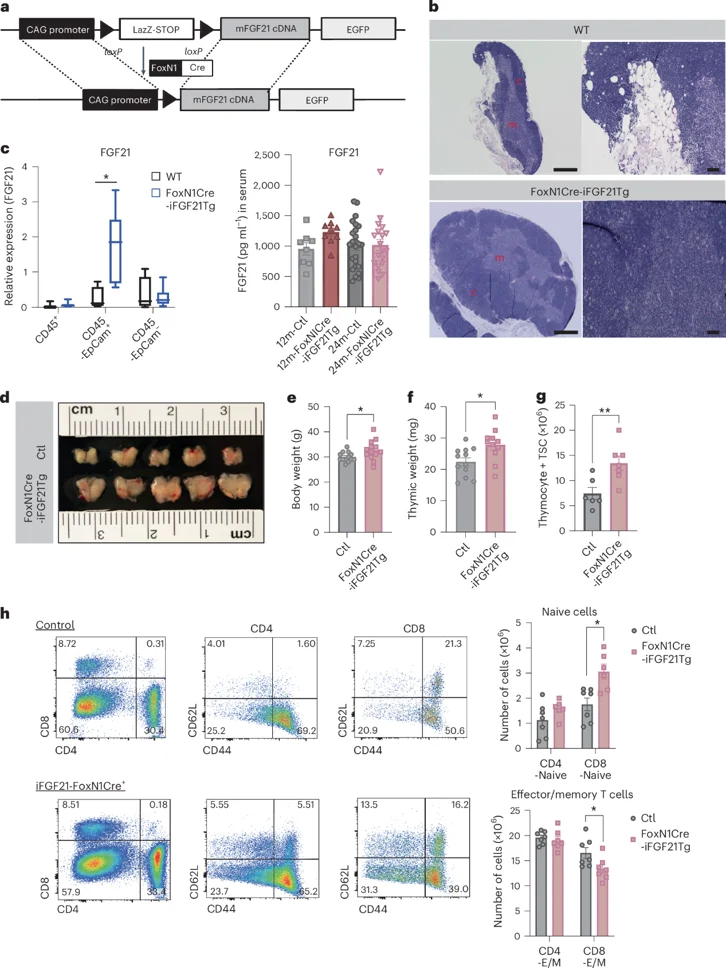
TEC-Derived FGF21 Protects Against Thymic Aging
Age-related thymic involution precedes aging of all other organs in vertebrates and initiates the process of declining T cell diversity, which leads to eventual immune dysfunction. Whether FGF21, a liver-derived pro-longevity hormone that is also produced in thymic stroma, including by adipocytes, controls the mechanism of thymic demise is incompletely understood.
Here, Youm, YH. et al. demonstrate that elevation of FGF21 in thymic epithelial cells (TECs) and in adipocytes protects against thymic aging, whereas conditional hepatic overexpression did not impact thymic biology in aged mice. Notably, elevation of thymic FGF21 increased naïve CD8 T cells in aged animals and extended healthspan. Mechanistically, thymic FGF21 overexpression elevated TECs and reduced fibroadipogenic cells. Ablation of β-klotho, the obligatory co-receptor for FGF21 in Foxn1+ TECs, accelerated thymic aging, suggesting regulation of TECs by FGF21 is partially required for thymic lymphopoiesis. These findings establish that paracrine FGF21 improves thymic function and delays immune aging.
Ask a Question
Write your own review


Description: C57BL/6-GFP Mouse Skeletal Muscle Microvascular Endothelial Cells from Creative Bioarray are isolated from C57BL/6-Tg (CAG-EGFP) 1Osb/J mouse skeletal muscle tissue of pathogen-free laboratory mice. ...

Description: eNOS KO Mouse Stomach Epithelial Cells from Creative Bioarray are isolated from stomach tissue of pathogen-free laboratory mice. eNOS KO Mouse Stomach Epithelial Cells are grown in a T25 tissue ...
Description: eNOS KO Mouse Liver Fibroblasts from Creative Bioarray are isolated from liver tissue of pathogen-free laboratory mice. eNOS KO Mouse Liver Fibroblasts are grown in T75 tissue culture flasks ...
Description: C57BL/6-GFP Mouse Corneal Epithelial Cells from Creative Bioarray are isolated from C57BL/6-GFP-Tg(CAG-EGFP)1Osb/J mouse corneal tissue of pathogen-free laboratory mice. C57BL/6-GFP Mouse Corneal ...

Description: BALB/c Mouse Retinal Microvascular Endothelial Cells from Creative Bioarray are isolated from retinal tissue of pathogen-free laboratory mice. BALB/c Mouse Retinal Microvascular Endothelial Cells are ...