
C57BL/6 Mouse Primary Stomach Epithelial Cells
Cat.No.: CSC-C4251X
Species: Mouse
Source: Stomach
Cell Type: Epithelial Cell
- Specification
- Background
- Scientific Data
- Q & A
- Customer Review
Mouse Primary Stomach Epithelial Cells can be used in assays of cell to cell adhesion and migration. Standard biochemical procedures performed with epithelial cell cultures include RT-PCR, Western blotting, immunoprecipitation, immunofluorescent staining or immunofluorescent flow cytometry or generating cell derivatives for desired research applications.
C57BL/6 Mouse Primary Stomach Epithelial Cells are directly isolated from the gastric mucosa of C57BL/6 mice, a commonly used inbred strain in biomedical research. These primary cells preserve the morphology, physiological characteristics, and functional properties of native gastric epithelial cells, including their roles in mucus secretion, barrier formation, and sensitivity to environmental stimuli. They closely imitate how cells behave in living organisms, unlike immortalized cell lines. This makes them perfect for research that needs biological accuracy.
These cells are highly helpful for learning about how epithelial cells stay healthy, how the stomach works, and how diseases like inflammation, infection, and cancer start. They are extensively utilized in pharmaceutical screening and toxicity assessments focused on the gastrointestinal system, as well as in research pertaining to host-pathogen interactions, notably studies involving Helicobacter species. C57BL/6 primary stomach epithelial cells originate from a genetically well-characterized lineage and can be included into transgenic and knockout animal models, facilitating molecular mechanistic investigations.
Unveiling Subpopulations in the Fly Crop by Comparing with Mouse Stomach
Cross-species cell type comparison faces limitations when relying solely on gene-based approaches, particularly with increasing phylogenetic distance. This study developed scGOclust, a computational tool that constructs cellular functional profiles using GO terms rather than direct gene comparison. The researchers applied scGOclust to analyze and compare heart, gut, and kidney cell types between mouse and fly, demonstrating its ability to recapitulate functional spectra, characterize homologous similarities, and reveal functional convergence.
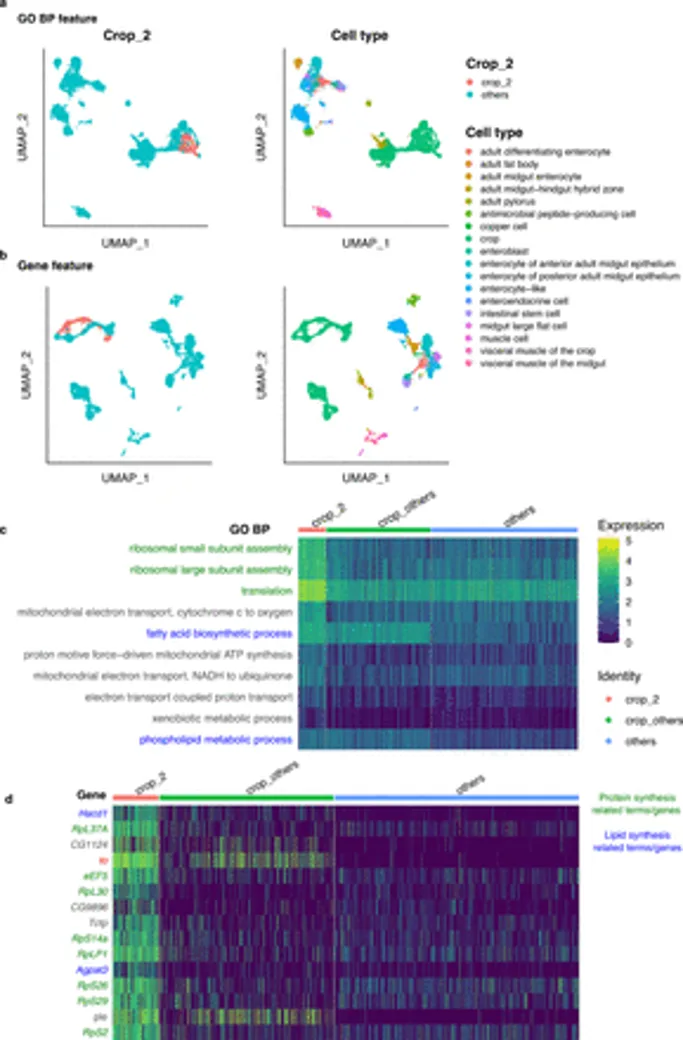
The fly crop, analogous to the mammalian stomach, temporarily stores food before midgut passage. PCA analysis separated crop cells by contractile activity, though overall crop profiles poorly correlated with stomach cells. Sub-clustering identified crop_2 cells that strongly correlated with mouse stomach epithelium (Fig. 1a-b), sharing GO terms for protein translation, energy metabolism, and lipid synthesis (Fig. 1c). crop_2 cells uniquely expressed ribosomal proteins (RpL37A, RpL30, RpS14A, RpLP1), translation factor eEF5, lipid synthesis enzymes (Hacd1, Agpat3), and the circadian feeding regulator to (Fig. 1d). Cross-species comparison with secretion-active mouse stomach cells suggests crop_2 participates in nutrient sensing via secretory activity-encouraging further study of crop secretion and circadian regulation.
Ask a Question
Write your own review
Description: C57BL/6-GFP Mouse Skeletal Muscle Microvascular Endothelial Cells from Creative Bioarray are isolated from C57BL/6-Tg (CAG-EGFP) 1Osb/J mouse skeletal muscle tissue of pathogen-free laboratory mice. ...
Description: eNOS KO Mouse Stomach Epithelial Cells from Creative Bioarray are isolated from stomach tissue of pathogen-free laboratory mice. eNOS KO Mouse Stomach Epithelial Cells are grown in a T25 tissue ...
Description: eNOS KO Mouse Liver Fibroblasts from Creative Bioarray are isolated from liver tissue of pathogen-free laboratory mice. eNOS KO Mouse Liver Fibroblasts are grown in T75 tissue culture flasks ...
Description: C57BL/6-GFP Mouse Corneal Epithelial Cells from Creative Bioarray are isolated from C57BL/6-GFP-Tg(CAG-EGFP)1Osb/J mouse corneal tissue of pathogen-free laboratory mice. C57BL/6-GFP Mouse Corneal ...
Description: BALB/c Mouse Retinal Microvascular Endothelial Cells from Creative Bioarray are isolated from retinal tissue of pathogen-free laboratory mice. BALB/c Mouse Retinal Microvascular Endothelial Cells are ...