
VERO E6
Cat.No.: CSC-C9140W
Species: Monkey
Source: Kidney
Morphology: epithelial
Cell Type: Epithelial Cell
- Specification
- Background
- Scientific Data
- Q & A
- Customer Review
VERO E6, also known as Vero C1008, is a continuous epithelial cell line derived from the kidney of an African green monkey (Chlorocebus sabaeus). It is a clonal subline of VERO 76, established in 1979 by P.J. Price through limiting dilution.
The defining advantage of VERO E6 lies in its exceptional susceptibility to a broad spectrum of viruses, particularly emerging pathogens. It is a primary cell culture model for SARS-CoV and SARS-CoV-2, supporting high-titer viral replication. The line is also permissive to Ebola, Marburg, Lassa, Junin, Machupo, Zika, West Nile, yellow fever, rabies, reovirus, and Japanese encephalitis viruses. When infected with hemorrhagic fever viruses, it exhibits clear cytopathic effects and plaque formation.
This high susceptibility is attributed to a genomic deletion that renders the cells incapable of producing type I interferons (IFN-α/β), thereby preventing an effective innate antiviral response. Unlike other Vero sublines that are heterozygous for the ACE2 receptor, VERO E6 harbors only a single allele due to X chromosome loss, a feature that may influence its interaction with ACE2-dependent viruses. VERO E6 exhibits contact inhibition post-confluence and is suitable for supporting slow-replicating viruses. These attributes establish VERO E6 as an indispensable platform for emerging infectious disease research.
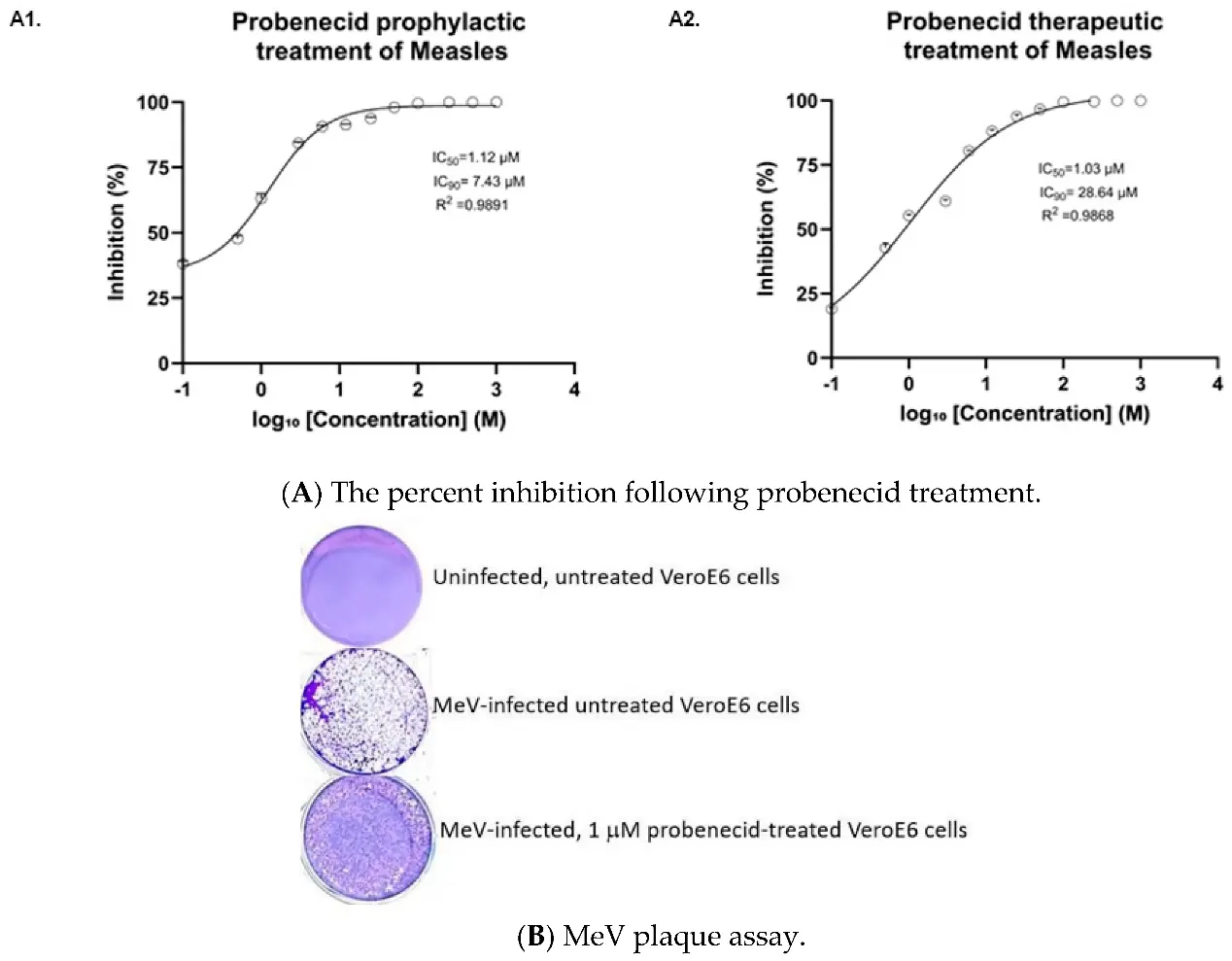
Probenecid Treatment Inhibits Replication of the Edmonston Measles Virus Strain in Vero Cells
This study examined the efficacy of probenecid treatment before and after measles virus (MeV) infection (MOI = 0.1) of VeroE6 and Vero-SLAM at 24, 48, and 72 hpi. The 24 hpi time point did not show measurable virus plaques; however, peak detectable virus plaque numbers in both VeroE6 and Vero-SLAM cells occurred at 48 hpi (Fig. 1). High plaque numbers were evident at 72 hpi; however, the plaques were not countable because MeV replication in untreated VeroE6 and Vero-SLAM cells destroyed the cell lawns. The values shown below represent the results of 3 independent experiments and 3 replicas/experiment. The study described below examined VeroE6 cells infected (MOI = 0.1) with Edmonston MeV and treated with probenecid. Effective IC50 values for VeroE6 cells that were (A1) prophylactically treated with probenecid 24 h before infection with Edmonston MeV (MOI of 0.1), or (A2) treated 1 h after infection with probenecid, were obtained at the concentrations shown in Fig. 1A.
Ask a Question
Write your own review

Description: Cynomolgus Monkey Primary Spleen Fibroblasts are isolated from Cynomolgus Cynomolgus Monkey spleen tissue.
Description: Cynomolgues Monkey Pancreatic Islets from Creative Bioarray are isolated from the Cynomolgus Monkey pancreas using Collagenase P and purified using Ficoll density gradient.
Description: Cynomolgus Monkey Pancreatic Epithelial Cells from Creative Bioarray are isolated from normal Cynomolgus Monkey pancreatic tissue. Cynomolgus Monkey Pancreatic Epithelial Cells are grown in T25 ...
Description: Cynomolgus Monkey Primary Bladder Epithelial Cells are isolated from normal Cynomolgus Monkey bladder tissue.
Description: Cynomolgus Monkey Dermal Lymphatic Endothelial Cells from Creative Bioarray are isolated from Cynomolgus monkey skin tissue. Monkey Dermal Lymphatic Endothelial Cells are grown in T25 tissue culture ...
Description: Cynomolgus Monkey Proximal Tubular Epithelial Cells from Creative Bioarray are isolated from normal Cynomolgus Monkey proximal tubular. Cynomolgus Monkey Proximal Tubular Epithelial Cells are grown ...