
Bridging the Translational Gap: A Systematic Framework for Model Selection
90% of drugs that enter clinical trials never reach patients. The culprit isn't bad science — it's bad models. Here's how to fix that.
The $2.6 Billion Question
Every year, the pharmaceutical industry pours billions into drug development, only to watch candidate after candidate fail in clinical trials. The numbers are brutal: only about 10% of drugs that enter Phase I ever make it to approval. The average cost of bringing a single drug to market now exceeds $2.6 billion — and the majority of that cost comes from failures, not successes.
What makes these failures especially frustrating is that they often happen after preclinical models have given every indication of safety and efficacy. The animal studies looked promising. The cell-based assays were clean. The PK/PD data made sense. And yet, in humans, the drug failed.
This is the translational gap — the systematic disconnect between what preclinical models predict and what actually happens in patients. It is, without exaggeration, the single most expensive problem in drug development.
Closing it is not just a scientific imperative. It's a business one.
Why Your Models Lie to You
The translational gap isn't random. It arises from specific, identifiable causes — and once you understand them, you can start making better choices.
Species differences are real, not theoretical.
A pig's lung is not a human lung. When researchers infused nanoparticles into pigs, they triggered severe cardiopulmonary distress — driven by pulmonary intravascular macrophages (PIMs) that aggressively clear particles from the bloodstream. Normal human lungs, however, don't have PIMs. The entire porcine response was a species-specific artifact, yet for years it shaped how the field thought about nanomedicine safety.
The same pattern recurs across biology. Microglia — the brain's immune cells — behave differently in mice, marmosets, and humans during aging and Alzheimer's disease. Metabolic enzymes show species-specific polymorphisms that alter drug responses. Even well-conserved neural circuits differ in ways that matter for psychiatric drug development.
One model is never enough.
The most common mistake in preclinical research is also the most consequential: relying on a single species — usually the mouse — and assuming its biology translates to humans. Researchers then compound the error by ignoring contradictory data from other species. As Edler and colleagues put it, this "use of a single species model, an assumption of similarity in humans, and ignoring contradictory data from other species" is a recipe for failure.
Internal validity is not external validity.
A study can be exquisitely designed — proper randomization, blinding, statistical power — and still tell you nothing about what will happen in humans. The ARRIVE and PREPARE guidelines were introduced years ago to improve reporting quality in animal research, but they address internal validity, not predictive validity. As Ferreira and colleagues noted in their landmark 2020 paper, "progress has been virtually absent" when it comes to external validity.
The Framework: How to Choose Models Systematically
So how do you pick models that actually predict human outcomes? The answer isn't to abandon animal models entirely — it's to be systematic about how you select, validate, and combine them.
Ferreira and colleagues (2020) proposed the FIMD framework — Framework to Identify Models of Disease — which remains the most practical tool available. Here's how it works in four steps:
Step 1: Define exactly what you're trying to predict.
Not "efficacy" in the abstract. Be specific. Are you predicting hepatotoxicity? Cardiotoxicity? Blood-brain barrier penetration? Cognitive improvement in Alzheimer's? Each endpoint demands a different model profile.
Step 2: Map which human disease aspects each model replicates.
Create a matrix. Does your mouse model replicate the molecular pathology? The cellular changes? The tissue-level dysfunction? The behavioral phenotype? The drug metabolism profile? Be honest about what's missing.
Step 3: Validate against human data.
Whenever possible, compare model predictions to known human clinical outcomes. Systematic reviews and meta-analyses can quantify how well different models perform across studies — revealing which models consistently predict and which don't.
Step 4: Select the best combination and justify it.
No single model predicts everything. The goal is a *portfolio* of complementary models — each contributing a different piece of the translational puzzle.
The New Toolkit: Models That Actually Work
The good news is that the toolkit has expanded dramatically. Here are the models that are genuinely closing the translational gap.
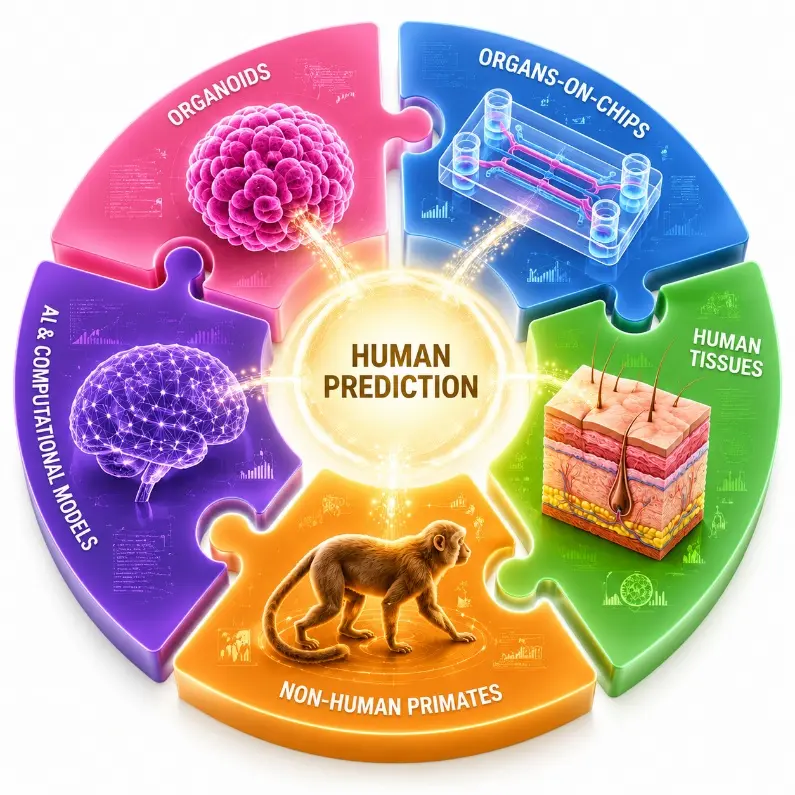
Human Organoids
Three-dimensional, self-organizing structures derived from human stem cells, organoids replicate key aspects of organ biology better than any traditional in vitro system. Liver organoids express metabolic enzymes at near-physiological levels. Cardiac organoids beat and respond to drugs. Kidney organoids express relevant transporters. Gut organoids form functional barriers. Brain organoids develop rudimentary neural circuits.
As Matsui and Shinozawa (2021) wrote in Frontiers in Genetics: Organoids are expected to mimic complex microenvironments and many of the in vivo physiological functions of relevant tissues, thus filling the translational gap between animals and humans.
Organ-on-a-Chip & Microphysiological Systems (MPS)
Where organoids provide cellular complexity, MPS adds physiological context — fluid flow, mechanical forces, multi-organ crosstalk. In 2016, 36 experts from academia, industry, and regulatory bodies published a comprehensive roadmap for MPS in ALTEX, arguing that these systems could "revolutionize our current global programs of prioritization of hazard characterization" (Marx et al., 2016).
The FDA Modernization Act 2.0, passed in 2022, explicitly allows drug developers to use MPS and other "new approach methodologies" (NAMs) in place of animal studies — a regulatory milestone that signals where the field is heading.
Human Ex Vivo Models
Sometimes the best model is actual human tissue. Neil and colleagues (2020) demonstrated in Scientific Reports that human skin explants can be maintained for over nine days with preserved barrier function and metabolic stability — providing a direct, human-relevant platform for testing topical therapeutics.
Strategic Non-Human Primates
For complex diseases where rodent models have consistently failed — Alzheimer's is the poster child, with a 99.6% clinical trial failure rate — non-human primates offer a crucial bridge. The MARMO-AD consortium is developing gene-edited marmoset models carrying human AD mutations (C410Y, A426P), with the explicit goal of "bridging the rodent to human translational gap".
AI and Computational Approaches
Deep learning methods like deepDTnet can identify novel drug targets and repurposing opportunities by mining heterogeneous biological networks. But AI has its own translational gap: Sokol and colleagues (2025) recently warned in npj Digital Medicine that AI systems must "genuinely support clinical reasoning and decision making" — not just chase benchmark performance — if they are to bridge, rather than widen, the gap.
Cross-Species Translation Done Right
Some of the most successful translational stories come from parallel investigation across species. When Dincheva and colleagues studied a common human polymorphism in the FAAH gene — which encodes the primary enzyme that degrades the endocannabinoid anandamide — they developed a knock-in mouse that biologically recapitulated the human mutation. The result: parallel alterations in biochemistry, neurocircuitry, and behavior across both species, demonstrating a gain-of-function mechanism that could be targeted therapeutically. This work, published in Nature Communications, exemplifies how cross-species validation — when done rigorously — can bridge the translational gap rather than fall into it.
The Bottom Line
The translational gap is not a law of nature. It is a consequence of choices — and those choices can be changed.
The evidence is clear: models that predict humans are human-derived, systematically validated, and used in combination, not in isolation. Organoids, organ chips, ex vivo human tissue, strategic NHP models, and AI-driven computational approaches — each has a role in a well-designed translational program.
The question isn't whether to adopt these models. It's how quickly you can integrate them into your workflow — before your competitors do.
Ready to Bridge the Gap?
Our team of translational scientists helps biotech and pharma partners design predictive preclinical programs using the FIMD framework, human organoid platforms, organ-on-a-chip systems, and cross-species comparative strategies.
Creative Bioarray Relevant Recommendations
| Products & Services | Description |
|---|---|
| Animal Disease Models | Our comprehensive portfolio of disease models spans multiple therapeutic areas, providing reliable preclinical platforms to study disease mechanisms and accelerate the development of innovative therapies. |
| 3D Spheroid Platform for Drug Development | Creative Bioarray provides advanced 3D spheroid models designed for researchers aiming to explore cell behavior in a more realistic environment. |
| Organoid Platform for Drug Development | Creative Bioarray presents a state-of-the-art Organoid Platform designed to transform drug development and biomedical research. By leveraging advanced organoid and organoid-immune co-culture models, this platform provides highly accurate and predictive solutions that closely replicate human biology. |
| Organ-on-a-Chip Platform for Drug Development | Creative Bioarray focuses on developing specific human disease models and leveraging our organ-on-a-chip platform to identify new therapeutics and clinical biomarkers, promote drug development, and create novel drug delivery systems. |