
Cell Culture Troubleshooting: Molecular Diagnostics & QC for Preclinical R&D
Reliable cell culture is fundamental to reproducible preclinical research, yet subtle contamination, viability loss, adhesion defects, metabolic stress, and assay variability can compromise experimental outcomes before obvious abnormalities appear. This guide provides a practical framework for cell culture troubleshooting and molecular QC, covering mycoplasma detection, cell line authentication, cryopreservation-related injury, ECM and adhesion defects, ROCK-dependent anoikis, metabolic and microenvironmental stress, and high-throughput assay edge effects. By linking common cell culture phenotypes with appropriate diagnostic assays and corrective strategies, researchers can identify root causes earlier, strengthen cell-based assay quality, and improve the reproducibility and reliability of preclinical bioassay data.
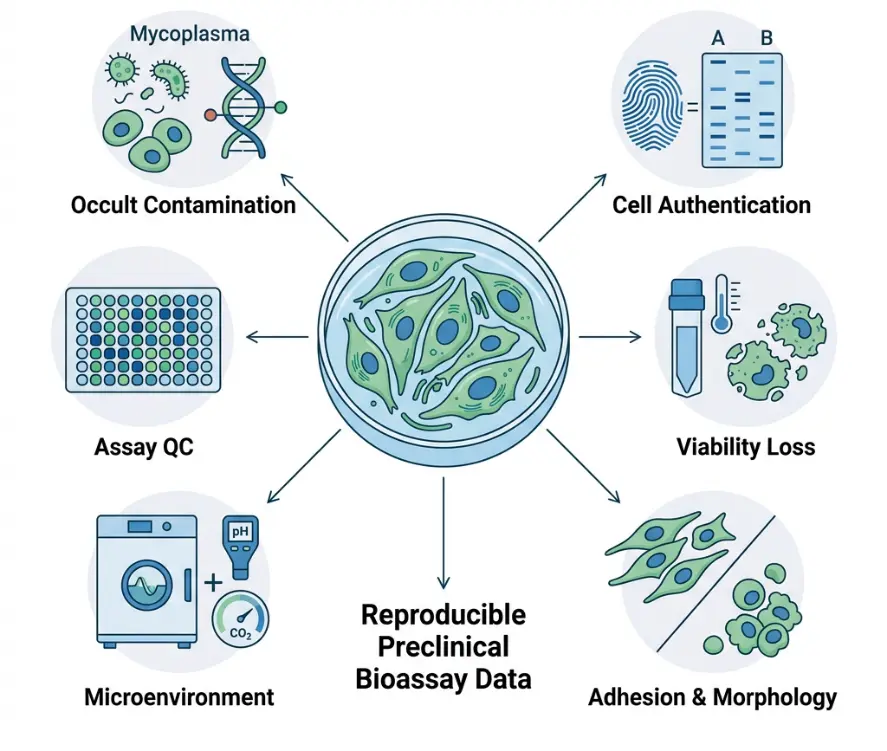
Occult & Molecular Contamination: Diagnostic Frameworks
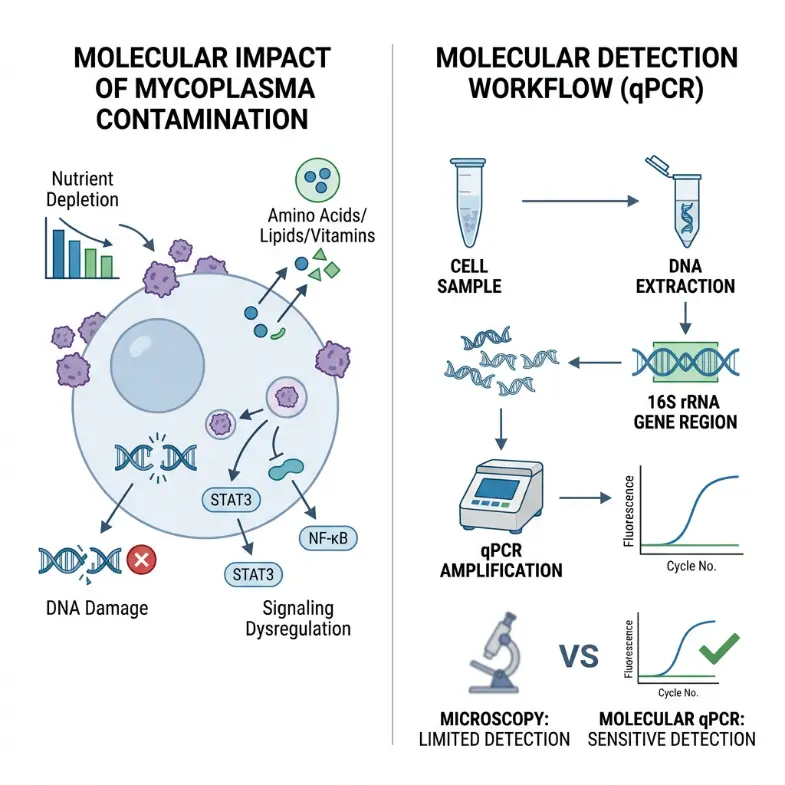
Beyond overt microbial overgrowth, stealth contamination subtly dysregulates intracellular signaling pathways (e.g., STAT3, NF-κB), distorts transcriptomic profiling, and degrades drug screening fidelity without inducing visible medium turbidity.
Mycoplasma Species: Molecular Subversion & High-Sensitivity Detection
Mycoplasma (predominantly M. hyorhinis, M. orale, and Acholeplasma laidlawii) lacks a peptidoglycan cell wall, allowing it to survive intracellularly or tightly bound to host plasma membranes.
- Pathophysiological Impact: Depletes arginine and glutamine stores, induces DNA damage, alters host protein expression, and inhibits IL-2 secretion in T-cell functional bioassays.
- Diagnostic SOP: Standard optical microscopy is insufficient. Implement 16S rRNA-targeted qPCR (detection threshold < 10 CFU/mL) alongside bioluminescent ATP-enzymatic cleavage assays.
- Eradication & Salvage Protocol: Immediate incineration of non-essential vessels. For critical patient-derived lines or induced pluripotent stem cells (iPSCs), administer a dual-action therapeutic cycle: 14 days of Plasmocin (macrolide/quinolone inhibitor) or a Tiamulin/Minocycline combination, followed by 3 days of antibiotic clearance and dual-negative qPCR verification.
Cross-Contamination, HeLa Dominance & Line Authentication
Cross-contamination accounts for ~15–20% of published cell line datasets. Intra-species line takeover (e.g., HEK293 or HeLa outgrowing slower primary cultures) invalidates target validation datasets.
- QC Mandatory Standard: Establish multiplex Short Tandem Repeat (STR) profiling against NIH/ATCC databases for human lines (min. 13 core loci including Amelogenin for sex determination). For rodent models, utilize Species-Specific Cytochrome c Oxidase Subunit I (COI) barcoding or SNP microarray panel analysis.
Viability Drop, Senescence & Metabolic Stagnation
Cryopreservation Thermodynamics & Apoptosis Pathways
Sub-optimal cryopreservation triggers cell loss through intracellular ice crystallization (mechanical rupture) or hyper-osmotic dehydration stress (solute effects), activating caspase-dependent apoptotic pathways upon thawing.
- Thermodynamic Control: Maintain an exact cooling rate of −1∘C/min using controlled-rate freezers or passive isopropyl alcohol containers down to −80∘C before liquid nitrogen immersion.
- DMSO Toxicity Mitigation: Cryoprotectant 10% DMSO rapidly damages cell membranes at temperatures above 4∘C. Thawing must be rapid (< 120 sec in a 37∘C water bath). Dilute suspension dropwise in a 1:10 volume ratio of ice-cold media containing 10% FBS or bovine serum albumin (BSA) to cushion osmotic pressure before low-speed centrifugation (120 × g, 5 min).
Metabolic Drift, Glutaminolysis & Ammonia Accumulation
Spontaneous chemical decomposition of free L-glutamine in media yields equimolar amounts of free ammonia (NH4+) and pyrrolidone carboxylic acid. Elevated ammonia concentration (> 2 − 3 mM) inhibits glycosylation, lowers intracellular pH, and induces premature replicative senescence in long-term culture.
- Biochemical Intervention: Replace unstable L-glutamine with stable dipeptides such as L-alanyl-L-glutamine, which requires cellular peptidases for cleavage, thereby maintaining steady-state amino acid availability without ammonia toxicity.
Adhesion Dynamics, Extracellular Matrix (ECM) & Morphology Shifts
Integrin Cleavage vs. Extracellular Matrix Degradation
Adherent cell lines rely on integrin-mediated focal adhesion complexes (α/β heterodimers) binding to ECM components (Collagen, Laminin, Fibronectin).
| Disruption Phenotype | Biochemical Mechanism | Mitigation & Engineering Solution |
|---|---|---|
| Post-passaging cell death (Anoikis) | Over-digestion by Trypsin cleaving extracellular domains of cell surface receptors and integrins. | Switch to non-mammalian recombinant enzymes, which selectively target lysine/arginine residues with reduced surface receptor cleavage. Neutralize with soybean trypsin inhibitor for serum-free assays. |
| Spontaneous detachment of iPSCs/Primary cells | Degradation or improper coating density of Matrigel/Vitronectin ECM substrate. | Standardize ECM coating: Pre-coat culture vessels with Recombinant Human Vitronectin or synthetic peptide surface at 0.5 μg/cm2; incubate for 1 hr at 37℃. Never allow matrix coatings to dry out. |
| Severe cell clumping in suspension culture | Extracellular DNA (eDNA) released from lysed cells forming viscous genomic complexes. | Supplement enzymatic dissociation buffer with DNase I (50 μg/mL) and Mg2+ cofactors (2 mM) to digest free DNA strands without damaging live cell membranes. |
Rho-Associated Kinase (ROCK) Inhibition in Fragile Cultures
Dissociation of single-cell suspensions from human pluripotent stem cells (hPSCs) or primary epithelial organoids activates the Rho/ROCK-dependent hyperactivation of actomyosin cytoskeleton, leading to execution of anoikis.
- SOP Benchmark: Supplement culture media with 10 μM Y-27632 (selective ROCK inhibitor) or Thiazovivin during thawing and single-cell passaging for 24 hours. This suppresses actomyosin hyper-contraction, boosting single-cell clonogenic viability from < 5% to > 80%.
Physiochemical Microenvironment & Metabolic Stress Control
Carbonate Buffering & Osmotic Drift Dynamics
The Henderson-Hasselbalch equilibrium for bicarbonate-buffered cell culture media dictates precise atmospheric CO2 partial pressure matching:

- Low CO2 / Outgassing (pH > 7.6, Magenta Medium): Causes intracellular alkalinization, destabilizes mitochondrial membrane potential, and impairs protein synthesis. Ensure incubators maintain calibrated 5% or 10% CO2 (dependent on medium NaHCO3 concentration, e.g., 3.7 g/L NaHCO3 requires 10% CO2; 1.5–2.2 g/L requires 5% CO2).
- Evaporative Hyper-osmolality: In long-term assays (e.g., 3D organoid formation over 14 days), edge-well evaporation in 96/384-well plates increases media osmolality from 300 mOsm/kg to > 380 mOsm/kg. This triggers hyper-osmotic shock, p38 MAPK phosphorylation, and cell shrinkage.
- Mitigation: Utilize active humidity-controlled incubators (relative humidity > 95%), fill peripheral plate wells with sterile deionized water, or use non-evaporative gas-permeable microplate seals.
Comprehensive Troubleshooting Decision Matrix
| Observed Pathology | Primary Root Cause | Diagnostic Assay | Corrective Action Strategy |
|---|---|---|---|
| Epithelial-to-Mesenchymal Transition (EMT) | Over-confluence (>90%), prolonged exposure to TGF- in serum, or high passage number. | Western blot / IF for E-Cadherin loss and Vimentin upregulation. | Discard passage >20 stock. Screen FBS lots for low baseline TGF- levels. Passage at strictly 70–80% confluence. |
| Widespread Cell Vacuolation | Inhibition of lysosomal activity, early-stage autophagy, or macropinocytosis induced by drug candidates. | LC3-II/LC3-I ratio evaluation via Western Blot or TEM imaging. | Reduce compound exposure concentration; perform media refresh to wash out accumulated metabolic byproducts. |
| Assay Edge Effect in HTS Screening | Thermal gradients across plate boundaries during incubator placement and edge evaporation. | Fluorometric cell viability scan across 384-well microplate layout. | Pre-incubate plates at room temperature for 30–45 mins post-seeding to eliminate thermal edge differentials. Utilize humidity-barrier plates. |
| Primary Immune Cell Activation Failure | High level of endogenous regulatory T cells (Tregs), suboptimal IL-2, or improper CD3/CD28 bead ratio. | Flow cytometry analysis for CD69/CD25 surface expression markers. | Optimize CD3/CD28 dynabead-to-T cell activation ratio to 1:1; verify recombinant IL-2 bioactivity (IU/mL) rather than mass concentration. |
Creative Bioarray Relevant Recommendations
| Products & Services | Description |
|---|---|
| Cell Line Authentication | Creative Bioarray STR profiling is critical for verifying the identity of human cell lines, ensuring the uniqueness of the cell line and detecting laboratory errors such as misidentification and cross-contamination of lines. |
| Cell Line Testing and Assays | Creative Bioarray offers a wide range of cell line testing and assays from cell viability and proliferation to cellular phosphorylation assays. |