
Are You Choosing the Right Preclinical Model? 10 Key Questions
Introduction
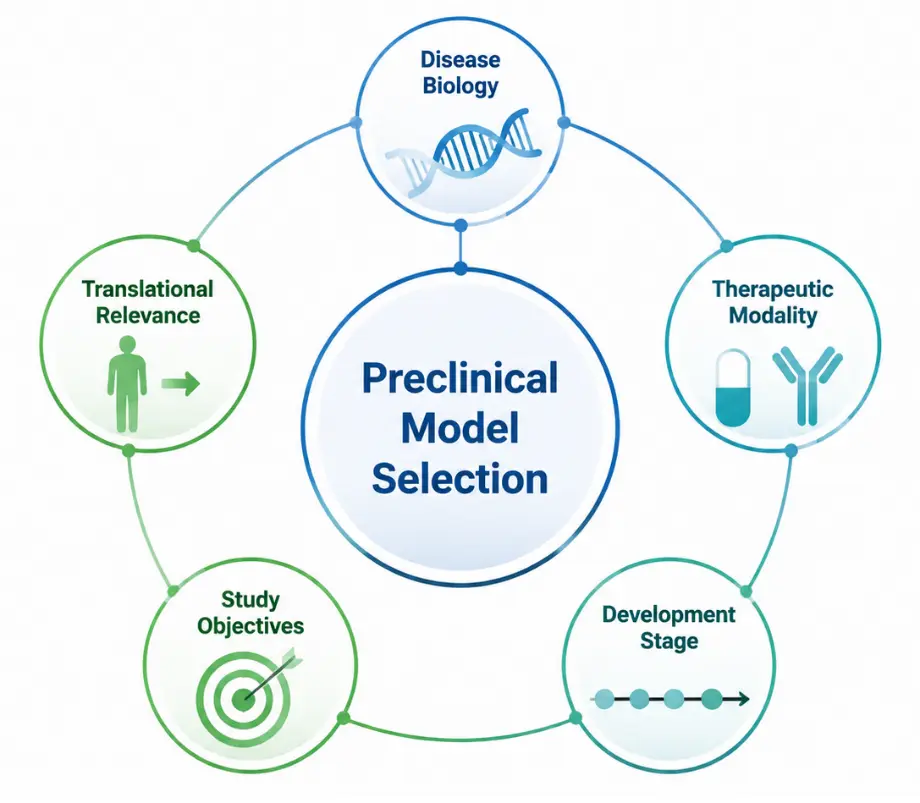
Choosing the right preclinical model is one of the most important decisions in drug development. A model that fails to reflect human biology can produce misleading efficacy, safety, or pharmacokinetic data, ultimately increasing development costs and reducing the likelihood of clinical success.
There is no universal "best" model. Traditional cell cultures, organoids, organ-on-a-chip systems, and animal models each provide unique advantages while addressing different research questions. The challenge is selecting the model that best fits your therapeutic modality, disease biology, and stage of development.
This guide highlights ten common mistakes in preclinical model selection and provides practical recommendations to help researchers design more predictive and translational studies.
1. Are You Choosing a Model Simply Because It Is Familiar?
Many laboratories continue to use the same cell lines or animal models because they are readily available, well characterized, and supported by existing protocols. While this approach can improve efficiency, it may not always provide the most biologically relevant data for a new project.
A model should be selected based on the scientific question rather than laboratory habit. Before choosing any experimental system, consider whether it accurately reflects the disease mechanism, therapeutic target, and study objectives. A familiar model is useful only if it is also the right model.
Best Practice
Define the biological question first, then select the model that best addresses it.
2. Does Your Model Truly Reflect Human Biology?
A model can produce highly reproducible data while still failing to predict patient outcomes. This is one of the primary reasons why many promising drug candidates lose efficacy during clinical development.
Traditional cell lines and some animal models often simplify complex human diseases and may not fully capture tissue architecture, immune interactions, or patient heterogeneity. Depending on the research objective, incorporating primary cells, organoids, organ-on-a-chip platforms, or humanized mouse models may provide more clinically relevant insights.
Best Practice
Prioritize models that reproduce the biological features most critical to your therapeutic target.
3. Can One Model Answer Every Research Question?
The short answer is no.
Every preclinical model has unique strengths and limitations. Cell-based assays are ideal for rapid screening, organoids better preserve tissue complexity, organ-on-a-chip systems simulate physiological environments, and animal models remain essential for evaluating systemic pharmacology.
Instead of searching for a single "best" model, build a stepwise strategy in which different models answer different scientific questions throughout the development process.
Best Practice
Treat preclinical models as complementary tools rather than competing technologies.
4. Have You Considered Your Drug Modality?
Different therapeutic modalities behave differently in biological systems. Small molecules, monoclonal antibodies, RNA therapeutics, gene therapies, and cell therapies each present distinct challenges related to delivery, metabolism, immune activation, and target engagement.
Using the same experimental model across all therapeutic classes may overlook these differences and produce misleading conclusions. The selected model should always be compatible with both the mechanism of action and the characteristics of the therapeutic modality.
Best Practice
Match your model to both the disease biology and the therapeutic modality.
5. Are You Assuming Animal Models Always Predict Human Responses?
Animal models remain indispensable in drug development, but no species can fully replicate human biology. Differences in immune function, receptor expression, and drug metabolism may lead to discrepancies between preclinical findings and clinical outcomes.
Rather than relying exclusively on one species, researchers should evaluate whether additional human-relevant models are needed to strengthen translational confidence.
Best Practice
Use animal studies together with human-based models whenever possible.
6. Does Your Model Capture the Disease Microenvironment?
Many diseases are influenced not only by target cells but also by surrounding stromal cells, immune components, extracellular matrix, and mechanical forces. Conventional 2D cultures often fail to reproduce these interactions.
For studies in oncology, fibrosis, inflammation, or regenerative medicine, advanced models such as organoids, co-culture systems, and organ-on-a-chip platforms may provide a more physiologically relevant environment.
Best Practice
Choose a model with the level of biological complexity required to answer your research question.
7. Are You Looking Only at Efficacy?
Demonstrating biological activity is only one part of successful drug development. Many candidates fail because of poor pharmacokinetics, unfavorable metabolism, limited bioavailability, or unexpected toxicity rather than insufficient efficacy.
Integrating ADME, pharmacokinetic, and safety assessments early in development helps identify potential risks before they become costly late-stage failures.
Best Practice
Evaluate efficacy, ADME, and safety as complementary components of a successful preclinical strategy.
8. Are You Using the Same Model Throughout Development?
The optimal model changes as a project advances. Early discovery often requires simple, high-throughput assays, whereas later stages demand models with greater physiological relevance and predictive power.
Maintaining the same experimental model throughout the development pipeline may either reduce efficiency or fail to generate the evidence needed for critical development decisions.
Best Practice
Adjust model complexity as your research progresses from discovery to preclinical validation.
9. Can You Trust the Reproducibility of Your Model?
Even an appropriate model can produce unreliable data if experimental variability is not adequately controlled. Factors such as cell passage number, donor variability, animal age, culture conditions, and operator differences may all influence study outcomes.
Reliable results depend not only on selecting the right model but also on establishing standardized protocols and quality control measures.
Best Practice
Standardize experimental procedures before relying on a model for critical decision-making.
10. Are You Selecting Models Without a Translational Strategy?
Preclinical studies should not be viewed as isolated experiments. Instead, every model should contribute to a broader strategy that supports progression toward clinical development.
Rather than asking whether a single model is sufficient, consider how different models can work together to generate complementary evidence. A coordinated workflow—from cell-based assays to advanced in vitro systems and in vivo validation—typically provides stronger support for translational decision-making.
Best Practice
Build a model selection strategy, not just a model selection list.
Before You Select Your Next Preclinical Model
Before launching a new study, take a few minutes to evaluate whether your selected model is truly aligned with your research goals. Asking the right questions early can prevent costly redesigns and improve the quality of downstream data.
A Quick Model Selection Checklist
Use the following checklist as a practical guide before finalizing your study design.
- Does the model reflect the key biology of the disease?
- Is it appropriate for your therapeutic modality and mechanism of action?
- Does it provide clinically relevant endpoints?
- Is the model suitable for the current stage of drug development?
- Have ADME, pharmacokinetics, or safety requirements been considered?
- Can the results be reproduced consistently?
- Will the data support the next development decision or regulatory milestone?
If the answer to several of these questions is "No", it may be worth reconsidering your model selection before moving forward.
Conclusion
Choosing the right preclinical model is one of the most influential decisions in drug development. An inappropriate model can lead to misleading efficacy or safety data, unnecessary costs, and delayed clinical progress. Conversely, a well-designed model selection strategy improves data quality, strengthens translational relevance, and supports more informed decision-making throughout the development pipeline.
As new technologies—including organoids, organ-on-a-chip systems, patient-derived models, and humanized mice—become increasingly accessible, researchers have more options than ever before. The challenge is no longer finding the most advanced model, but selecting the right combination of models to answer the right scientific questions.
Ultimately, effective preclinical research is not defined by the complexity of an individual model, but by how well each model contributes to a robust, evidence-based development strategy.
Creative Bioarray Relevant Recommendations
| Products & Services | Description |
|---|---|
| Animal Disease Models | Our comprehensive portfolio of disease models spans multiple therapeutic areas, providing reliable preclinical platforms to study disease mechanisms and accelerate the development of innovative therapies. |
| 3D Spheroid Platform for Drug Development | Creative Bioarray provides advanced 3D spheroid models designed for researchers aiming to explore cell behavior in a more realistic environment. |
| Organoid Platform for Drug Development | Creative Bioarray presents a state-of-the-art Organoid Platform designed to transform drug development and biomedical research. By leveraging advanced organoid and organoid-immune co-culture models, this platform provides highly accurate and predictive solutions that closely replicate human biology. |
| Organ-on-a-Chip Platform for Drug Development | Creative Bioarray focuses on developing specific human disease models and leveraging our organ-on-a-chip platform to identify new therapeutics and clinical biomarkers, promote drug development, and create novel drug delivery systems. |